
Claim a Free Sample
Get a preview with key statistics, projections, and trends for this report. Ideal for quick insights.
Send Me a SampleNeed full access?
Purchase ReportUS Data Center Colocation Market
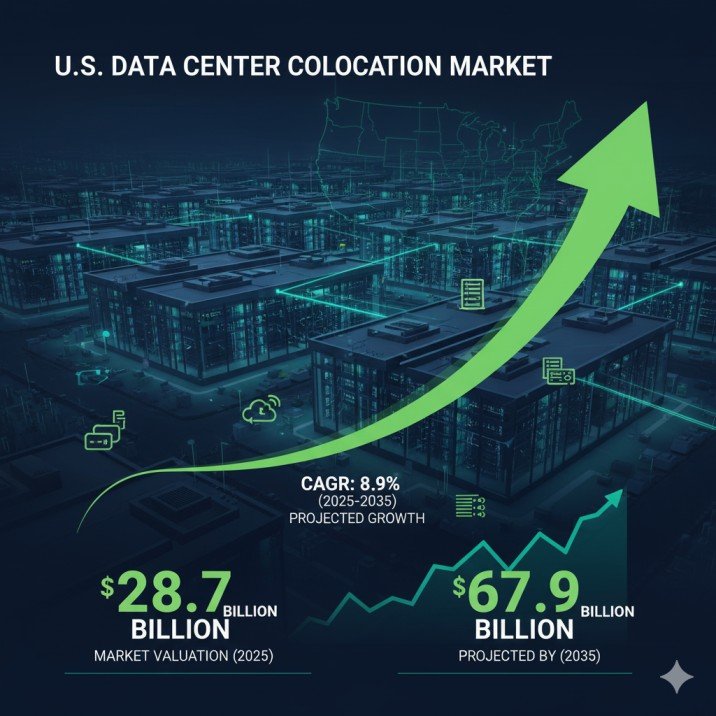
The US data center colocation market was valued at USD 28.7 billion in 2025 and is projected to reach USD 67.9 billion by 2035, growing at a CAGR of 8.9%.
US Data Center Colocation Market Forecast 2025–2035: Powering Scalability, Security, and Sustainability in the Cloud Era
Size, byProduct, 2024 - 2032{USD Billion}
US data center colocation market was valued at USD 28.7 billion in 2025 and is projected to reach USD 67.9 billion by 2035, growing at a CAGR of 8.9%. request a free sample copy
The market is characterized by rapid capacity expansion in Tier I and II cities, hyperscale colocation partnerships, modular data center buildouts, and sustainability-driven innovations in power and cooling.
Reports Description
The US data center colocation market is evolving at an accelerated pace, driven by exponential data generation, cloud migration, and the need for scalable, secure, and cost-efficient infrastructure. Colocation services, which allow enterprises to rent space and resources within third-party data centers, are proving essential in a digital-first economy. This report explores the technological, financial, and regulatory forces shaping the next decade of the colocation landscape.
Download Sample Ask for Discount Request Customization
Market Significant Growth Factors
Primary growth factors include surging demand for high-performance computing (HPC), AI workloads, edge computing, and the increasing use of hybrid and multi-cloud strategies. Companies are shifting away from building private data centers due to high CAPEX, instead opting for flexible colocation models. Security compliance, energy efficiency mandates, and remote management capabilities also drive adoption.
Report Scope
|
Parameter |
Details |
|
Base Year |
2024 |
|
Forecast Period |
2025–2035 |
|
Market Size in 2025 |
USD 28.7 Billion |
|
Projected Market Size |
USD 67.9 Billion by 2035 |
|
CAGR (2025–2035) |
8.9% |
|
Regions Covered |
US (Northeast, Midwest, West, South), Global (EU, APAC, China) |
|
Segments Covered |
Type, Deployment, End-Use, Tier Classification, Region |
|
Key Deliverables |
Forecasts, Trends, Vendor Strategies, Regulatory Overview |
Report Coverage & Deliverables
-
Market sizing and forecast analysis (2025–2035)
-
Strategic segmentation by type, deployment, end-use, and tier classification
-
Regional growth mapping and infrastructure hotspots
-
Competitive landscape, mergers, and capacity expansion analysis
-
Strategic outlook, trends, and buyer adoption behavior
Recent Developments
-
In April 2025, Equinix opened a new 80MW green-powered data center in Northern Virginia with AI-powered thermal optimization.
-
In February 2025, Digital Realty announced a multibillion-dollar expansion across Dallas and Silicon Valley for hyperscale tenants.
-
In December 2024, CoreSite integrated a zero-trust edge security framework across all US colocation facilities.
Download Sample Ask for Discount Request Customization
Regional Insights
Northern Virginia (Ashburn), Silicon Valley, Dallas, Phoenix, and Atlanta remain dominant colocation hubs due to fiber density, low-latency networks, and tax incentives. Secondary markets such as Denver, Salt Lake City, and Columbus are gaining traction due to demand for edge and disaster recovery sites.
Regional Market Size of the U.S. Data Center Colocation Market (2025)
End-Use Insights
Major end-users include cloud service providers, financial institutions, healthcare systems, government agencies, and e-commerce platforms. As AI/ML workloads expand, colocation centers are adapting to support GPU-intensive processing and data-intensive sectors like genomics, autonomous driving, and fintech.
Deployment Insights
Deployment models include retail colocation (racked space for small-medium businesses), wholesale colocation (dedicated cages and suites for large enterprises), and hyperscale colocation (built-to-suit for cloud giants). Retail colocation leads in revenue volume, but hyperscale colocation drives overall market growth.
Process Insights
The core processes involve facility design and build, power and cooling optimization, remote infrastructure management, and interconnection services. Automation, predictive maintenance using AI, and sustainable design principles are transforming traditional colocation models.
Offerings Insight
-
Rack Space Leasing (1U to full cabinets)
-
Private Suites and Cages
-
Interconnection & Peering Services
-
Power Backup & Cooling Solutions
-
Remote Hands & Monitoring
-
Green Energy Colocation
U.S. Market Trends
The US market is characterized by consolidation, increased power density demands, carbon-neutral initiatives, and growing demand for sovereign cloud and secure colocation. Organizations are choosing multi-region colocation to address data sovereignty, latency, and regulatory compliance
Europe Trends
European colocation trends focus on cross-border data protection (GDPR compliance), green energy usage, and growing demand in Frankfurt, London, Amsterdam, and Paris (FLAP markets). Sustainability metrics are becoming a key differentiator.
Germany Trends
Germany’s colocation market is influenced by data privacy laws and industrial digitization. Demand for local colocation is growing, especially in Frankfurt and Berlin, with an emphasis on energy-efficient infrastructure.
Asia Pacific Trends
Asia Pacific is scaling up colocation capacity rapidly, particularly in Singapore, Sydney, and Tokyo. Demand from cloud-native startups and content delivery platforms is creating opportunities for modular and edge colocation facilities
China Trends
China’s market is led by domestic hyperscalers seeking secure, localized infrastructure. While regulatory hurdles exist, strategic partnerships between global and local players are helping foreign firms enter the tightly controlled Chinese data market.
Key Players
-
Equinix Inc.
-
Digital Realty Trust
-
CoreSite Realty Corporation
-
QTS Realty Trust
-
NTT Global Data Centers
-
Switch Inc.
-
Flexential
US Data Center Colocation Market Segmentation
|
Segment |
Categories |
|
By Type |
Retail Colocation, Wholesale Colocation, Hyperscale Colocation |
|
By Deployment |
Single Tenant, Multi-Tenant, Modular, Edge |
|
By End-Use |
Cloud Providers, Finance, Government, Healthcare, E-commerce |
|
By Tier Classification |
Tier I, Tier II, Tier III, Tier IV |
|
By Region |
Northeast, Midwest, West Coast, South, Southwest |
Frequently Asked Questions
The global data center colocation market size was estimated at USD 69.41 billion in 2024 and is expected to reach USD 78.90 billion in 2025.
The global data center colocation market is expected to grow at a compound annual growth rate of 16.0% from 2025 to 2030 to reach USD 165.45 billion by 2030.
The retail type segment dominated the data center colocation market with a share of over 70% in 2024, and is estimated to retain the leading position throughout the forecast period.
The IT & telecom segment led the global data center colocation market with a revenue share of around 29.0% in 2024. The high share of this segment is attributed to the increased number of mobile internet users and the continued development of new applications and software in the industry.
North America was the dominant regional market for data center colocation and accounted for a revenue share of around 39.0% in 2024. The region is estimated to expand further at a significant CAGR from 2025 to 2030 due to the strong presence of several major cloud service providers and SMEs deploying colocation data centers.