
Claim a Free Sample
Get a preview with key statistics, projections, and trends for this report. Ideal for quick insights.
Send Me a SampleNeed full access?
Purchase ReportMarket Size & Trends
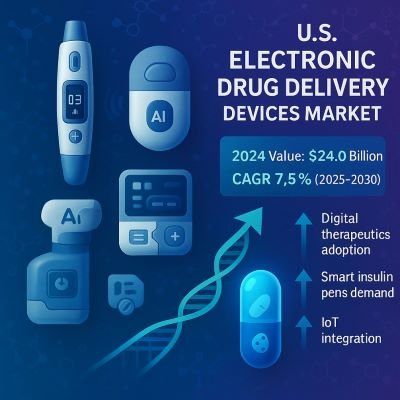
The size of the U.S. electronic drug delivery devices market was found to be USD 24.0 billion in 2024 and is anticipated to grow at a CAGR of 7.5% during 2025-2030. The increasing population of geriatrics, rising burden of chronic diseases, heightened demand for home healthcare, and integration of digital technologies are the drivers of the market growth. Such devices provide a more convenient and less painful controlled drug delivery mode, with the added benefit of reducing side effects. They ensure drug concentration remains within a desired functional range referred to as the therapeutic window.
U.S. Electronic Drug Delivery Devices Market
The rising incidence of chronic illness is driving the market for drug delivery devices. Chronic illness like cancer, diabetes, and heart disease needs long-term treatment, often in the form of regular administration of drugs to avoid complications, reduce symptoms, and enhance the quality of life. Various devices that can be employed for this purpose are insulin pumps, inhalers, patches, implantable devices, and continuous glucose monitors.
The National Cancer Institute projected that about 2,001,140 new cancer diagnoses would be made in the U.S. in 2024. Additionally, breast cancer is the most prevalent cancer type diagnosed among U.S. women. In 2022, a total of 272,454 new diagnoses were reported. The American Cancer Society estimates that in 2025, about 316,950 women in the United States will be diagnosed with invasive breast cancer. Moreover, it is estimated that in 2021, 38.4 million individuals of any age group, which is equivalent to 11.6% of all people in the United States, were living with diabetes.
Large hospitals, including IU Health Methodist Hospital, Northside Hospital Atlanta, UAB Hospital, and Christiana Hospital, implement EDDD to manage chronic conditions and alleviate pain. In addition, electronically empowered, wirelessly integrated, intelligent drug-delivery devices lend themselves to home and on-the-go applications. The USC Schaeffer Center research discovered that most Americans find hospital-grade care at home compelling given its convenience, comfort, and effectiveness. Drawing on a sample from the Understanding America Study, scientists mailed surveys to about 1,100 people about their care preferences. What they found was that 47% of the group named hospital-at-home care as an acceptable substitute for typical inpatient care.
Product Insights
The Implantable Drug Delivery Devices (IDDD) led the U.S. electronic drug delivery devices market, holding the highest revenue share of 33.0% in 2024. This is due to the fact that the devices support drug administration from once a day to once a month, obviating the necessity for repeated dosing and visits. Perfect for a busy person, they provide constant, controlled delivery, like insulin, minimizing the requirement for repeated injections. Inserted subcutaneously, they introduce medication into the body's circulatory system. The devices can be employed to treat a wide range of medical conditions, such as cancer, chronic pain, hormonal disorders, and neurological diseases. Some of the benefits of these devices include their capacity to administer localized therapy, guaranteeing drug delivery to the target tissue directly, minimizing the risk of side effects, and enhancing therapeutic efficiency. Others include pumps, microchips, biodegradable devices, and implantable reservoir systems.
The Smart Metered Dose Inhalers (SMDIs) segment is anticipated to register the highest CAGR of 11.0% during the forecast period. Its demand is fuelled by the fact that it is used in the treatment of respiratory disorders like COPD and asthma, which are growing in the U.S. In 2022, U.S. adult asthma prevalence was between 7.9% in Texas and 13.3% in Rhode Island, and child rates between 4.5% in Illinois and 10.2% in Massachusetts. SMDIs assist patients with medication management by reminding them of missed or duplicate doses, sending reminders to use medication on time, enhancing inhaler technique, and possibly preventing drug wastage. Smart MDIs overcome these shortcomings by including sensors, Bluetooth capability, and data-monitoring ability. These allow tracking in real-time, patient feedback, and remote monitoring.
Report Coverage & Deliverables
- Competitive benchmarking
- Historical data & forecasts
- Company revenue shares
- Regional opportunities
- Latest trends & dynamics
Application Insights
The diabetes submarket led the electronic drug delivery devices market with the highest revenue share in 2024. Type 2 diabetes is growing at a very rapid pace in the U.S. , primarily because of reasons like inappropriate diet, sedentary lifestyle, and genetic factors. Electronic drug delivery devices like insulin pens and pumps have various benefits over conventional injections like better convenience, accuracy in dosing, and greater patient comfort. They also enable improved treatment compliance and can contribute to decreasing the overall costs of healthcare.
The oncology segment will also expand at the highest CAGR during the forecast period. The growth will be supported by the rising incidence of cancer cases in the U.S. In 2025, an estimated 2 million individuals in the U.S. are likely to be diagnosed with cancer. Prostate cancer, with 313,780 new cases, is the most prevalent among men, and lung and bronchus cancer will have 226,650 new cases. Thus, the device is a more superior option compared to injections since it has transformed drug delivery by significantly improving the bioavailability and targeted delivery of therapeutic molecules to cancerous tissues. Through the use of the Enhanced Permeability and Retention (EPR) effect, they enhance localized drug concentrations in tumor areas and decrease exposure systems.
Key U.S. Electronic Drug Delivery Devices Company Insights
A few of the prominent players in the U.S. electronic drug delivery devices market include Medtronic, BD, Insulet Corporation, and Tandem Diabetes Care, Inc. They spend on research and development, concentrating on innovation and enhancing device functionality. They also emphasize patient-centric solutions, providing ease of use and better treatment compliance. Strategic alliances, approval by regulatory bodies, and ongoing technology advancements such as wireless control and precise dosing ensure continued market leadership.
Medtronic is a healthcare firm that designs and produces medical therapies, devices, and services. It is specialized in several fields such as cardiovascular, diabetes, neurological, and surgical care. Medtronic improves patient outcomes by providing innovative technologies and solutions.
BD is a medical technology firm that develops, makes, and distributes various medical instrument systems, reagents, and medical devices. It specializes in enhancing patient care and developing medical innovation, with areas of expertise in diagnostics, medication management, and infection prevention.
Key U.S. Electronic Drug Delivery Devices Companies
- Medtronic
- BD
- Insulet Corporation
- Tandem Diabetes Care, Inc.
- Eli Lilly and Company
- Novo Nordisk A/S
- Johnson & Johnson Services, Inc.
- United Therapeutics Corporation
- Abbott
- AstraZeneca
Recent Developments
-
In April 2025, Medtronic resubmitted 510(k) filings to the FDA for its MiniMed 780G insulin pump and SmartGuard algorithm, seeking clearance as interoperable electronic drug delivery devices. The approval would allow for integration with Abbott's new CGM platform, improving automated insulin delivery.
U.S. Electronic Drug Delivery Devices Market Report Scope
|
Report Attribute |
Details |
|
Market size value in 2025 |
USD 25.8 billion |
|
Revenue forecast in 2030 |
USD 37.1 billion |
|
Growth rate |
CAGR of 7.5% from 2025 to 2030 |
|
Base year for estimation |
2024 |
|
Historical data |
2018 - 2023 |
|
Forecast period |
2025 - 2030 |
|
Quantitative units |
Revenue in USD million/billion and CAGR from 2025 to 2030 |
|
Report coverage |
Revenue forecast, company ranking, competitive landscape, growth factors, and trends |
|
Segments covered |
Product, application |
|
Country scope |
U.S. |
|
Key companies profiled |
Medtronic; BD; Insulet Corporation; Tandem Diabetes Care, Inc.; Eli Lilly and Company; Novo Nordisk A/S; Johnson & Johnson Services, Inc.; United Therapeutics Corporation; Abbott; AstraZeneca. |
|
Customization scope |
Free report customization (equivalent up to 8 analysts working days) with purchase. Addition or alteration to country, regional & segment scope. |
|
Pricing and purchase options |
Avail customized purchase options to meet your exact research needs. Explore purchase options |
U.S. Electronic Drug Delivery Devices Market Report Segmentation
This report forecasts revenue growth at the country level and provides an analysis of the latest industry trends in each of the sub-segments from 2018 to 2030. For this study, MIR has segmented the U.S. electronic drug delivery devices market report based on product and application
-
Product Outlook (Revenue, USD Million, 2018 - 2030)
-
Smart Infusion Pumps (Infusion Systems)
-
Non-Biologic Smart Infusion Systems
-
Biologic Smart Infusion Systems
-
Smart Infusion Insulin Pumps
-
Other
-
-
-
Smart Metered Dose Inhalers (Inhalation Devices)
-
Implantable Drug Delivery Devices
-
Biologic Implantable Drug Delivery Devices
-
Non-Biologic Implantable Drug Delivery Devices
-
-
Smart Transdermal Patches (Transdermal Delivery Systems)
-
Other
-
-
Application Outlook (Revenue, USD Million, 2018 - 2030)
-
Diabetes
-
Respiratory Devices
-
Oncology
-
Cardiology
-
Frequently Asked Questions
The global electronic drug delivery devices market size was estimated at USD 62.2 billion in 2024 and is expected to reach USD 67.3 billion in 2025.
The global electronic drug delivery devices market is expected to grow at a compound annual growth rate of 8.1% from 2025 to 2030 to reach USD 99.5 billion by 2030.
The implantable drug delivery devices segment dominated the global electronic drug delivery devices market and accounted for the largest revenue share of 33% in 2024.
Some key players operating in the electronic drug delivery devices market include Medtronic plc, Insulet Corporation, Becton, Dickinson and Company (BD), Tandem Diabetes Care, Ypsomed AG, Novo Nordisk A/S, Sanofi S.A., Eli, Lilly and Company, AstraZeneca plc, GlaxoSmithKline plc, and Boehringer Ingelheim International GmbH, Pfizer, Inc.
Key factors that are driving the electronic drug delivery devices market growth include the increasing prevalence of chronic diseases and growing geriatric population, rising preference for home healthcare, increasing awareness of personalized medicine, and the integration of digital technologies.