
Claim a Free Sample
Get a preview with key statistics, projections, and trends for this report. Ideal for quick insights.
Send Me a SampleNeed full access?
Purchase ReportComputational Pathology Market Trends
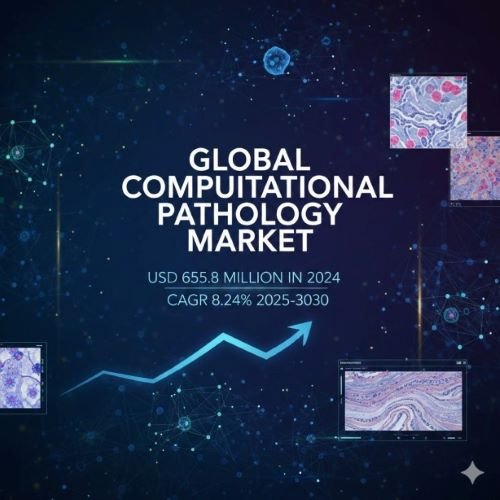
The size of the global computational pathology market was estimated to be USD 655.8 million in 2024 and is anticipated to expand at a CAGR of 8.24% from 2025 to 2030.Size, byProduct, 2024 - 2032{USD Billion} The size of the global computational pathology market is anticipated to expand at a CAGR of 8.24% from 2025 to 2030. request a free sample copy
Computational Pathology Market Size, Share & Trends Analysis Report By Component (Software, Services) By Application, By Technology (Natural Language Processing Models), By End-use (Hospitals & Diagnostic Labs), By Region, And Segment Forecasts
This growth is driven by the increased adoption of machine learning and AI technologies, increased demand for enhanced solutions for rapid diagnosis, increasing chronic disease prevalence, and enhanced investment in healthcare by market players interested in developing advanced solutions. Additionally, the growing emphasis on drug discovery and increasing telepathology adoption also supports the market growth.
The integration of machine learning and AI technologies into pathology workflows greatly revolutionizes the diagnostic process. For example, in October 2021, Tribun Health introduced CaloPix 5, a cutting-edge AI-driven computational pathology solution for diagnostics, prognosis, and drug development. The new-generation version of the image management system is augmented with capabilities like a completely web-based interface, high-volume storage management, and AI automation algorithms for breast, digestive, and lung cancer. The platform brings together different modules, such as tele-learning and formal reporting, to assist laboratories and pathologists in their digitalization.
The introduction of such solutions facilitates image analysis at a fast and accurate rate, which helps pathologists determine patterns that can suggest disease progression. Through automation of general tasks, AI allows pathologists to handle more advanced diagnostic challenges, improving efficiency and precision. This transformation improves diagnostic accuracy and aids in the creation of personalized medicine via predictive modeling.
In addition, the growing adoption and development of telepathology solutions are also adding to the market growth. Telepathology enables pathologists to consult cases and interact with colleagues from across geographical distances, thus increasing accessibility and improving the diagnostic process. The growth of these services has also been further boosted by the COVID-19 pandemic, which brought to the forefront the demand for remote healthcare solutions.
As healthcare organizations keep embracing telepathology to maximize resource utilization and enhance patient care, this trend will have a notable impact on the market growth. In June 2023, Zomedica Corp. revealed that it had launched its innovative TRUVIEW platform, an innovative diagnostic solution for the veterinary market. The telepathology and digital imaging aspects of this TRUVIEW platform and the firm's myZomedica web portal enable images to be sent to Zomedica pathologists to review and consult. The emergence of such solutions has further augmented the use of telepathology, thus boosting market growth.
Report Coverage & Deliverables
PDF report & online dashboard will enable you toUnderstand competitive benchmarking
Gain insights into historical data & forecasts
Company revenue shares
Regional opportunities
Latest trends & dynamics
Request a Free Sample Copy
The Grand Library - BI Enabled Market Research Database
Click on image to enlarge
Case Study & Insights
Case StudyArtificial intelligence–aided cancer diagnosis enhances the productivity of pathologists in prostatic biopsiesThis study assessed whether artificial intelligence (Paige Prostate) can enhance the diagnostic quality and productivity of pathologists while reading prostate core needle biopsy.
According to the findings, AI support enhanced accuracy in diagnosis, minimized turnaround time, and improved efficiency, assisting pathologists to make quicker and more uniform decisions.
Market Concentration & Features
The industry is witnessing an extremely high level of innovation as a result of various interconnected advances like Machine Learning (ML), Deep Learning, Natural Language Processing (NLP) models, and Computer Vision. The implementation of ML algorithms has allowed pathologists to increase diagnostic accuracy with predictive analytics as these algorithms examine huge amounts of data to pick up patterns that are missed by the human eye, thus allowing earlier and more accurate detection of cancer. This shift to automated systems has lowered diagnosis time significantly, enhancing the efficiency of workflows in clinical environments.
The volume of M&A deals is moderate in the market. The mature players are taking over the emerging players to enhance their position. In March 2023, for example, Clarapath bought Crosscope, a digital pathology firm that focuses on artificial intelligence software. Clarapath, which boasts of its fully automated SectionStar tissue sectioning system, plans to bring these technologies together with Crosscope's computational pathology tools to design an end-to-end platform that improves patient-centric care in human as well as animal health.
Growing government backing in the way of approvals is stimulating firms to invest in technology developments and expansion initiatives. For example, Paige obtained the FDA de novo marketing authorization for its artificial intelligence-driven diagnostic software, Paige Prostate, for the detection of prostate cancer in September 2021. This path-breaking approval makes Paige Prostate eligible to be employed as an in vitro diagnostic device through the FullFocus digital pathology viewer.
Geographical expansion fuels the growth by increasing access to sophisticated solutions across different geographical areas worldwide. For example, in April 2022, Crosscope Inc. collaborated with Waleed Pharmacy & Stores LLC to bring AI-powered digital pathology solutions to Oman. The partnership is intended to improve cancer diagnostics and care due to the increasing incidence of cancer in the region. Waleed Pharmacy will act as Crosscope's representative in Oman, using its experience to promote healthcare IT solutions.
Component Insights
Software segment led the market and recorded the highest market share of 66.5% in 2024 due to its favorable effect on clinical workflows and diagnostic processes. Software solutions powered by AI have greatly improved the efficiency of pathologists by eliminating the time-consuming procedures like image analysis, data extraction, and report generation. In addition, software development that makes the adoption of computation pathology easier is also fueling the growth of the segment. Aiosyn in March 2023 rolled out AiosynQC, an AI-driven automated quality control product for accelerating digital pathology workflows in pharmaceuticals, research, and diagnostics. It is the first of a series of workflow solutions offered by Aiosyn, with the mission to make integrating computational pathology algorithms into routine practices easy, thus improving diagnostic accuracy and quality.
Services segment is anticipated to experience the highest growth during the forecast period due to the growing need for remote services and telepathology solutions. Computational pathology tasks are being outsourced as a trend fueled by the demand for cost-efficient and scalable solutions. With healthcare institutions experiencing issues like a lack of trained pathologists, they are resorting to service providers that provide specialized expertise and cutting-edge technologies, thus driving the segment growth.
Application Insights
Disease diagnosis segment led the market in terms of revenue share of 45.7% in 2024 due to growing demand for precise and effective diagnostic solutions in clinical application. As healthcare systems battle the issue of oncoming prevalence chronic conditions, there is growing demand for sophisticated diagnostic solutions that enable improved patient care. Firms are increasingly making investments in sophisticated solutions to enhance the treatment and diagnostics of chronic diseases. For example, in May 2024, Microsoft partnered with the University of Washington, and the Providence health network to overcome significant barriers to the broad adoption of artificial intelligence in cancer diagnostics by launching an ambitious digital pathology initiative. It looks to create a machine learning model that has been trained on one of the largest collections of real-world, whole-slide tissue images to improve diagnostic accuracy and scalability in clinical practice. With more hospitals and labs embracing digital pathology solutions, the disease diagnosis segment is likely to see high growth during the forecast period.
Academic research segment is likely to experience the most rapid growth due to the growing focus on precision medicine and personalized healthcare, fueling the need for sophisticated analytical methods to decipher intricate biological data. Academic research institutions are spearheading innovation with research programs that take advantage of computational pathology platforms to process big datasets.
Technology Insights
Machine learning generated the highest revenue share in 2024 because these technologies assist in increasing diagnostic accuracy and efficiency through more complex data analysis. As an example, Bayer and Aignostics partnered in March 2024 to drive precision oncology by building next-generation diagnostics solutions. In addition, the collaboration will concentrate on developing artificial intelligence (AI) and machine learning (ML)-driven computational pathology algorithms. These algorithms will connect baseline pathology information, such as molecular tumor profiles, with clinical data like patient outcomes. This combination will help improve patient identification, stratification, and selection for clinical trials. Such strategic initiatives towards the creation of ML-based solutions are also helping drive segment growth.
Natural Language Processing (NLP) models segment is anticipated to grow the fastest because they can improve the accuracy of diagnoses and make work processes more efficient. With the inclusion of NLP, unstructured medical information such as pathology reports can be analyzed efficiently. This allows pathologists to obtain useful information from huge databases and make faster and more accurate diagnoses.
End-use Insights
Hospitals and diagnostic laboratories accounted for the highest revenue share in 2024. This is due to the growing uptake of digital pathology in such establishments to improve diagnostic output and workflow efficiency, which is critical in the management of the growing incidence of chronic diseases like cancer. For example, in March 2025, Paris Saint-Joseph Hospital and Marie Lannelongue Hospital joined hands with Koninklijke Philips N.V. to embrace digital pathology as a component of their overall enterprise imaging strategy. Its integration is geared towards giving health professionals uninterrupted access to diagnostic intelligence across anatomical, cellular, and molecular information. Furthermore, the growing utilization of telepathology enables such institutions to project their reach past geographical boundaries, rendering expert analyses accessible even in remote locations.
Pharmaceutical and biotechnology firms are anticipated to experience the highest growth during the forecast period. These firms are utilizing sophisticated computational methods to optimize drug discovery and development processes. By incorporating AI and ML algorithms into processes, they can process large volumes of data more effectively, resulting in quicker identification of biomarkers and therapeutic targets. Moreover, increasing demand for personalized medicine requires accurate diagnostic tools to provide personalized treatment plans according to individual patient requirements.
Regional Insights
North America led the computational pathology market and held the highest revenue share of 40.5% in 2024. This is due to the well-developed healthcare infrastructure, adoption of advanced technologies, and availability of various market players, which enhances the availability of computational pathology solutions. The well-developed healthcare infrastructure of the region provides growth opportunities for the companies, thus enhancing their interest in region's healthcare sector.
For example, in February 2023, Clarapath acquired Crosscope to combine tissue robotics processing with digital pathology driven by AI, to transform lab operations. This merger brings together Clarapath's SectionStar, a completely automated tissue sectioning system, and Crosscope's computational pathology tools and advanced workflow. The union aims to resolve essential issues in labs, including labor shortages and rising sample volumes, through efficiency and quality of care improvements.
U.S. Computational Pathology Market Trends
Computational pathology market in the U.S. had the highest share in 2024. One of the primary drivers of the market growth is the high rate of adoption of these solutions within the country due to their broad spectrum of applications, ranging from disease diagnosis to research purposes in academia. In addition, the growing efforts and investments in research to further boost the use of computational pathology are further propelling the market growth. For example, in April of 2024, the University of Pittsburgh and UPMC opened the computational pathology and AI Center of Excellence (CPACE) at the UPMC Cancer Pavilion, with the goal of bringing together professionals who specialize in these solutions and artificial intelligence to ensure collaboration and innovation in medical science. CPACE is centered on the use of AI for enhanced disease identification and personalized treatment recommendations, with the ultimate goal of enhanced patient care and outcomes.
Europe Computational Pathology Market Trends
The market for computational pathology in Europe is growing due to the increasing use of AI-enabled diagnostic solutions, digitization of healthcare, and emphasis on precision medicine. For example, the European Union's funding of AI research via efforts such as the Horizon 2020 program drives technological advancements in computational pathology. Furthermore, the need for effective, scalable diagnostic algorithms, particularly in the post-COVID-19 era, has further driven the growth of the market throughout Europe.
Asia Pacific Computational Pathology Market Trends
Asia Pacific computational pathology market is anticipated to have the highest growth rate during the forecast period. The market in the Asia Pacific region has witnessed an increased incidence of diseases like cancer, cardiovascular diseases, and neurological conditions. As per the Global Cancer Observatory (GLOBOCAN 2022), an estimated 9,826,539 individuals were diagnosed with cancer in 2022, with lung, breast, and colorectum cancer being the most common types of cancer. This has resulted in increasing demand for effective diagnostic solutions and heightened use of these solutions for disease detection, grading, and research. Furthermore, the rising investments and rising consciousness regarding the benefits of technologically superior solutions are also helping drive the market.
China's computational pathology market is spurred on by the rise in investment into healthcare infrastructure that has created cutting-edge laboratories and research facilities integrated with digital pathology technologies. The researchers are investing further in research to create innovative solutions. For example, in April 2025, researchers at the Chinese University of Hong Kong presented a novel paradigm, MAGA-GLTrans, to tackle the efficiency issues of digital pathology due to dependency on high-magnification whole-slide imaging. It takes low-magnification images and a self-supervised magnification alignment process to cut down computation time (up to 10.7x) and storage/transfer requirements (more than 20x) without any degradation in diagnostic accuracy. This development increases the clinical value of computational pathology, particularly in time-critical settings such as intraoperative diagnosis.
India computational pathology market is likely to see high growth during the forecast period due to the growing development in diagnostic equipment that can improve accuracy and efficiency in pathology. Based on the Indian Council of Medical Research (ICMR) report, approximately 1,461,427 individuals were diagnosed with cancer in India during 2022, with an incident rate of approximately 100.4 per 100,000 population. Additionally, growing awareness regarding benefits of such solutions is further driving the market growth.
Latin America Computational Pathology Market Trends
Latin America computational pathology market is fueled by the need for innovative diagnostic instruments, most notably in oncology. Furthermore, technological advancements and government encouragement are hastening AI and machine learning integration in pathology to improve treatment accuracy and efficiency.
Middle East & Africa Computational Pathology Market Trends
MEA computational pathology market is fueled by rising healthcare digitization, increasing AI-based diagnostic tool adoption, and increasing healthcare infrastructure growth. Government efforts to upgrade healthcare systems, along with increasing recognition of precision medicine, are compelling demand for sophisticated pathology solutions. Besides, the cancer diagnosis and treatment focus of the region is further propelling the use of computational pathology technologies, furthering market growth.
Key Computational Pathology Company Insights
Key companies are adopting strategies such as mergers and acquisitions, product and service launches, agreements, joint ventures, collaborations, and expansion to strengthen their position in the market.
Key Computational Pathology Companies
The following are the leading companies in the computational pathology market. These companies collectively hold the largest market share and dictate industry trends
- Leica Biosystems Nussloch GmbH (Danaher)
- Hamamatsu Photonics, Inc.
- Koninklijke Philips N.V.
- Olympus Corporation
- F. Hoffmann-La Roche Ltd.
- Mikroscan Technologies, Inc.
- Epredia (3DHISTECH Ltd.)
- Visiopharm A/S
- Proscia Inc.
- Tempus
- Huron Technologies International Inc
- ContextVision AB
- CellaVision
- aetherAI
- CellCarta
- IBEX (IBEX MEDICAL ANALYTICS)
- Nucleai, Inc.
Recent Developments
- In May 2024, Microsoft collaborated with the University of Washington, and Providence Health aims to address key challenges in implementing AI for cancer diagnostics, leveraging significant scale. The researchers have developed a machine learning model, which Providence describes as one of the most extensive AI training initiatives in real-world whole-slide tissue analysis.
“This transformative work is the result of focused efforts to overcome three major challenges that have stymied previous computational pathology models from widely being applied in the clinical settingshortage of real-world data, inability to incorporate whole-slide modeling and lack of accessibility,”
- In July 2024, Proscia launched an updated version of Concentriq AP. This new release enhances AI's role in advancing pathologists' insights into four of the top five most common cancers globally. Concentriq AP, a cloud-based workflow solution, is designed to deliver significant confidence and efficiency improvements for large global laboratory networks.
“We built the new version of Concentriq AP working closely with our growing customer base to realize our vision for pathology’s precision medicine future. It gives them the features they need to scale their use of AI-enabled pathology and capitalize on the latest innovations that shape our understanding of disease.”\
- In May 2021, Quest Diagnostics partnered with Paige.ai for developing AI-driven digital pathology cancer diagnostics. Paige's computational platform uses machine learning to extract diagnostic information from pathology slides, helping pathologists analyze images more quickly and accurately. The collaboration focuses on developing software for diagnosing solid tumors in lung cancer, prostate, and colorectal breast patients and aims to deliver insights to improve cancer diagnosis and make precision medicine more accessible and actionable.
“As the leader in advanced diagnostics, we are excited to actively participate in the creation and use of new technologies that further the mission to make precision medicine clinically accessible, actionable and economical. We are energized about contributing our expertise to Paige’s computational pathology leadership to deliver insights from leading-edge technologies to improve the diagnosis of cancer and other diseases.”
Computational Pathology Market Report Scope
|
Report Attribute |
Details |
|
Market size value in 2025 |
USD 700.2 million |
|
Revenue forecast in 2030 |
USD 1.04 billion |
|
Growth rate |
CAGR of 8.24% from 2025 to 2030 |
|
Actual data |
2018 - 2023 |
|
Forecast period |
2025 - 2030 |
|
Quantitative units |
Revenue in USD million/billion, and CAGR from 2025 to 2030 |
|
Report coverage |
Revenue forecast, company ranking, competitive landscape, growth factors, and trends |
|
Segments covered |
Component, application, technology, end-use, region |
|
Regional scope |
North America; Europe; Asia Pacific; Latin America; MEA |
|
Country scope |
U.S.; Canada; Mexico; UK; Germany; Spain; France; Italy; Spain; Denmark; Sweden; Norway; China; Japan; India; Australia; South Korea; Thailand; Brazil; Argentina; South Africa; Saudi Arabia; UAE; Kuwait |
|
Key companies profiled |
Leica Biosystems Nussloch GmbH (Danaher); Hamamatsu Photonics K.K.; Koninklijke Philips N.V.; Olympus Corporation; F. Hoffmann-La Roche Ltd.; Mikroscan Technologies, Inc.; Epredia (3DHISTECH Ltd.); Visiopharm A/S; Proscia Inc.; Tempus; Huron Technologies International Inc.; ContextVision AB; CellaVision; aetherAI; CellCarta; IBEX (IBEX MEDICAL ANALYTICS); Nucleai, Inc. |
|
Customization scope |
Free report customization (equivalent up to 8 analysts working days) with purchase. Addition or alteration to country, regional & segment scope. |
|
Pricing and purchase options |
Avail customized purchase options to meet your exact research needs. Explore purchase options |
Global Computational Pathology Market Report Segmentation
This report forecasts revenue growth and provides at global, regional, and country levels an analysis of the latest trends in each of the sub-segments from 2018 to 2030. For this report, Grand View Research has segmented the global computational pathology market report-based on components, application, technology, end-use, and region
-
Component Outlook (Revenue, USD Million, 2018 - 2030)
-
Software
-
Services
-
-
Application Outlook (Revenue, USD Million, 2018 - 2030)
-
Disease Diagnosis
-
Drug Discovery & Development
-
Academic Research
-
-
Technology Outlook (Revenue, USD Million, 2018 - 2030)
-
Machine Learning (ML)
-
Deep Learning
-
Others
-
-
Natural Language Processing (NLP) Models
-
Computer Vision
-
Others
-
-
End-use Outlook (Revenue, USD Million, 2018 - 2030)
-
Hospitals and Diagnostic Labs
-
Biotechnology and Pharmaceutical Companies
-
Academic and Research Institutes
-
Other
-
-
Regional Outlook (Revenue, USD Million, 2018 - 2030)
-
North America
-
U.S.
-
Canada
-
Mexico
-
-
Europe
-
UK
-
Germany
-
France
-
Italy
-
Spain
-
Denmark
-
Sweden
-
Norway
-
-
Asia Pacific
-
Japan
-
China
-
India
-
Australia
-
South Korea
-
Thailand
-
-
Latin America
-
Brazil
-
Argentina
-
-
Middle East & Africa
-
South Africa
-
Saudi Arabia
-
UAE
-
Kuwait
-
-