
Claim a Free Sample
Get a preview with key statistics, projections, and trends for this report. Ideal for quick insights.
Send Me a SampleNeed full access?
Purchase ReportMarket Size & Trends
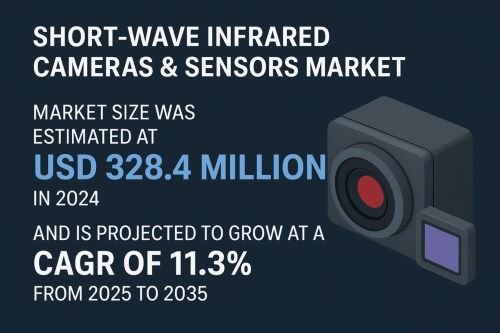
The global short-wave infrared cameras & sensors market size was estimated at USD 328.4 million in 2024 and is projected to grow at a CAGR of 11.3% from 2025 to 2035.
Short-Wave Infrared Cameras & Sensors Market Size, Share & Trends Analysis Report By Technology, By Product (SWIR Cameras, SWIR FPAs), By Application, By Interface, By Region, And Segment Forecasts
Size, byProduct, 2024 - 2032{USD Million}
short-wave infrared cameras & sensors market size was estimated at USD 328.4 million in 2024 and is projected to grow at a CAGR of 11.3% from 2025 to 2035. request a free sample copy
The growth is driven by rising demand for high-precision imaging technologies across industries such as defense, semiconductors, food inspection, and industrial automation. The increasing adoption of short-wave infrared (SWIR) technology for quality control, material sorting, and surveillance applications is a major contributor to market expansion.
In addition, advancements in SWIR sensor designs, such as lower power consumption, miniaturization, and improved sensitivity, are making these solutions more accessible for broader industrial use.
SWIR cameras & sensors, specifically those based on focal plane array (FPA) technology, are emerging as vital components in a wide range of imaging applications. Operating in the 0.9 to 1.7-micron wavelength range, SWIR imaging offers capabilities that surpass traditional visible and thermal imaging systems, enabling the detection of hidden features, material differences, and moisture levels. These advantages make SWIR FPAs valuable in fields such as industrial inspection, surveillance, defense, and scientific research. Their ability to operate in low-light or obscured environments also enhances their utility in applications where clarity and detail are required.
The market for SWIR cameras & sensors is witnessing robust growth, driven by increasing demand across both commercial and military sectors. Defense applications have historically led the adoption curve due to SWIR's ability to see through smoke, fog, and camouflage. However, recent advancements in sensor miniaturization, cost reductions, and innovations in InGaAs (Indium Gallium Arsenide) technology are expanding use cases into agriculture, machine vision, semiconductor inspection, and medical diagnostics. As industries pursue higher accuracy and automation in imaging processes, SWIR systems are becoming indispensable for enabling non-destructive testing and quality control.
Report Coverage & Deliverables
PDF report & online dashboard will help you understand
- Competitive benchmarking
- Historical data & forecasts
- Company revenue shares
- Regional opportunities
- Latest trends & dynamics
Technology Insights
The cooled SWIR cameras/sensors market held the highest revenue share of 55.1% in 2024 due to their higher image performance, particularly in long-range and low-light applications. Cooled SWIR cameras & sensors are also increasingly popular in the SWIR cameras & sensors market based on their high sensitivity, good signal-to-noise ratio, and capability of maintaining performance in harsh environments. Their capacity for the recognition of low-intensity signals in intricate conditions makes them best suited to challenging applications in defense, aerospace, and semiconductor inspection. Because the demand for high-performance imaging in these sectors continues to increase, cooled SWIR solutions are a major improvement over uncooled SWIR systems, particularly when it comes to the achievement of high resolution and accuracy. These characteristics make cooled SWIR cameras essential for jobs requiring detailed analysis in low-light or harsh conditions, such as finding small targets at large distances or under changing weather.
The uncooled SWIR cameras/sensors segment had a CAGR of 14.1% between 2025 and 2030. Uncooled SWIR cameras & sensors are being used more and more for a range of purposes because they are efficient and cost-effective. These sensors are not dependent on complicated cooling systems, which saves both their weight and power requirements, making them perfect for portable systems. Their simplicity and lower number of components result in lower production costs, which makes them available to a larger number of industries and applications. Additionally, their ease of integration into pre-existing systems makes them a sensible option for manufacturers wishing to include infrared technology in their products. Consequently, they are becoming integral parts in systems where energy efficiency, size, and weight are paramount.
Product Insights
The SWIR cameras segment led the market in 2024. The integration of visible (RGB) and SWIR sensors into a single camera demonstrates the increased adoption of multispectral imaging. There is a trend toward industries seeking to merge several imaging capabilities into a single system. This makes it easier to operate through fewer devices. Therefore, it increases efficiency and reduces equipment size and complexity. For example, in August 2024, JAI, a Danish industrial camera manufacturer, released the SW-4010Q-MCL line scan camera, which combines three CMOS sensors for visible imaging and one InGaAs sensor for SWIR. This camera allows simultaneous multispectral data capture from 400 to 1700 nm. It also has more advanced features like pixel rescaling, color space conversions, and synchronized dual-stream output, so it is an ideal solution for high-precision machine vision applications.
The SWIR FPAs segment is estimated to foresee noteworthy growth in the forecast period. SWIR FPAs, such as InGaAs-based, HgCdTe-based, and Quantum Dot-based technologies, are seeing tremendous growth because of their outstanding imaging capabilities in the short-wave infrared spectrum, which is critical for a broad range of applications. InGaAs-based FPAs are seeing tremendous growth because of their outstanding performance in the short-wave infrared (SWIR) spectrum, which is critical for use in industrial, scientific, and defense applications. They are most beneficial in security, aerospace, and machine vision applications, where sensitivity and night-time sensitivity are more important. HgCdTe-based FPAs find increasing application in thermal imaging, particularly in areas where accurate temperature readings are necessary, like environmental monitoring, space exploration, and surveillance.
Application Insights
The defense & military segment dominated the largest revenue market in 2024. Advanced technologies are being incorporated in SWIR cameras & sensors by companies to increase intelligence, autonomy, and operational effectiveness in military missions. These features are necessary for enhanced situational awareness and effectiveness in defense uses. Multiple targets can be tracked continually and recognized in real-time through these systems. Technologies for accurate distance measurement enhance target precision. Precise target recognition empowers military troops to make better decisions while on operations. As these technologies evolve, they will be very important in contemporary defense tactics. These technologies reduce the level of human interference and enhance mission accomplishment levels in military settings.
The security & surveillance segment is expected to significantly grow during the forecast period. Dual-spectrum imaging using visible and SWIR wavelengths is picking up pace in different applications. It allows systems to function efficiently under varying lighting and atmospheric conditions. This method improves detection, particularly in situations where visibility is poor. The capability to record a wider spectral range enhances the accuracy of data. With industries requiring more dependable imaging, dual-spectrum configurations are becoming more popular. The need for robust and long-lasting systems is growing, particularly in industries that work in harsh environments. These systems are engineered to operate in harsh environments with reliable performance. Defense, industrial inspection, and security applications are leading the way. As industries encounter increasingly tougher conditions, demand for rugged equipment increases.
Interface Insights
The camera link segment saw substantial growth in 2024. Camera link with SWIR sensors can be integrated to provide accurate, automated inspections across many industries. It enhances the accuracy of inspections by minimizing human error. In food manufacturing, semiconductor fabrication, and electronics sectors, it increases process efficiency overall. The option of automating inspection provides greater throughput and consistency. Consequently, industries can get faster production cycles and better quality control. For example, in October of 2023, Japanese automation giant Omron Corporation launched its new SWIR Camera Series. It employs short-wave infrared technology to combat manufacturing problems, providing flexible inspection opportunities and innovative interfaces like camera link. This technology enhances accuracy in markets like food and commodity by eliminating the reliance on conventional light. It improves inspection in the semiconductor and electronics sector through visibility using material like plastic wrap or silicon coating.
The CoaXPress segment is anticipated to have the highest CAGR during the forecast period. CoaXPress-enabled SWIR cameras are versatile in use in a number of industries like agriculture, food safety, and medical diagnostics. Their capability to take high-resolution images in the SWIR range enables thorough analysis of numerous materials as well as biological tissues. In agriculture, these cameras assist in monitoring crop health and identifying early disease symptoms. In food safety, they assist in checking products for contaminants or irregularities. Their ability to uncover tissue structures and abnormalities benefits medical diagnostics with improved detection of diseases. With their high-speed data transfer and accuracy, CoaXPress-enabled SWIR cameras create valuable insights in a wide range of industries.
Regional Insights
North America Short-Wave Infrared cameras & sensors market led the world with the highest revenue share of 38.4% in 2024. With technological growth and increasing demand from different industries. Military and defense sectors are major drivers for this growth, with SWIR technology being crucial for surveillance, reconnaissance, and targeting systems in low-visibility conditions. The capability of SWIR cameras to identify objects and details in the dark or behind obscurants is a major benefit for defense operations. With advancing defense technology, the demand for advanced imaging systems increases. The military's growing dependence on SWIR for tactical missions is propelling its adoption and shaping the future of the market. The industrial segment is another key driver of the growth of the SWIR market, with SWIR sensors playing a vital role in quality control and process monitoring. In manufacturing, the sensors are employed to identify defects in materials, maintaining product quality and reducing waste.
U.S. Short-Wave Infrared Cameras & Sensors Market Trends
The Short-Wave Infrared (SWIR) cameras & sensors market in the U.S. is propelled by the swift uptake of SWIR cameras & sensors. Wider spectral detection is broadening the range of SWIR sensors in America, allowing them to collect data across a much greater segment of the infrared spectrum. The improvement increases the sensitivity of focal plane arrays in use in domestic uses that need careful spectral differentiation. Increased access to more wavelengths enhances image precision across different lighting conditions prevalent in American industrial and environmental circumstances.
Europe Short-Wave Infrared Cameras & Sensors Market Trends
The Short-Wave Infrared (SWIR) cameras & sensors market in Europe is experiencing strong momentum in the ICT market with the growing need for high-end imaging solutions in defense, automotive, and industrial applications. SWIR technologies have the benefit of providing high-quality images under low-light and harsh environmental conditions. This feature is propelling their use in quality control, security, and surveillance applications. In addition, SWIR sensors are also being implemented in autonomous vehicles to enhance navigation during low-visibility conditions. The intense research and development focus of Europe is also boosting the implementation of these cutting-edge technologies.
Asia Pacific Short-Wave Infrared Cameras & Sensors Market Trends
Asia Pacific Short-Wave Infrared (SWIR) cameras & sensors market is expected to witness the highest CAGR during the forecast period. China and India are increasing their defense budgets, leading to demand for sophisticated surveillance systems. SWIR technology enhances imaging in low-light environments, critical for successful reconnaissance. The systems enable national security programs through better visibility in difficult environments. Technology enhances military operations through real-time, high-quality imaging capabilities. Increasing demand is fueling the adoption of SWIR in defense forces in the region. The uptake of SWIR cameras in Asia Pacific industrial applications is increasing considerably, especially for process monitoring and quality control.
Key Short-Wave Infrared Cameras & Sensors Company Insights
Prominent firms have used product launches and developments, followed by expansions, mergers and acquisitions, contracts, agreements, partnerships, and collaborations as their primary business strategy to increase their market share. The companies have used various techniques to enhance market penetration and boost their position in the competitive industry.
-
Teledyne FLIR designs, develops, manufactures, markets, and distributes SWIR technologies that enhance perception and awareness. The company brings innovative sensing solutions into daily life through thermal imaging, visible-light imaging, video analytics, measurement and diagnostics, and advanced threat detection systems. Teledyne FLIR offers a diversified portfolio that serves a number of applications in government & defense, industrial, and commercial markets. The company’s products help first responders and military personnel protect and save lives, promote efficiency within the trades, and innovate consumer-facing technologies.
-
Hamamatsu Photonics develops and manufactures advanced optical sensors, including high-speed and high-sensitivity photomultiplier tubes. The company produces photodiodes, photo ICs, image sensors, and various opto-semiconductor devices. It also creates specialized systems for life science, medical, and semiconductor industries. In addition, Hamamatsu designs high-power semiconductor lasers and conducts fundamental and applied research on light. The Global Strategic Challenge Center drives long-term strategic initiatives to ensure sustainable growth.
Key Short-Wave Infrared Cameras & Sensors Companies
The following are the leading companies in the short-wave infrared cameras & sensors market. These companies collectively hold the largest market share and dictate industry trends.
- Teledyne Technologies Incorporated.
- Hamamatsu Photonics
- Xenics (Exosens)
- Allied Vision Technologies
- Sensors Unlimited (Collins Aerospace)
- New Imaging Technologies (NIT)
- Princeton Infrared Technologies Inc.
- Raptor Photonics
- TriEye
- Chunghwa Leading Photonics Tech (CLPT)
- Active Silicon
- BitFlow, Inc.
Recent Developments
-
In March 2025, member company Xenics joined forces in a strategic cooperation with the German Aerospace Center (DLR) to deliver innovative imaging technology to NASA/JPL's VERITAS mission and ESA's EnVision mission to Venus. An important piece in both of these missions is Xenics's Bobcat Short-Wave Infrared (SWIR) sensor, designed to ensure high-resolution images in space's unforgiving environment. This partnership is to create precise surface maps and reveal new geologic information regarding Venus, which is a giant leap in international collaboration for planetary exploration.
Hamamatsu Photonics Europe made a strategic alliance with VUB, a European research university, in April 2024 to advance innovation and research in the field of photonics. The partnership targets providing support to firms with feasibility assessments, prototyping, and photonics quality assurance, as well as developing photonic modules and subsystems for the purpose of enhancing Hamamatsu's products. Additionally, the collaboration takes advantage of the PhotonHub Europe platform to raise cooperation levels among other research institutes in Europe and introduces the inclusion of "Pilot Lines" for assisting photonics technologies' transition from conceptualization to commercialization.
Short-Wave Infrared Cameras & Sensors Market Report Scope
|
Report Attribute |
Details |
|
Market size value in 2025 |
USD 362.7 million |
|
Revenue forecast in 2030 |
USD 620.2 million |
|
Growth rate |
CAGR of 11.3% from 2025 to 2035 |
|
Base year for estimation |
2024 |
|
Historical data |
2018 - 2023 |
|
Forecast period |
2025 - 2035 |
|
Quantitative units |
Revenue in USD million/billion and CAGR from 2025 to 2035 |
|
Report coverage |
Revenue forecast, company ranking, competitive landscape, growth factors, and trends |
|
Segments covered |
Technology, product, application, interface, region |
|
Regional scope |
North America; Europe; Asia Pacific; Latin America; MEA |
|
Country scope |
U.S.; Canada; Mexico; UK; Germany; France; China; Japan; India; South Korea; Australia; Brazil; KSA; UAE; South Africa |
|
Key companies profiled |
Teledyne Technologies Incorporated.; Hamamatsu Photonics; Xenics (Exosens); Allied Vision Technologies; Sensors Unlimited; New Imaging Technologies (NIT); Princeton Infrared Technologies Inc.; Raptor Photonics; TriEye; Chunghwa Leading Photonics Tech; Active Silicon; BitFlow, Inc. |
|
Customization scope |
Free report customization (equivalent up to 8 analysts working days) with purchase. Addition or alteration to country, regional & segment scope. |
|
Pricing and purchase options |
Avail customized purchase options to meet your exact research needs. Explore purchase options |
Global Short-Wave Infrared Cameras & Sensors Market Report Segmentation
Technology Outlook (Revenue, USD Million, 2018 - 2035)
-
-
Cooled SWIR Cameras/Sensors
-
Uncooled SWIR Cameras/Sensors
-
-
Product Outlook (Revenue, USD Million, 2018 - 2035)
-
SWIR Cameras
-
Area Scan Cameras
-
Line Scan Cameras
-
-
SWIR FPAs
-
InGaAs-based FPAs
-
HgCdTe-based FPAs
-
Quantum Dot-based FPAs
-
Others
-
-
-
Application Outlook (Revenue, USD Million, 2018 - 2035)
-
Defense & Military
-
Industrial
-
Security & Surveillance
-
Healthcare & Research
-
Automotive
-
Agriculture & Food
-
Others
-
-
Interface Outlook (Revenue, USD Million, 2018 - 2035)
-
Camera Link
-
CoaXPress (CXP)
-
GigE
-
HDMI
-
USB
-
Other
-
-
Regional Outlook (Revenue, USD Million, 2018 - 2035)
-
North America
-
U.S.
-
Canada
-
Mexico
-
-
Europe
-
UK
-
Germany
-
France
-
-
Asia Pacific
-
China
-
Japan
-
India
-
South Korea
-
Australia
-
-
Latin America
-
Brazil
-
-
Middle East and Africa (MEA)
-
KSA
-
UAE
-
South Africa
-
-
Frequently Asked Questions
The global short-wave infrared cameras & sensors market size was estimated at USD 328.4 million in 2024 and is expected to reach USD 362.7 million in 2025.
The global short-wave infrared cameras & sensors market is expected to grow at a compound annual growth rate of 11.3% from 2025 to 2030 to reach USD 620.2 million by 2030.
North America dominated the short-wave infrared (SWIR) camera and sensor market with a share of 38.4% in 2024. Driven by technological advancements and rising demand across various industries. Military and defense applications are key drivers of this growth, with SWIR technology proving essential for surveillance, reconnaissance, and targeting systems in low-visibility environments.
Some key players operating in the short-wave infrared (SWIR) camera and sensor market include Teledyne Technologies Incorporated.; Hamamatsu Photonics; Xenics (Exosens); Allied Vision Technologies; Sensors Unlimited (Collins Aerospace); New Imaging Technologies (NIT); Princeton Infrared Technologies Inc.; Raptor Photonics; TriEye; Chunghwa Leading Photonics Tech (CLPT); Active Silicon; BitFlow, Inc.; Pleora Technologies Inc.; Euresys; Matrox Graphics Inc.
Key factors that are driving the market growth include Industrial automation as it is increasingly reliant on advanced imaging technologies for real-time decision-making, and SWIR cameras play a vital role in this transformation. Unlike traditional visible light cameras, SWIR sensors detect materials and features that are invisible to the human eye, such as moisture, contamination, and internal defects