
Claim a Free Sample
Get a preview with key statistics, projections, and trends for this report. Ideal for quick insights.
Send Me a SampleNeed full access?
Purchase ReportMarket Size & Trends
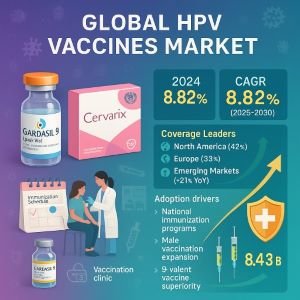
The global human papillomavirus vaccines market size was estimated at USD 8.42 billion in 2024, and it is projected to grow at a CAGR of 8.82% from 2025 to 2030. The rising global incidence of HPV-related infections and cancers is a major force driving the growth of the market.
Human Papillomavirus Vaccines Market
Size, byProduct, 2024 - 2030{USD Billion}
Human papillomavirus vaccines market size is projected to grow at a CAGR of 8.82% from 2025 to 2030. request a free sample copy
Key Points
The North America human papillomavirus vaccines market led worldwide with a market share of 39.83% in 2024.
The growth of the U.S. human papillomavirus vaccines market is strong, boosted by public funding.
Based on type, the quadrivalent segment accounted for the highest market share of 75.67% in 2024.
Based on disease, the cervical cancer segment dominated the market with a revenue share of 63.78% in 2024.
By distribution channel, the hospital and retail pharmacies segment was the market leader with a revenue share of 54.75% in 2024.
Human papillomavirus is the primary cause of cervical cancer, which ranks as the fourth most prevalent cancer among women worldwide. It is also associated with several other malignancies, including anal, oropharyngeal, and penile cancers. According to the report published in March 2024, World Health Organization (WHO), cervical HPV prevalence is highest in sub-Saharan Africa at 24%, followed by Latin America and the Caribbean (16%), Eastern Europe (14%), and South-East Asia (14%).
This alarming trend has increased vigilance among governments and the public at large, mounting the need for preventive healthcare interventions. Consequently, numerous national immunization programs-mostly in low- and middle-income countries-are scaled up with the assistance of international health institutions like Gavi. With an increasing number of nations using HPV vaccines as part of their routine immunization, the market is set to grow steadily, promoting innovations in preventive as well as therapeutic products.
Strong government support and global public health efforts are driving the growth of the HPV vaccines market. Most governments have included HPV vaccines in national immunization programs, frequently providing them free of charge to the masses to facilitate high coverage. Initiatives like the WHO's Global Strategy to Eliminate Cervical Cancer by 2030 seek to have 90% coverage among girls aged 15 years, significantly fueling demand. Non-profits like Gavi, the Vaccine Alliance, seek to drive down the cost of vaccines and increase access in low- and middle-income nations. Financing by global stakeholders like the Bill & Melinda Gates Foundation and UNICEF sustains distribution, logistics, and outreach. This institutional support not only enhances rates of vaccination but also supports a beneficial regulatory and financial climate for pharmaceutical firms, promoting additional innovation and investment. As these concerted efforts persist, they reinforce the infrastructure that protects against HPV worldwide.
Technological progress at a rapid pace and increased research and development activities are driving HPV vaccine industry innovations. The emergence of next-generation vaccines like Gardasil 9 that offer protection for nine strains of HPV reflects the direction towards broader and more comprehensive immunization. Therapeutic vaccines that will cure existing infections and cancers caused by them are also expanding the market. The experience with mRNA technology during the COVID-19 pandemic has created interest in leveraging a similar platform for the HPV vaccines and therapies. Additionally, advances in cold-chain logistics, needle-free delivery systems, and thermostable products are increasing vaccine access and utilization across hard-to-reach or underdeveloped regions. These advancements not only improve efficacy and patient compliance but also attract huge investments from biotech firms and pharma majors. With the growing R&D sophistication of the pipeline, new, more affordable, and accessible HPV solutions will significantly boost the global market presence.
Increased public awareness and education about HPV and its impact on health are driving increasing levels of vaccination and market expansion. Historically, cultural taboo and lack of understanding regarding HPV spread and consequences have limited vaccine acceptance, especially by young people and parents. However, focused information campaigns by health ministries, NGOs, schools, and media-are changing minds by highlighting the vaccine's role in preventing cancer, rather than sexually transmitted infection. School-based programs, popular personality endorsements, and social media efforts have been effective in changing popular opinion. Furthermore, healthcare providers are increasingly likely to start HPV vaccination as a normal part of adolescent care. Electronic technologies such as SMS reminders, cellular phone applications, and internet-based scheduling systems add further to participation. This inclusive awareness is reducing vaccine hesitancy and prompting informed health decisions, hence fuelling demand for not just vaccines but also screening and therapeutic care. Consequently, this is helping immensely in the expansion of the HPV care market.
Growing markets are playing a major role in expanding the HPV vaccines market, fueled largely by widening access and strategic partnerships. Accelerated disease burden in Africa, Asia, and Latin America has fueled mass vaccination campaigns in these regions through collaborations between pharmaceutical companies and international health officials. Such collaborations often come with technology transfers, local production deals, and tiered pricing structures to help reduce logistical and financial hurdles. In addition, regulatory harmonization and more efficient clinical trials processes in developing countries make the developing world an attractive site for new product introductions. These governments are also implementing school-based immunization programs and public-private partnerships to deliver expanded coverage. Such programs are successful not merely in improving population health but also in establishing a sustainable market for future medicines. With demand in developed markets settling, the growth opportunity within underserved markets makes emerging economies an ideal frontier for market growth and innovation on HPV prevention and treatment.
Report Coverage & Deliverables
- Competitive benchmarking
- Historical data & forecasts
- Company revenue shares
- Regional opportunities
- Latest trends & dynamics
Market Concentration & Characteristics
The HPV vaccines market is witnessing significant innovation, especially in multivalent vaccine development and new therapeutic vaccines. Improvements in mRNA technology and immune-modulating therapy are broadening the horizon for treatment. R&D is also directed towards enhancing vaccine stability and delivery, which is making it even more accessible. These advancements are vital for extending protection and addressing chronic HPV infections more effectively.
Mergers and acquisitions are increasingly defining the HPV market, with leading drug companies going out to bolster their product ranges and pipeline capacity. Strategic buys of biotechnology companies with new HPV drugs or vaccine platforms provide quick market access and minimize time-to-market for new products. Such M&A also facilitates geographic expansion and scale-up in manufacturing, promoting competitiveness, and solidifying presence in the marketplace worldwide.
Regulatory policies exert a significant influence on the HPV market, determining vaccine approval, pricing, and distribution. Authoritative agencies such as the FDA and EMA have in-place streamlined approval processes for priority vaccines, and WHO prequalification enables use in international immunization programs. High safety and efficacy standards promote public confidence, yet divergent regional guidelines may delay launches worldwide. Harmonized regulatory policies would greatly contribute to rapid adoption and worldwide availability.
Product growth in the HPV market involves both preventive and therapeutic technology. New multivalent vaccines that provide wider strain coverage are coming to market, while therapeutic vaccines and antiviral drugs are increasing the market's curative side. The companies are also creating pediatric and gender-free formulations, widening the coverage population. Increased product offerings give greater market penetration, cater to varied needs, and propel sustainable revenue increases.
The HPVG vaccines market is growing fast in the emerging markets, spurred on by heavy disease burden and enhanced healthcare infrastructure. Collaboration with international health organizations makes it easier to penetrate Africa, Asia, and Latin America through subsidized pricing and educational campaigns. Local production and government-run immunization programs are crucial to increasing coverage. Regional growth benefits not only fills healthcare needs but also provides huge new revenue streams for manufacturers.
Type Insights
The quadrivalent segment accounted for the highest 75.67% market share in 2024 as a result of its protection against four types of HPV, viz., 6, 11, 16, and 18. These four types account for approximately 70% cervical cancers and about 90% genital warts, and hence the quadrivalent vaccine has emerged as a mainstay of HPV immunization programs across the world. Its market expansion comes from growing awareness regarding HPV-related cancers and genital warts, and increasing immunization programs in high-income countries and developing nations. In addition, the quadrivalent vaccine, especially Gardasil, with its proven track record, has become a popular option among national immunization programs. It is widely recognized by healthcare professionals and governments as being cost-effective, as well as having the potential to target multiple strains of HPV at one time. Even with the emergence of nonavalent vaccines that provide still wider protection, the quadrivalent vaccine remains in demand, particularly where immunization infrastructures are well established. The segment continues to grow with vigour as it makes meaningful contributions to the global battle against HPV-related disease.
The nonavalent segment is anticipated to record the highest CAGR over the forecast period due to its wider protection against nine HPV types-6, 11, 16, 18, 31, 33, 45, 52, and 58. These are linked with a broader range of cancers, such as cervical, vulvar, vaginal, anal, penile, and oropharyngeal cancers, thereby making the nonavalent vaccine an extremely broad preventive measure. The expansion is also bolstered by mounting government backing, WHO advice, and expanding inclusion in national immunization programs. Increased public awareness, enhanced access to healthcare, and increased availability through bodies like the Pan American Health Organization (PAHO) are driving volumes, especially in middle- and low-income nations. Consequently, the nonavalent vaccine segment is set to experience fast growth, filling a major void in HPV-related disease prevention.
Disease Insights
The cervical cancer market dominated the market with a 63.78% revenue share in 2024, attributed to increased awareness and preventive measures. Cervical cancer is still among the most frequent cancers linked to HPV, especially types 16 and 18, which are responsible for approximately 70% of all cases. Consequently, the global health community has made cervical cancer prevention via HPV vaccination a priority, particularly in adolescent girls. Government-sponsored vaccination programs, public campaigns, and school programs have helped increase vaccine coverage in developed and developing countries alike. In addition, the World Health Organization's (WHO) target for eliminating cervical cancer as a public health problem by accelerating HPV vaccination rates has also contributed to market momentum. Growth is further assisted by technological progress and the development of vaccines that have wider HPV strain coverage, including the nonavalent vaccine. This region remains a key driver of demand for the HPV vaccines market because of its high disease burden and preventability.
The oropharyngeal (head and neck) cancers segment will register the highest CAGR through the forecast period on account of the rise in the incidence of HPV-related cancers of the throat, particularly in the high-income countries. Unlike the risk factors of tobacco and alcohol use, HPV-associated oropharyngeal cancers are increasingly being identified as a major cause of head and neck cancer, especially among males. This new order in disease patterns has evoked public health officials and scientists to suggest gender-neutral HPV vaccination, further increasing the target population. With increasing awareness of the relationship between HPV and oropharyngeal cancer, increasing numbers of countries are incorporating HPV vaccines into regular boys' and girls' immunization programs. The increased strain coverage of nonavalent vaccines, including protection against HPV types 16 and 18, which are most strongly linked with these cancers, is also driving segment growth.
Distribution Channel Insights
Thehospitals and retail pharmacies segment held the largest market share of 54.75% in 2024 and is predicted to register the highest CAGR throughout the forecast period. This is primarily due to the rise in accessibility, convenience, and credibility of these healthcare facilities. Hospitals are at the core of formal immunization campaigns, especially in urban and semi-urban cities, where formal healthcare infrastructure facilitates effective delivery of vaccines. At the same time, retail pharmacies are becoming progressively more significant in providing walk-in vaccination services, extended operating hours, and large geographic coverage that increase patient compliance and reach. Governments and public health agencies also collaborate with such channels to boost HPV vaccine coverage, especially under public-private alliances. In much of the country, retail pharmacies have become vaccinating providers authorized by law, speeding up immunization service decentralization. Moreover, rising education regarding HPV-related conditions and stringent public health programs have resulted in greater traffic in these venues, making this segment both the largest and also one of the fastest-growing distribution channels.
Government suppliers segment will be growing at the highest CAGR during the forecast period. Governments, sometimes in partnership with global health organizations like the WHO, GAVI, and PAHO, are initiating mass vaccination initiatives to contain the prevalence of HPV-related conditions like cervical cancer. This segment is growing with enhanced public health funding, national immunization programs, and HPV vaccine buying through revolving funds and group purchasing agreements that enable cost-effective access. Public health clinics and government-run schools are the primary points of delivery for these vaccines, which cover a large population, particularly adolescent girls and boys. Strategic campaigns educating the community on vaccine safety and awareness have also helped in accepting these vaccines. Government suppliers might encounter logistical difficulties in covering distant areas, but sustained efforts to enhance cold chain facilities and healthcare delivery systems persist in enhancing their position in market growth and the availability of equitable vaccines.
Regional Insights
The North America human papillomavirus (HPV) vaccines industry dominated globally with a market share of 39.83% in 2024. The region’s dominance is driven by widespread immunization programs and strong public health initiatives. As reported by the CDC, in 2023, 78.5% of adolescent girls and 75% of boys in the United States received at least one dose of the HPV vaccine. Even with this advancement, overall initiation rates declined somewhat in 2022-the first time since 2013, among some subgroups of teens aged 13-17. This trend highlights the continued importance of increased emphasis on equitable education and outreach efforts in all communities.
U.S. Human Papillomavirus Vaccines Market Trends
The U.S. HPV vaccines industry growth is strong, and it is fueled by public funding. Vaccines for Children (VFC) programs allow the CDC to purchase vaccines at discounted prices and distribute them to providers so uninsured, underinsured, Medicaid-eligible, and American Indian or Alaska Native children through age 18 are provided access. ACIP-recommended vaccines are also covered for those under 21 by Medicaid under the EPSDT program. For adults aged over 21, Medicaid provides coverage of sanctioned vaccines with no out-of-pocket costs. Moreover, Section 317 of the Public Health Service Act authorizes federal funds to states and local agencies to increase vaccine availability for uninsured adults, bridging important coverage gaps and enabling widespread immunization activities.
Europe Human Papillomavirus Vaccines Market Trends
The human papillomavirus (HPV) vaccines market in Europe is growing, helped by increasing vaccination levels. As per gov.uk, in England in the academic year 2022 - 2023, 75.7% of Year 9 girls were given their first dose of the HPV vaccine-an increase of 6.1 percentage points from 69.6% when the same cohort was in Year 8 the previous year. In Year 9 boys, first-dose coverage was at 69.7%, showing ongoing improvement in gender-equal immunization and reinforcing market potential in the region.
The UK human papillomavirus (HPV) vaccines market growth is being influenced by government programs for immunization and increasing public awareness. The National Health Service (NHS) provides free HPV vaccination for adolescents, and this contributes to high levels of coverage for girls and boys. Improved uptake has been demonstrated in the recent data, particularly among Year 9 students, and this indicates effective delivery in schools. Sustained investment in preventive healthcare, public awareness, and broader vaccine access drives long-term market growth and celebrates the UK's leadership in preventing HPV-associated disease.
Germany human papillomavirus (HPV) vaccines industry growth is expected to increase during the forecast period. As of 2021, only 54% of 15-year-old girls and 27% of boys were completely vaccinated against HPV, short of the WHO's 90% target for girls by 2030. The COVID-19 pandemic also affected uptake, with first-dose vaccination among girls aged 9-14 declining more than 21% below 2019 levels in 2021 and 2022. In spite of these difficulties, Germany's immunization program has resulted in substantial reductions in HPV-related disease, including a 51.1% decrease in high-grade cervical lesions and a 75% reduction in vaginal precancer/cancer prevalence. Initiatives such as vaccination programs in schools in areas such as Bremen have been effective in boosting coverage among the disadvantaged groups. To drive coverage further, health authorities are exploring options such as early preventive check-ups and electronic reminder systems. Through continued efforts, Germany plans to raise its vaccination coverage and enhance its HPV prevention measures.
Asia Pacific Human Papillomavirus Vaccines Market Trends
The Asia Pacific region's human papillomavirus (HPV) vaccine industry is seeing rapid development, with less than half of the region's countries having complete national HPV immunization programs. Most have no accurate data on coverage. But Singapore and Brunei are leading the way, with both achieving more than 90% first-dose administration in girls aged 15. Strong health infrastructure and well-functioning public health programs ensure their success and provide an example to follow for the rest of the region.
The Japanese human papillomavirus (HPV) vaccines market is witnessing high growth with the rising awareness among consumers, government campaigns, and enhanced incidence of HPV-related conditions like cervical cancer. Resumption of vaccination drives and improved healthcare infrastructure have augmented the uptake of vaccines, especially among young women. Advances in vaccine technology and increasing research in therapeutic solutions are also fueling the market growth. Moreover, increasing support from global health agencies and greater accessibility are anticipated to drive strong market growth over the next few years.
China human papillomavirus (HPV) vaccines market is experiencing significant growth due to a number of factors. Government policies, including the China Action Plan for Accelerated Elimination of Cervical Cancer (2023 - 2030), will boost vaccination levels through pilot schemes providing free HPV vaccines across provinces. Launch of locally manufactured vaccines, such as Wantai's bivalent HPV vaccine, has boosted accessibility and affordability with falling prices in certain markets. Although issues such as vaccine hesitancy and shortage of supplies have hindered progress, continuous initiatives to increase public awareness and infrastructure will continue to drive market expansion.
Latin America Human Papillomavirus Vaccines Market Trends
The Latin America human papillomavirus (HPV) vaccine market is experiencing strong growth influenced by a number of pivotal factors. Government action, including the incorporation of HPV vaccines into national immunization schedules, has expanded access to vaccines and raised awareness. Regional assistance from organizations like PAHO and UNICEF has made vaccine procurement at lower prices, thus making them more accessible to countries in the region. The development of at-home HPV screening tests represents technological advancement, which has enhanced early detection and prevention. Despite challenges like vaccine hesitancy and limited knowledge about HPV, ongoing educational campaigns and healthcare provider recommendations are helping to overcome these barriers.
The human papillomavirus (HPV) vaccines industry in Brazil is expanding due to several key factors. Government-led vaccination initiatives, including school-based programs targeting girls aged 9 to 13, have increased vaccine accessibility and coverage. Public health programs have raised the awareness regarding the relationship between HPV and cervical cancer, and thus improved vaccine coverage. Greater healthcare infrastructure with increased vaccine supply through clinics and schools has enhanced access, especially in remote areas. International collaborations with bodies such as PAHO and UNICEF have helped decrease the cost of vaccines, thus increasing coverage further.
Middle East & Africa Human Papillomavirus Vaccines Market Trends
The MEA human papillomavirus (HPV) vaccine market is experiencing rapid growth based on a few prominent factors. Government-led efforts, including the inclusion of HPV vaccines into state immunization programs, have made vaccines more accessible. International assistance from agencies such as Gavi, the Vaccine Alliance, has made vaccine procurement at lower prices possible, thereby making vaccines more affordable for region countries. Advances in technology, such as the introduction of HPV screening kits for use at home, have enhanced early detection and prevention. In spite of difficulties such as hesitancy towards vaccines and a lack of understanding about HPV, consistent publicity campaigns and doctor recommendations are aiding the causes. Therefore, MEA region countries are experiencing high market growth, and forecasted compound annual growth rates (CAGR) are even pointing towards further growth in the future years.
The Saudi Arabian human papillomavirus (HPV) vaccines market is experiencing major growth, driven by a range of significant factors. The integration of the HPV vaccine into the Saudi national immunization schedule by the Ministry of Health in March 2022 and then the inclusion of the vaccine in younger age groups in September 2022 has majorly amplified vaccine access. This program is a part of a larger drive towards eradicating cervical cancer, which causes about 179 deaths a year in the nation. In addition to this, the government's eagerness to promote preventive healthcare is also reflected in the form of subsidized screening services like pap smears that make them affordable for the masses. In spite of these developments, issues like hesitancy regarding vaccines remain, with research showing that 34% of parents are hesitant to vaccinate their teenage daughters. Responding to these concerns via focused educational campaigns and healthcare professional endorsement is needed to further maximize vaccine uptake as well as alleviate the burden of HPV-related diseases in Saudi Arabia.
Key Human Papillomavirus Vaccines Company Insights
Key market players are adopting market strategies, such as new product launches, collaborations, and geographical expansions, to increase their global footprint. For instance, in March 2024, Merck announced at the EUROGIN 2024 HPV Congress its plans to begin clinical development of a novel investigational multi-valent Human Papillomavirus (HPV) vaccine aimed at offering broader protection against a wider range of HPV types. In addition, the company revealed its intention to launch clinical trials involving both females and males to assess the efficacy and safety of a single-dose regimen of GARDASIL9 (9-valent recombinant HPV vaccine), in comparison to the currently approved three-dose schedule.
Key Human Papillomavirus Vaccines Companies
The following are the leading companies in the human papillomavirus vaccines market. These companies collectively hold the largest market share and dictate industry trends.
- Merck & Co., Inc.
- GlaxoSmithKline plc (GSK)
- Serum Institute of India Pvt. Ltd.
- Sanofi Pasteur SA
- Pfizer Inc.
- Inovio Pharmaceuticals Inc.
- Walvax Biotechnology Co., Ltd.
- Bharat Biotech International Ltd.
- Johnson & Johnson Services, Inc.
- Moderna, Inc.
- Gilead Sciences, Inc.
Recent Developments
-
In April 2025, Bulgaria extended its national HPV vaccine program in partnership with the Ministry of Health and the Bulgarian HPV Coalition, taking a huge leap for the country to prevent at least six forms of cancer-cervical, vaginal, vulvar, anal, penile, and head & neck-all of which are caused by the prevalent HPV virus.
In February 2025, the Pan American Health Organization (PAHO) made a public statement that beginning in July 2025, the 9-valent HPV vaccine will be available to all countries in the Americas via its Revolving Fund for Access to Vaccines. The goal is to offer more affordable and streamlined access to the vaccine, which protects against nine types of the human papillomavirus (HPV), which are associated with many different cancers, including cervical, anal, and oropharyngeal cancers.
In November 2024, Merck released new clinical and real-world data for its 9-valent Human Papillomavirus (HPV) vaccine, GARDASIL 9 (Human Papillomavirus 9-valent Vaccine, Recombinant), to spotlight information regarding the burden and incidence of different HPV-related cancers and diseases.
Human Papillomavirus Vaccines Market Report Scope
|
Report Attribute |
Details |
|
Market size value in 2025 |
USD 9.19 billion |
|
Revenue forecast in 2030 |
USD 14.03 billion |
|
Growth Rate |
CAGR of 8.82% from 2025 to 2030 |
|
Base year for estimation |
2024 |
|
Historical data |
2018 - 2023 |
|
Forecast period |
2025 - 2030 |
|
Quantitative units |
Revenue in USD million/billion and CAGR from 2025 to 2030 |
|
Report coverage |
Revenue forecast, company ranking, competitive landscape, growth factors, and trends |
|
Segments covered |
Type, disease, distribution channel, region |
|
Regional scope |
North America; Europe; Asia Pacific; Latin America; Middle East & Africa |
|
Country scope |
U.S.; Canada; Mexico; UK; Germany; France; Spain; Italy; Denmark; Sweden; Norway; Japan; China; India; Australia; South Korea; Thailand; Brazil; Argentina; South Africa; Saudi Arabia; UAE; Kuwait, |
|
Key companies profiled |
Merck & Co., Inc.; GlaxoSmithKline plc (GSK); Serum Institute of India Pvt. Ltd.; Sanofi Pasteur SA; Pfizer Inc.; Inovio Pharmaceuticals Inc.; Walvax Biotechnology Co., Ltd.; Bharat Biotech International Ltd.; Johnson & Johnson Services, Inc.; Moderna, Inc.; Gilead Sciences, Inc. |
|
Customization scope |
Free report customization (equivalent up to 8 analysts working days) with purchase. Addition or alteration to country, regional & segment scope. |
|
Pricing and purchase options |
Avail customized purchase options to meet your exact research needs. Explore purchase options |
Global Human Papillomavirus Vaccines Market Report Segmentation
-
Type Outlook (Revenue, USD Million, 2018 - 2030)Bivalent
-
Quadrivalent
-
Nonavalent
-
-
Disease Outlook (Revenue, USD Million, 2018 - 2030)
-
Cervical Cancer
-
Vaginal and Vulvar Cancers
-
Anal Cancer
-
Oropharyngeal (Head and Neck) Cancers
-
Genital Warts
-
-
Distribution Channel Outlook (Revenue, USD Million, 2018 - 2030)
-
Hospitals and Retail Pharmacies
-
Government Suppliers
-
Others
-
-
Regional Outlook (Revenue, USD Million, 2018 - 2030)
-
North America
-
U.S.
-
Canada
-
Mexico
-
-
Europe
-
UK
-
Germany
-
France
-
Italy
-
Spain
-
Denmark
-
Sweden
-
Norway
-
-
Asia Pacific
-
Japan
-
China
-
India
-
Australia
-
Thailand
-
South Korea
-
-
Latin America
-
Brazil
-
Argentina
-
-
Middle East & Africa
-
South Africa
-
Saudi Arabia
-
UAE
-
Kuwait
-
-
Frequently Asked Questions
The global human papillomavirus vaccines market size was estimated at USD 8.42 billion in 2024 and is expected to reach USD 9.19 billion in 2025.
The global human papillomavirus vaccines market is expected to grow at a compound annual growth rate of 8.82% from 2025 to 2030 to reach USD 14.03 billion by 2030.
North America dominated the HPV vaccines market with a share of 39.84% in 2024. This is attributable to rising awareness, government immunization programs, and increasing HPV-related cancer rates. Advances in vaccine technology and expanded age group approvals also contribute significantly to market expansion.
Some key players operating in the HPV vaccines market include LGC Limited, Bio-Rad Laboratories, Inc., Randox Laboratories Ltd., QACS - The Challenge Test Laboratory, Merck KGaA, Weqas, BIPEA, NSI Lab Solutions, Absolute Standards, Inc., INSTAND
Key factors that are driving the market growth include rising awareness of HPV-related cancers, especially cervical cancer. Government-led vaccination programs, increased screening initiatives, and broader vaccine approvals across age groups contribute significantly. Technological advancements and strong support from global health organizations further fuel market demand and accessibility worldwide.