
Claim a Free Sample
Get a preview with key statistics, projections, and trends for this report. Ideal for quick insights.
Send Me a SampleNeed full access?
Purchase ReportGreenhouse Horticulture Market Overview
Greenhouse horticulture refers to the controlled cultivation of crops, flowers, and ornamental plants using advanced structures that regulate climate factors like temperature, humidity, and carbon dioxide. This technique enhances crop quality and yield while extending growing seasons—making it particularly valuable in regions with extreme or fluctuating weather.
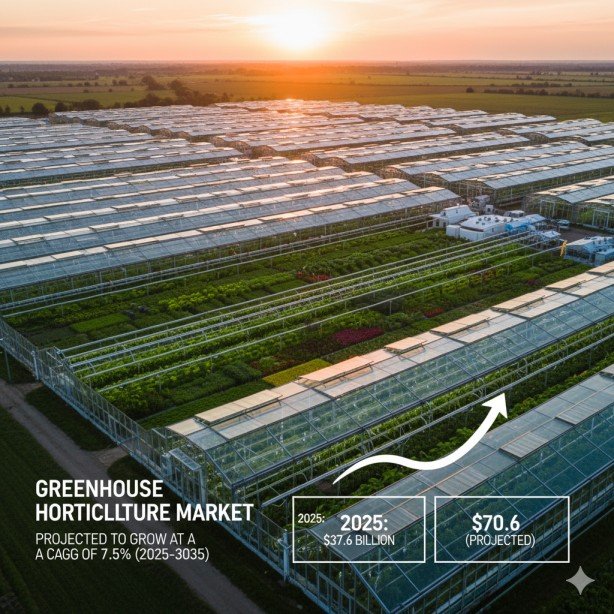
The global greenhouse horticulture market is projected to grow at a CAGR of 7.5% between 2025 and 2035. The market is estimated to reach USD 37.6 billion in 2025 and is forecasted to expand to USD 70.6 billion by 2035. As climate volatility, food security concerns, and urban expansion increase, the demand for reliable and sustainable agricultural methods like greenhouse horticulture continues to rise.

Global Greenhouse Horticulture Market Forecast 2025–2035: Cultivating Sustainability, Innovation, and Food Security
Size, byProduct, 2024 - 2032{USD Billion}
Greenhouse horticulture market is projected to grow at a CAGR of 7.5% between 2025 and 2035 request a free sample copy
Key Growth Drivers
Food Security Amid Population Growth
The global population is surging, straining traditional agricultural systems. Greenhouse horticulture provides a resilient solution by enabling year-round production, controlled growing conditions, and consistent supply of fresh fruits, vegetables, and other crops.
These systems ensure high yields even in adverse climates, helping stabilize food availability across urban and remote regions. Greenhouse practices are proving effective in supporting self-sufficiency and combating seasonal food shortages.
Download Sample Ask for Discount Request Customization
Climate Change Awareness Accelerates Adoption
Rising global temperatures and erratic weather patterns have brought agriculture’s carbon footprint into sharp focus. Greenhouse horticulture offers a sustainable alternative by using water, nutrients, and land more efficiently in a controlled environment.
Furthermore, consumers are increasingly seeking locally grown, chemical-free produce, driving demand for sustainable greenhouse-grown vegetables and herbs. These environmentally conscious trends align with policy-level efforts to reduce emissions and promote sustainable food production.
Market Challenges
Limited Access to Cost-Effective Technology
Despite its advantages, greenhouse horticulture remains underutilized in some regions due to the high cost of technology. Small and medium-sized farmers face financial and technical barriers to adopting automated systems like smart greenhouses, IoT sensors, and climate-control solutions.
Solar-powered and geothermal systems, though energy-efficient, remain expensive. This limits their accessibility in developing markets, slowing widespread industry adoption.
Download Sample Ask for Discount Request Customization
Report Scope for the Global Greenhouse Horticulture Market
| Parameter | Details |
|---|
| Report Title | Global Greenhouse Horticulture Market Forecast 2025–2035 |
| Forecast Period | 2025 to 2035 |
| Base Year | 2024 |
| Market Size (2025) | USD 37.6 Billion |
| Market Size (2035) | USD 70.6 Billion |
| CAGR (2025–2035) | 7.5% |
| Market Segmentation | By Material Type, By Crop Type, By Technology, By Application, By Region |
| Material Types Covered | Plastic (Polyethylene, Polycarbonate, PVC), Glass |
| Crop Types Covered | Fruits & Vegetables, Flowers & Ornamentals, Nursery Crops, Others |
| Technologies Covered | Heating, Cooling, Irrigation, Monitoring (IoT, AI), Ventilation Systems |
| Applications Covered | Commercial Greenhouses, Research Institutions, Retail & Hobby Growers |
| Regions Covered | North America, Europe, Asia-Pacific, LAMEA |
| Key Players | Dalsem, Richel Group, Van Der Hoeven, Netafim, Priva, Plastika Kritis, etc. |
| Key Growth Drivers | Food Security, Urbanization, Climate Change Awareness, Tech Advancements |
| Key Challenges | High Technology Costs, Limited Access for Small Farmers |
Segmentation Analysis
By Material Type
-
PlasticDominates the market due to affordability, flexibility, and lightweight structure. Polyethylene and PVC materials are especially popular.
-
GlassGrowing steadily due to energy efficiency, aesthetic appeal, and long-term durability in high-tech greenhouses.
By Crop Type
-
Fruits and VegetablesLead the market due to increasing demand for healthy, fresh produce year-round. These crops thrive in controlled environments, ensuring consistent quality and availability.
-
Flowers and OrnamentalsExperiencing growth due to rising interest in home decor, floral gifting, and ornamental landscaping.
Regional Outlook
Europe holds the largest market share, driven by climate variability, limited arable land, and strong regulatory support for sustainable farming. Controlled environment agriculture is widely adopted in countries like the Netherlands, Spain, and Italy.
Asia-Pacific is the fastest-growing region, fueled by urbanization, food demand, and government initiatives promoting agricultural technology. Countries such as China and India are investing heavily in greenhouse infrastructure and smart farming solutions.
Recent Industry Developments
-
November 2024HortiRoad2India initiated partnerships in India to drive greenhouse innovation and food system transformation.
-
June 2023Dalsem was awarded a contract to build a large-scale, high-tech greenhouse in Ontario, Canada, for starter plant cultivation.
These strategic expansions, investments, and collaborations reflect the rising momentum in the greenhouse horticulture space as global food systems evolve to meet sustainability and supply demands.
Greenhouse Horticulture MarketRegional Overview (Approximated Contributions)
The table below outlines the key regions and their estimated relative market share, driving factors, and typical types of greenhouse horticulture. The percentages are generalized and may vary slightly between different market reports.
Key Players in the Global Greenhouse Horticulture Market
-
Richel Group
-
Van Der Hoeven Horticultural Projects
-
Certhon
-
Netafim Ltd.
-
Rough Brothers Inc. (Gibraltar Industries)
-
Priva
-
Logiqs B.V.
-
Top Greenhouses Ltd.
-
Harnois Greenhouses
Market Segmentation
By Material Type
-
Plastic Greenhouses (Polyethylene, Polycarbonate, PVC)
-
Glass Greenhouses
By Crop Type
-
Fruits & Vegetables (Tomatoes, Cucumbers, Lettuce, etc.)
-
Flowers & Ornamentals
-
Nursery Crops
-
Others (Herbs, Medicinal Plants)
By Technology
-
Heating Systems
-
Cooling Systems
-
Irrigation Systems
-
Control & Monitoring Systems (IoT, AI)
-
Ventilation Systems
-
Others
By Application
-
Commercial Greenhouses
-
Research & Educational Institutions
-
Retail & Hobby Greenhouses
By Region
-
North America
-
Europe
-
Asia-Pacific
-
LAMEA (Latin America, Middle East, Africa)