
Claim a Free Sample
Get a preview with key statistics, projections, and trends for this report. Ideal for quick insights.
Send Me a SampleNeed full access?
Purchase ReportWater Soluble Fertilizers Market Summary
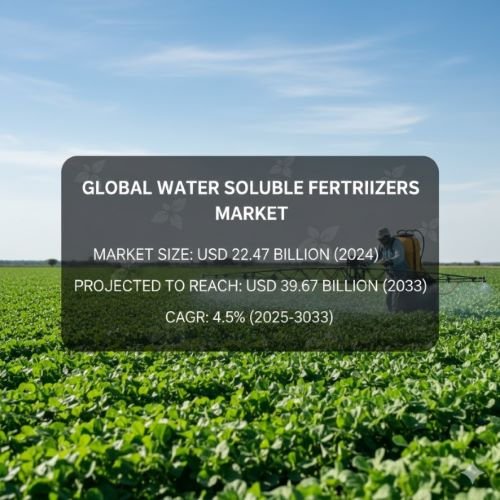
The global water soluble fertilizers market size was estimated at USD 22.47 billion in 2024 and is projected to reach USD 39.67 billion by 2033, growing at a CAGR of 4.5% from 2025 to 2033.
Size, byProduct, 2024 - 2032{USD Billion} The global water soluble fertilizers market size is growing at a CAGR of 4.5% from 2025 to 2033. request a free sample copy
Global Water Soluble Fertilizers Market By Type, By Composition (Straight and Complex), By Grade (NPK, NP, PK and Others), By Structure, By Application, By Crop, By Region, By Sales Channel, Competition Forecast and Opportunities, 2011-2021
The rising demand for high-efficiency fertilizers primarily drives the growth of the market to support precision farming and controlled nutrient delivery.
Key Market Trends & Insights
Asia Pacific dominated the water soluble fertilizers market with the largest revenue share of 36.7% in 2024.
The market in China is expected to grow at a significant CAGR of 7.0% from 2025 to 2033.
By product, the water soluble NPK segment is expected to grow at a CAGR of 4.3% from 2025 to 2033 in revenue.
By crop type, the horticultural openfield segment held the largest revenue share of 38.7% in 2024 in value.
By application, regarding value, the fertigation segment held the largest revenue share of 38.2% in 2024.
Market Size & Forecast
2024 Market SizeUSD 22.47 Billion
2033 Projected Market SizeUSD 39.67 Billion
CAGR (2025-2033)4.5%
Asia PacificLargest market in 2024
North AmericaFastest growing market
Increasing adoption of fertigation and foliar application techniques, coupled with the shrinking availability of arable land, is compelling farmers to shift toward nutrient-efficient solutions. Growing awareness regarding sustainable agriculture practices and favorable government initiatives promoting water-efficient and high-yield crop production further accelerate market expansion.
The market presents significant growth opportunities driven by the rapid expansion of greenhouse cultivation, vertical farming, and precision agriculture across emerging economies. Technological advancements in fertigation systems and increased investment in sustainable agricultural inputs enable broader market penetration. Moreover, rising demand for specialty and high-value crops such as fruits, vegetables, and ornamentals, particularly in export-oriented regions, offers lucrative prospects for product innovation and portfolio diversification among market players.
Despite strong growth potential, the market faces challenges such as high initial costs associated with fertigation infrastructure and limited awareness among small-scale farmers in developing regions. Additionally, concerns over nutrient leaching and soil degradation due to excessive or improper application of water-soluble fertilizers pose regulatory and environmental hurdles. The fragmented distribution channels and dependency on weather-sensitive crop cycles also impact consistent market demand and profitability for manufacturers and distributors.
Market Concentration & Characteristics
The market is moderately fragmented, with a few global players, such as Agrium Inc., Potash Corp, Israel Chemicals Limited, and The Mosaic Company, dominating the competitive landscape. These companies benefit from their scale of operations, competitive pricing, and diversified product offerings. They are actively investing in research and development, expanding production capacities, and focusing on sustainable practices to strengthen their positions in the competitive market.
Leading players in the market are adopting strategies including product innovation, strategic partnerships, and geographic expansion to strengthen their market position. Companies invest in R&D to develop crop-specific and micronutrient-enriched formulations that enhance yield and nutrient uptake efficiency. Collaborations with agritech firms and drip irrigation solution providers enable integrated offerings for precision agriculture.
Report Coverage & Deliverables
Product Insights
The water-soluble NPK segment held the largest revenue share of 19.9% in 2024 due to its balanced nutrient composition, high compatibility with fertigation systems, and wide applicability across various crops and soil types. Its customizable formulations allow growers to deliver precise ratios of nitrogen (N), phosphorus (P), and potassium (K) tailored to specific crop stages, optimizing plant health and maximizing yield potential. With increasing global emphasis on efficient nutrient use and sustainable farming practices, the demand for water-soluble NPK fertilizers has surged, particularly in high-value horticulture, greenhouse cultivation, and precision agriculture systems. The segment also benefits from its versatility across various geographies and ability to effectively support soil and foliar applications.
Other key product segments also contribute significantly to the market. Calcium nitrate and potassium nitrate are favored for fruit and vegetable crops due to their quick solubility and role in improving fruit firmness and shelf life. Urea phosphate and mono potassium phosphate (MKP) are increasingly used in fertigation for their high phosphorus content and acidity, enhancing nutrient availability in alkaline soils. Magnesium nitrate and magnesium sulfate support chlorophyll synthesis and are widely adopted in micronutrient programs, especially for leafy vegetables and cash crops. Ammonium nitrate, ammonium sulfate, and urea ammonium nitrate continue to be preferred in large-scale field crops for their high nitrogen content. At the same time, monoammonium phosphate (MAP) is valued for early root development. The Others category, comprising specialty blends and micronutrient-enriched formulations, is gaining traction with the rising demand for crop-specific and soil-condition-based fertilization. Overall, while water-soluble NPK leads the market, the diversity of crop needs and regional soil conditions continues to drive a broad product mix across global applications.
Crop Insights
The horticultural open-field segment accounted for the largest revenue share of 38.2% in 2024, primarily due to the extensive global cultivation of fruits, vegetables, and other high-value crops in open-field conditions. These crops are highly sensitive to nutrient deficiencies and require consistent management to ensure optimal yield and quality. Water soluble fertilizers are particularly favored in this segment as they enable targeted and efficient nutrient application through fertigation and foliar methods, minimizing nutrient loss and improving plant uptake. Openfield horticulture also benefits from rising consumer demand for fresh produce, especially in export-oriented regions such as Asia Pacific and Latin America. This has driven large-scale adoption of water soluble fertilizers among commercial growers.
Water Soluble Fertilizers Market Share
Other segments also contribute meaningfully to market growth. The horticultural greenhouse segment is expanding steadily, supported by the growing popularity of controlled-environment agriculture for year-round cultivation of premium fruits, vegetables, and floriculture crops. Greenhouse operations rely heavily on fertigation systems and precision nutrient management, creating strong demand for high-performance water soluble formulations. The Field Crops segment, while traditionally dominated by conventional fertilizers, is witnessing increased use of water soluble variants to enhance nutrient efficiency and support sustainable practices in large-scale farming. The Turf & Ornamental segment caters to landscape management, nurseries, and golf courses, where aesthetics and uniform growth are critical. The Others category includes specialty and industrial crops, such as medicinal plants and herbs, which are increasingly benefiting from tailored nutrient solutions. Together, these segments reflect the diverse and expanding application scope of water soluble fertilizers across global agriculture.
Application Insights
By application, fertigation segment dominated the market share with 38.2% in 2024 due to its efficiency in delivering nutrients directly through irrigation systems, ensuring uniform distribution and optimal absorption by plant roots. This method is widely adopted in large-scale field and horticultural crop cultivation, particularly in regions with advanced irrigation infrastructure such as Europe, North America, and the Asia Pacific. Fertigation enables precise nutrient management, reduces wastage, and supports sustainable agriculture by minimizing runoff and environmental impact. As precision farming gains momentum, the integration of water soluble fertilizers into fertigation systems is expected to grow substantially.
On the other hand, the foliar application segment is gaining prominence for its ability to provide quick nutrient uptake, especially during critical growth stages or when root absorption is limited due to soil constraints. This method is highly effective for micronutrient delivery and is widely used in high-value crops such as fruits, vegetables, and ornamental plants. Foliar application is beneficial in correcting visible nutrient deficiencies and enhancing crop resilience under stress conditions. Its cost-effectiveness and compatibility with integrated pest and disease management practices make it an increasingly popular choice among small to medium-scale farmers worldwide.
Regional Insights
Asia Pacific held the largest revenue share, 36.7%, in 2024, fueled by increasing population-driven food demand, shrinking arable land, and rising adoption of modern agricultural practices. Countries across the region are investing in precision irrigation technologies, greenhouse farming, and high-efficiency fertilizers to boost productivity and crop quality.
Global Water Soluble Fertilizers Market – Regional Size Table (2024–2033)
| Region | 2024 (USD Billion) | 2027 (USD Billion) | 2030 (USD Billion) | 2033 (USD Billion) | 2025–2033 CAGR | Key Growth Drivers |
|---|---|---|---|---|---|---|
| North America | 5.10 | 5.90 | 6.75 | 7.60 | 3.8% | High adoption of fertigation, greenhouse farming, and precision agriculture |
| Europe | 4.80 | 5.50 | 6.30 | 7.10 | 3.9% | Growth in horticulture, controlled environment agriculture, and sustainability regulations |
| Asia Pacific | 10.20 | 12.10 | 14.10 | 16.80 | 5.3% | Expanding protected farming, greenhouse adoption, high fertilizer consumption in China, India, Southeast Asia |
| Latin America | 1.90 | 2.30 | 2.70 | 3.15 | 4.0% | Growth in high-value crops, fertigation adoption, and modern irrigation systems |
| Middle East & Africa | 0.47 | 0.63 | 0.82 | 0.98 | 5.0% | Increasing adoption of precision agriculture, water-efficient fertigation, and greenhouse projects |
| Total (Global) | 22.47 | 26.53 | 30.67 | 39.67 | 4.5% | Driven by rising demand for high-yield crops, horticulture, and controlled environment agriculture |
Water Soluble Fertilizers Market Trends, by Region, 2025 - 2033
China Water Soluble Fertilizers Market Trends
China, the leading agricultural economy in the region, holds a substantial share in the Asia Pacific watersoluble fertilizers market. The country is undergoing a structural shift toward sustainable agriculture, driven by national policies to reduce chemical fertilizer use and improve nutrient efficiency.
Europe Water Soluble Fertilizers Market Trends
Europe held the second largest revenue share of 28.5% in 2024, driven by its strong regulatory emphasis on sustainable agriculture, efficient water use, and nutrient management. The region benefits from advanced farming infrastructure, widespread adoption of fertigation in greenhouse cultivation, and a high level of awareness regarding the environmental impacts of conventional fertilizers.
Germany Water Soluble Fertilizers Market Trends
Germany, as one of Europe’s leading agricultural and Turf and ornamental economies, plays a pivotal role in advancing the water soluble fertilizers market through its focus on innovation, precision farming, and environmental stewardship. German farmers increasingly prefer crop-specific, water-efficient fertilizer solutions, particularly in protected cultivation and high-value crop segments.
North America Water Soluble Fertilizers Market Trends
North America held the second largest revenue share of 22.8% in 2024. It represents a mature and technologically advanced market for water soluble fertilizers, driven by widespread adoption of precision farming, fertigation systems, and controlled-environment agriculture. The region benefits from strong institutional support, advanced irrigation infrastructure, and a high level of awareness among farmers regarding nutrient management and sustainability.
US Water Soluble Fertilizers Market Trends
The US, as the largest market within North America, plays a critical role in shaping regional trends through its large-scale agricultural operations, robust R&D ecosystem, and active regulatory frameworks promoting environmentally responsible farming practices.
Latin America Water Soluble Fertilizers Market Trends
Latin America is emerging as a high-potential market for water soluble fertilizers, supported by the expansion of export-driven agriculture and increasing adoption of modern irrigation systems. Countries such as Brazil and Chile are witnessing strong demand for high-value crops, including fruits, vegetables, and coffee, which require precise nutrient management for quality and yield optimization.
Middle East & Africa Water Soluble Fertilizers Market Trends
Middle East & Africa (MEA) is also experiencing steady growth in the water soluble fertilizers market, largely driven by the need to optimize agricultural output in arid and semi-arid regions. With limited water resources and challenging soil conditions, farmers in countries such as Saudi Arabia, the UAE, Egypt, and South Africa are increasingly adopting water-efficient fertilization techniques.
Key Water Soluble Fertilizers Company Insights
Key players, such as Agrium Inc., Potash Corp, Israel Chemicals Limited, and The Mosaic Company, are dominating the market.
Israel Chemicals Limited (ICL) is a globally diversified specialty minerals and chemicals company with a strong presence in the fertilizers sector. The company produces a wide range of water-soluble macro- and micro-nutrient fertilizers, including potash, phosphates, and specialty plant nutrition products, serving agricultural markets, food manufacturers, and Turf & ornamental customers. Leveraging its integrated operations, ICL controls the value chain from mining and raw-material processing to advanced formulation and distribution, enabling it to deliver tailored nutrient solutions and controlled-release technologies. With significant production capacity in Israel, Europe, and North America and robust investment in R&D and sustainable innovation, ICL targets both large-scale agriculture and high-value horticultural segments across global markets.
Key Water Soluble Fertilizers Companies
The following are the leading companies in the water soluble fertilizers market. These companies collectively hold the largest market share and dictate industry trends.
Agrium Inc.
Potash Corp
Israel Chemicals Limited
The Mosaic Company
K+S AG
EuroChem
Yara International ASA
Coromandel International Limited
Compo GmbH & Co. KG
Hebei Monband Water Soluble Fertilizer Co., Limited
Water Soluble Fertilizers Market Report Scope
Report Attribute
Details
Market size value in 2025
USD 24.08 billion
Revenue forecast in 2033
USD 39.67 billion
Growth rate
CAGR of 4.5% from 2025 to 2033
Base year for estimation
2024
Historical data
2021 - 2023
Forecast period
2025 - 2033
Quantitative units
Revenue in USD million/billion, Volume in Kilotons, and CAGR from 2025 to 2033
Report coverage
Revenue forecast, company ranking, competitive landscape, growth factors, and trends
Segments covered
Product, crop, application, region
Regional scope
North America; Europe; Asia Pacific; Middle East & Africa; Latin America
Country scope
U.S.; Canada; Mexico; Germany; UK; France; Italy; Spain; China; India; Japan; South Africa; Saudi Arabia
Key companies profiled
Agrium Inc.; Potash Corp; Israel Chemicals Limited; The Mosaic Company; K+S AG; EuroChem; Yara International ASA; Coromandel International Limited; Compo GmbH & Co. KG; Hebei Monband Water Soluble Fertilizer Co. Limited
Customization scope
Free report customization (equivalent up to 8 analysts’ working days) with purchase. Addition or alteration to country, regional & segment scope.
Pricing and purchase options
Avail customized purchase options to meet your exact research needs. Explore purchase options
Global Water Soluble Fertilizers Market Report Segmentation
This report forecasts revenue growth at the global, regional, and country levels and provides an analysis of the latest industry trends in each of the sub-segments from 2018 to 2033. For this study, Grand View Research has segmented the global water soluble fertilizers market report based on crop, technology, resin, and region.
Product Outlook (Volume, Kilotons; Revenue, USD Million; 2021 - 2033)
Ammonium Nitrate
Ammonium Sulphate
Calcium Nitrate
Potassium Sulphate
Potassium Nitrate
Monoammonium Phosphate (MAP)
Mono Potassium Phosphate (MKP)
Urea Phosphate
Magnesium Nitrate
Magnesium Sulfate
Water-soluble NPK
Urea
Urea Ammonium Nitrate
Others
Crop Outlook (Volume, Kilotons; Revenue, USD Million; 2021 - 2033)
Horticultural Openfield
Horticultural Greenhouse
Field Crops
Turf & Ornamental
Others
Application Outlook (Volume, Kilotons; Revenue, USD Million; 2021 - 2033)
Fertigation
Foliar
Raw Material
Regional Outlook (Volume, Kilotons; Revenue, USD Million; 2021 - 2033)
North America
U.S.
Canada
Mexico
Europe
Germany
UK
France
Italy
Spain
Asia Pacific
China
Japan
India
South Korea
Middle East & Africa
South Africa
Saidi Arabia
Latin America
Brazil
Argentina