
Claim a Free Sample
Get a preview with key statistics, projections, and trends for this report. Ideal for quick insights.
Send Me a SampleNeed full access?
Purchase ReportMarket Size & Trends
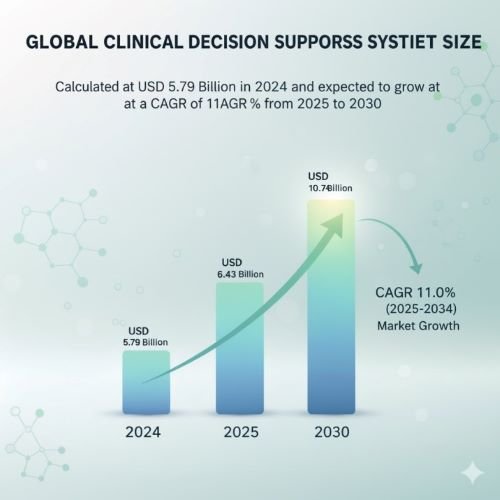
The size of the global clinical decision support systems market was calculated at USD 5.79 billion in 2024 and is expected to grow at a CAGR of 11.0% from 2025 to 2030.
Size, byProduct, 2024 - 2032{USD Billion} clinical decision support systems market was calculated at USD 5.79 billion in 2024 and is expected to grow at a CAGR of 11.0% from 2025 to 2030. request a free sample copy
Clinical Decision Support Systems Market Size, Share & Trends Analysis Report By Product (Standalone CDSS, Integrated EHR with CDSS), By Application (Drug-Drug Interactions), By Delivery Mode, By Component, By Region, And Segment Forecasts
Clinical decision support systems (CDSSs) have witnessed tremendous development over the last few decades, offering clinicians critical tools to inform their decisions in patient care. CDSSs have emerged as a promising way to enhance patient outcomes and decrease overall healthcare expenditure.
AI and ML technology is revolutionizing the CDSS market by providing more sophisticated functionalities like predictive analytics, pattern detection, and personalized recommendations. AI-based CDSSs are capable of processing huge volumes of data, identifying patterns, predicting outcomes, and recommending the best treatment protocols. Researchers are combining AI with CDSS, as evidenced by University of Texas at Austin's Dell Medical School researchers who created an AI-driven CDSS to support clinicians in discussing diet and making decisions with patients regarding diet improvement in December 2022.
Personalized medicine is gaining increasing adoption, where CDSSs are instrumental in this. The systems use patient information, such as genetic markers and medical history, to personalize individual treatment regimes. With CDSSs, treatment becomes more effective, while the likelihood of adverse effects declines, thus expanding the market.
Governments globally are introducing regulations and incentives to enhance CDSS and other health IT solutions. These regulations aim to improve patient safety, interoperability, and quality of care, and as a result, healthcare organizations are investing in CDSS in order to meet regulatory requirements and be eligible for incentives.
The COVID-19 pandemic has also contributed towards the positive growth in the market, causing greater adoption of CDSS. CDSSs have played a key role in aiding patient resources and services, as evidenced by their application in real-time clinical diagnosis of COVID-19 and patient triage. Online services offered by different countries have further boosted market growth. Market players have launched CDSSs for handling COVID-19 data and insights. For example, Epocrates introduced an innovative tool for long COVID-19 in May 2022, incorporating the latest updates to enhance the library of clinical decision support guidelines. As a result, the growth in adoption and introduction of clinical decision support systems has driven market growth during the pandemic.
Report Coverage & Deliverables
- Competitive benchmarking
- Historical data & forecasts
- Company revenue shares
- Regional opportunities
- Latest trends & dynamics
AI-Driven Clinical Decision Support Systems Market
Scientists are incorporating AI into Clinical Decision Support Systems (CDSS) to analyze large amounts of data to suggest treatment approaches, indicate potential problems, simplify operations, and assist medical practitioners. Thus, scientists are combining CDSS with AI. For example, in December 2022, the researchers from the University of Texas at Austin's Dell Medical School created an AI-driven CDSS to aid clinicians in counseling about nutrition and sharing decision-making with patients regarding dietary improvement.
Using patient health information, such as data from electronic health records (EHRs), clinical decision support systems powered by artificial intelligence improve the precision of diagnoses, treatments, and prognoses for particular medical conditions. AI CDSS forecast medical outcomes or evaluate disease risk using biomedical imaging data. AI CDSS can review past, present, and new patient data to detect safety issues, mistakes, or possibilities for improving care pathways. Their accurate predictive potential creates new avenues for improving patient care.
Market Concentration & Characteristics
The level of innovation within the industry for clinical decision support systems is high. The innovation includes integrating higher-level technologies such as machine learning (ML) and artificial intelligence (AI) and the provision of continuous feature updates that improve operational effectiveness. For example, in November 2023, GE HealthCare introduced AI models to forecast patient response to immunotherapies. They will be applied to clinical decision support and pharma drug development.
The market has a high level of M&A activities. The players in the market execute various activities like mergers & acquisitions, collaborations, and product launches to enhance their product portfolio, thereby leading to the growth of the market. For example, in October 2022, Beckman Coulter Diagnostics acquired StoCastic, LLC., which provides evidence-based decision support to hospital emergency departments (ED). The acquisition will enhance Beckman Coulter Diagnostics' CDSS portfolio.
Regulatory agencies, like the FDA, oversee the CDSS business. For example, in September 2022, the U.S. FDA posted finalized and updated guidance documents, including Final CDS Guidance, on topics covering clinical decision support software and other digital health topics.
Key players are concentrating on geographic expansion to grab new geographic CDSS markets. Expansion is usually achieved by opening manufacturing plants or R&D units in new geographies or mergers and acquisitions of firms based in other countries
Product Insights
Stand-alone CDSS had the highest market share of 30.7% in 2024, as it is used extensively due to its low cost and ease of use. They do not need standardization or high clinical expertise and can function without actual patient data. Their ease of use leads to dominance in hospitals and clinics.
The combined EHR with CDSS segment will grow at the highest CAGR over the forecast period due to growing EHR adoption across multi-specialty health centers. The integrated systems enable CDSSs to have access to patient histories and databases and automate clinical workflows. In April 2023, the US government released a proposed rule offering providers broader access to data in their EHR systems to assess CDSS algorithms and results. Integration of CDSSs with EHRs standardizes workflow and utilizes existing data. Furthermore, increasing numbers of CDSS capabilities are integrated into EHR systems, assisting segment growth
Application Insights
Drug allergy alerts held the largest market share of 25.7% in 2024. Some individuals have allergies towards certain drugs, and hence, it is crucial to have systems that issue allergy alerts. since it is largely used in clinical decision support systems (CDSSs) for improving patient safety and avoiding adverse drug reactions (ADRs). CDSSs enable the personalization of alerts based on a patient's profile and particular allergy data. Healthcare professionals can customize alert thresholds and preferences to be relevant and actionable for every patient. The increasing burden of drug allergies is promoting CDSS adoption, driving segment growth. For instance, around 10% of the U.S. population is penicillin-allergic, as per the CDC.
The clinical guidelines segment will grow at the highest CAGR throughout the forecast period. Clinical Decision Support (CDS) systems offer guidance for diagnosis and treatment, presenting necessary real-time information mainly at the point of care. These systems perform routine tasks automatically, notify clinical teams about possible issues, and offer suggestions for evaluating healthcare professionals and patients. For example, the American Medical Informatics Association (AMIA) defines Clinical Decision Support as a tool for improving health-related decision-making and action, equipping clinicians, patients, and stakeholders to better improve clinical decision-making processes, healthcare service quality, and patient outcomes.
Component Insights
CDSS services commanded the highest market share of 42.3% in 2024, as it provides implementation, training, support, customization, and consulting services to enable healthcare organizations to derive maximum value from CDSS software and optimize clinical decision-making. The segment led the market as ongoing technical support guarantees CDSS functionality and performance. Moreover, healthcare professionals need training to utilize CDSS effectively, further driving segment growth.
CDSS software segment is expected to expand at the highest CAGR over the forecast period. The CDSS software, when combined with software for CPOE and EHRs, offers stronger decision support by presenting personalized and tailored results for the specific patient. New innovations for technical support, software interoperability, and effective outcomes are expected to propel the market in the forecast period. For example, in July 2022, QIAGEN revealed that its CDS software platform, QIAGEN Clinical Insights (QCI), was used to review more than three million patient molecular profiles for cancerous and inherited diseases.
Delivery Mode Insights
On-premise segment in delivery mode led the market with the highest share of 41.9% in 2024. On-premise CDSS solutions provide customization and integration flexibility with current healthcare systems and workflows to meet specific organizational requirements. Multispecialty hospitals and large healthcare organizations opt for this system for better data control within their infrastructure. Incorporating existing systems such as EHRs allows for better data flow and interoperability, leading to improved efficiency in decision support.
Cloud-based systems are anticipated to expand at the highest CAGR during the forecast period. As a major IT innovation, they provide reliability and affordability. Greater accessibility through mobile platforms and comprehensive data protection solutions fuel their popularity. In contrast to web-based systems, cloud solutions are independent of web browsers, which makes them more secure and user-friendly.
Regional Insights
North America clinical decision support systems market led the world market with more than 43.10% revenue market in 2024.This is driven by increased demand for IT solutions within the healthcare sector and the focus on providing quality healthcare services. Increased technological innovation is driving the growth of the market. Programs championing the use of CDSS, such as EBSCO Information Services' launch of its Dyna Innovation Center in December 2023, drive regional market growth. For example, in December 2023, EBSCO Information Services opened Dyna Innovation Center in the U.S. to foster innovation in clinical decision-making. Therefore, such moves by the market players are likely to help the CDSS market in the region grow.
Global Clinical Decision Support Systems Market Size by Region (2024–2030)
| Region | Market Size (2024, USD Billion) | Share (%) | CAGR (2025–2030) | Projected Market Size (2030, USD Billion) | Key Growth Drivers |
|---|---|---|---|---|---|
| North America | 2.48 | 42.8% | 10.5% | 4.50 | High adoption of EHR-integrated CDSS, advanced healthcare IT infrastructure, supportive regulations, and strong presence of key market players. |
| Europe | 1.55 | 26.8% | 10.8% | 2.80 | Growing focus on patient safety, rising adoption of AI-driven CDSS, government initiatives for healthcare IT modernization, and regulatory support. |
| Asia-Pacific | 1.20 | 20.7% | 13.0% | 2.38 | Increasing healthcare IT investments, rising demand for advanced clinical solutions, growing hospital networks, and adoption of cloud-based CDSS. |
| Latin America | 0.30 | 5.2% | 11.2% | 0.56 | Expanding hospital infrastructure, growing awareness of clinical decision support, and increasing adoption in emerging markets such as Brazil and Mexico. |
| Middle East & Africa (MEA) | 0.26 | 4.5% | 11.5% | 0.50 | Growing adoption of healthcare IT, rising demand for improved patient outcomes, and government initiatives to modernize hospitals and clinics. |
| Total (Global) | 5.79 | 100% | 11.0% (overall) | 10.74 | — |
U.S. Clinical Decision Support Systems Market Trends
CDSS market in the United States captured the largest share in 2024. Growth is fuelled by rising use of EHRs among hospitals and healthcare organizations. For example, based on the Office of the National Coordinator for Health Information Technology, in 2021, around 78% of physicians and 96% of hospitals employed a certified EHR.
Europe Clinical Decision Support Systems Market Trends
European CDSS market is likely to hold a significant market share during the forecast period. It is growing owing to the availability of prominent players, growing implementation of CDSS, and the supportive frameworks. For example, in February 2024, the European Commission published a document to highlight and encourage the use of clinical decision support tools.
UK clinical decision support systems market is expected to register high growth with the growing implementation of sophisticated healthcare IT solutions. Likewise, effective collaborations strategies among healthcare and IT sectors in the UK and government support, is anticipated to drive the nation's market growth. For example, in June 2023, the UK government pledged about USD 22.7 million of funds to implement AI-powered decision support systems for stroke, cancer, and heart disease early diagnosis.
Asia Pacific Clinical Decision Support Systems Market Trends
CDSS market of Asia Pacific will have the fastest CAGR during the forecast period. The reason for the growth lies in the growing investments by the healthcare sector in nations like China, Japan, India, and Australia. Asia Pacific's market is demonstrating high potential as a result of increasing R&D spending by governments of major regional economies to enhance information technology penetration in the healthcare industry. Major companies in this market include MedPac Systems Solutions India LLP, Allscripts Healthcare Solutions, Inc., Practo, Cerner Corp., and Koninklijke Philips N.V.
Australia clinical decision support systems market is primarily driven by the growing adoption and endorsement of CDSS, particularly by government agencies. For example, in April 2022, Northern Territory (NT) Health collaborated with Alcidion to gain access to the sophisticated Miya Precision CDS platform. NT Health will implement the CDS platform in its five public hospitals and remote and community health centers that provide services to over 200,000 individuals. The CDS platform was to facilitate the network's bed and patient flow management within NT hospitals and satellite facilities.
China clinical decision support systems market is anticipated to grow at a high CAGR due to various business initiatives taken by the market players. For example, in June 2023, AffaMed Therapeutics released Headache CDSS in collaboration with the International Headache Center of the Chinese PLA General Hospital at the 16th Annual Meeting of Neurologists of the Chinese Medical Association.
Key Clinical Decision Support Systems Company Insights
The global CDSS market is fairly competitive. The most notable participants in the market are McKesson Corporation; Philips Healthcare; Wolters Kluwer NU; Cerner Corporation; Siemens Healthineers, along with other providers of clinical decision support systems. These players are involved in new product launches, product innovations, acquisitions, and partnerships to gain a competitive edge over each other.
Key Clinical Decision Support Systems Companies
The following are the leading companies in the clinical decision support systems market. These companies collectively hold the largest market share and dictate industry trends.
- McKesson Corporation
- Cerner Corporation
- Siemens Healthineers GmbH
- Allscripts Healthcare, LLC
- athenahealth, Inc.
- NextGen Healthcare Inc.
- Koninklijke Philips N.V. (Royal Philips)
- IBM Corporation
- Agfa-Gevaert Group
- Wolters Kluwer N.V.
- Becton, Dickinson and Company
- Cabot Technology Solutions
- GE HealthCare
- Nordic
- BeeKeeperAI
- BSCO Industries, Inc.
Recent Developments
-
In April 2025, Becton, Dickinson and Company launched next-generation HemoSphereAdvanced Monitoring Platform, integrating AI-driven clinical decision support to enhance real-time hemodynamic monitoring.
-
In December 2023, EBSCO Information Services launched the Dyna Innovation Center in the U.S. to promote advancements like the integration of AI, in clinical decisions
-
In October 2023, Wolters Kluwer Health launched AI Labs, a collective resource to integrate generative AI with UpToDate, its CDS solution, enabling medical professionals to make better-informed decisions.
-
In August 2023, GE HealthCare launched CardioVisio for Atrial Fibrillation, a patient-centric, digital CDS tool to allow precision care.
-
In February 2023, EBSCO Information Services launched new features in DynaMedex Mobile App to improve clinical decision support. These enhancements improve the mobile experience for users by enabling clinicians to deliver evidence-based patient care efficiently.
-
In May 2020, DHIndia announced a partnership with EHRC@IIITB & Healthelife to develop a CDSS for the screening of COVID-19. The partnership also included the formation of a minimal triage application for front-line doctors. Some of the prominent players in the global clinical decision support systems market include
-
In March 2020, IBM Watson Health partnered with EBSCO Information Services to enhance CDSS and operations for healthcare systems and providers.
Clinical Decision Support Systems MarketReport Scope
|
Report Attribute |
Details |
|
Market size value in 2025 |
USD 6.36 billion |
|
Revenue forecast in 2030 |
USD 10.71 billion |
|
Growth rate |
CAGR 11.0% from 2025 to 2030 |
|
Actual data |
2018 - 2024 |
|
Forecast period |
2025 - 2030 |
|
Quantitative units |
Revenue in USD million/billion and CAGR from 2025 to 2030 |
|
Report coverage |
Revenue forecast, company ranking, competitive landscape, growth factors, and trends |
|
Segments covered |
Product, application, delivery mode, component, region |
|
Regional scope |
North America; Europe; Asia Pacific; Latin America; MiddleEast and Africa |
|
Country scope |
U.S.; Canada; Germany; UK; France; Italy; Spain; Norway, Sweden, Denmark, Japan; India; China; Australia; Thailand; South Korea; Brazil; Mexico; Argentina, South Africa; Saudi Arabia; UAE; Kuwait |
|
Key companies profiled |
McKesson Corporation; Cerner Corporation; Siemens Healthineers GmbH; Allscripts Healthcare, LLC; athenahealth, Inc.; NextGen Healthcare Inc.; Koninklijke Philips N.V. (Royal Philips); IBM Corporation; Agfa-Gevaert Group; Wolters Kluwer N.V.; Becton, Dickinson and Company; Cabot Technology Solutions; GE HealthCare; Nordic; BeeKeeperAI; BSCO Industries, Inc. |
|
Customization scope |
Free report customization (equivalent up to 8 analysts working days) with purchase. Addition or alteration to country, regional & segment scope. |
|
Pricing and purchase options |
Avail of customized purchase options to meet your exact research needs. Explore purchase options |
Global Clinical Decision Support Systems Market Report Segmentation
Product Outlook (Revenue, USD Million, 2018 - 2030)
-
-
Standalone CDSS
-
Integrated CPOE with CDSS
-
Integrated EHR with CDSS
-
Integrated CDSS with CPOE & EHR
-
-
Application Outlook (Revenue, USD Million, 2018 - 2030)
-
Drug-drug interactions
-
Drug allergy alerts
-
Clinical reminders
-
Clinical guidelines
-
Drug dosing support
-
Others
-
-
Delivery Mode Outlook (Revenue, USD Million, 2018 - 2030)
-
Web-based Systems
-
Cloud-based Systems
-
On -premise Systems
-
-
Component Outlook (Revenue, USD Million, 2018 - 2030)
-
Hardware
-
Software
-
Services
-
-
Regional Outlook (Revenue, USD Million, 2018 - 2030)
-
North America
-
U.S.
-
Canada
-
Mexico
-
-
Europe
-
Germany
-
UK
-
Italy
-
Spain
-
France
-
Sweden
-
Denmark
-
Norway
-
RoE
-
-
Asia Pacific
-
China
-
India
-
Japan
-
Thailand
-
South Korea
-
Australia
-
RoAPAC
-
-
Latin America
-
Brazil
-
Argentina
-
RoLATM
-
-
MEA
-
South Africa
-
Saudi Arabia
-
UAE
-
Kuwait
-
RoMEA
-
-