
Claim a Free Sample
Get a preview with key statistics, projections, and trends for this report. Ideal for quick insights.
Send Me a SampleNeed full access?
Purchase ReportClimate Tech Market Size & Trends
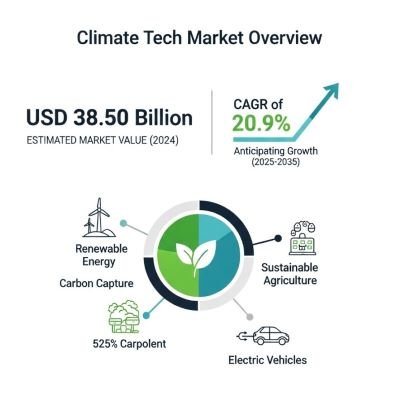
The size of the global climate tech market was estimated to be USD 38.50 billion in 2024 and is anticipated to expand at a CAGR of 20.9% from 2025 to 2035.
Climate Tech Market Size, Share & Trends Analysis Report By End User (Energy & Utilities, Manufacturing Industries, Agricultural Enterprises), By Technology, By Region, And Segment Forecasts
Size, byProduct, 2024 - 2032{USD Billion}
climate tech market size is anticipated to expand at a CAGR of 20.9% from 2025 to 2035. request a free sample copy
Growth in the market is mainly being fueled by rising regulatory pressure towards carbon neutrality, growing investment in renewable energy schemes, fast innovation in green technologies, increasing corporate commitments towards sustainability, and greater public awareness regarding climate change impacts. Governments globally are enforcing tougher environmental regulations, compelling industries to embrace low-carbon technologies and driving demand for climate technologies. Large corporations are making bold net-zero commitments, further propelling the transition to clean energy, carbon capture, and sustainable agriculture technologies.
Increasing government regulations and carbon neutrality objectives are transforming the climate tech sector as companies are increasingly being forced to invest in cleaner, greener technologies. Climate tech firms are creating solutions like carbon capture systems, clean energy platforms, and energy-efficient products to assist industries in meeting new environmental requirements. Regulatory pressures are compelling and forcing companies in various sectors to implement green technologies. The increased focus on achieving net-zero emissions is radically altering the climate tech industry landscape.
Also, the spurt in green energy investments is contributing significantly towards driving industry expansion, as private sectors and governments increasingly invest in solar, wind, and other clean energy technologies. This movement is generating an immense need for cutting-edge climate tech solutions to maximize energy generation, storage, and transmission. Firms are concentrating on coming up with state-of-the-art technologies that will increase efficiency while minimizing environmental harm. This increasing focus on clean energy uptake continues to spur the development of the climate tech sector.
Additionally, the boom in renewable energy uptake is gathering pace as businesses aim to de-risk from fossil fuels and reduce their carbon impact. Breakthroughs in solar, wind, and energy storage technologies are increasingly making clean energy affordable, efficient, and available. This transition to renewable energy sources is propelling the creation of new climate tech solutions that are centered on energy efficiency, grid modernization, and smart energy management. The growing dependence on renewables is transforming the way climate technologies are being deployed, thus fueling the expansion of the climate tech industry.
In addition, the increase in climate investments and funding is substantially driving the creation of new technologies and solutions. Climate tech firms are drawing considerable capital from venture capital, private equity, and government programs to speed up the shift to a low-carbon economy. This funding trend is facilitating fast innovation, scaling up sustainable technologies, and the growth of climate-specialized startups, fueling overall market expansion.
Report Coverage & Deliverables
- Competitive benchmarking
- Historical data & forecasts
- Company revenue shares
- Regional opportunities
- Latest trends & dynamics
End User Insights
The energy & utilities sector ruled the market with a revenue of more than 33% in 2024, led by the rising sophistication of energy infrastructure, the desire for sustainable energy solutions, and the demand for innovation in renewable energy technologies. As industries turn towards cleaner forms of energy, businesses are moving towards sophisticated climate tech solutions that provide efficient and cost-effective methods to tap into solar, wind, tidal, and other alternative energies.
To address these demands, companies are outsourcing energy system design, energy storage, and smart grid technology to specialized service providers who have the capability to provide high-performance, scalable solutions. This, combined with increased global energy needs and sustainability ambitions, cements the leadership of the energy & utilities segment within the climate tech market.
The transportation & logistics companies segment is likely to see a strong CAGR of more than 24% between 2025 and 2030. This is on account of growing demand for green solutions throughout the transport industry as companies look to minimize emissions and maximize energy efficiency. As the transport sector aims to maximize its environmental impact, the use of clean energy technologies like electric vehicles (EVs), hydrogen fuel cells, and renewable energy-based logistics is growing exponentially.
Also, the incorporation of cutting-edge technologies such as AI, IoT, and automation to streamline route planning, fuel efficiency, and supply chain effectiveness is further driving market growth. The emergence of green logistics with an emphasis on emission reduction and minimizing environmental footprints is driving the growth of the transportation & logistics companies segment in the climate tech market.
Technology Insights
The renewable energy technologies segment led the climate tech market and held the highest revenue share in 2024. This is due to huge investments by firms in the deployment and development of sophisticated renewable energy systems, such as solar, wind, and tidal energy technologies. Large corporations, especially in the energy industry, tend to need customized solutions to maximize their intricate energy infrastructure, lower operational expenses, and improve their sustainability initiatives. In addition, the increasing demand for clean energy solutions, aided by regulatory pressures and economic incentives, is driving the demand for more advanced engineering solutions, supporting the market leadership of renewable energy technologies in the climate tech sector.
The sustainableagriculture technologies segment will experience the highest CAGR during the period from 2025 to 2035. As climate change issues intensify and environmental laws tighten, numerous companies are finding themselves increasingly shifting towards cost-effective and scalable technologies to embrace renewable energy technologies. These companies are helped by cloud-based platforms and modular solutions that enable them to deploy clean energy technologies like solar power, wind power, and energy efficiency at a fraction of the expense of conventional means. Moreover, government incentives and funding for promoting clean energy uptake and technological advancement are driving the growth of the sustainable energy technologies industry. These variables cumulatively are anticipated to propel the fast growth of the sustainable agricultural technologies segment over the next few years.
Regional Insights
North America climate tech market accounted for the largest revenue share of over 35% in 2024, primarily driven by the region’s strong commitment to sustainability initiatives and aggressive net-zero targets. The increasing investment in renewable energy projects, electric vehicles, carbon capture technologies, and climate-resilient infrastructure is fueling demand for advanced climate tech solutions. Major corporations and governments across the region are prioritizing climate innovation, creating a favorable environment for startups and established companies to develop and deploy cutting-edge green technologies. The rising availability of climate-focused funding and supportive regulatory frameworks is further accelerating the growth of the climate tech market in the region.
Climate Tech MarketRegional Forecast (2024 - 2035)
The global Climate Tech market encompasses a vast array of technologies and solutions aimed at mitigating and adapting to climate change. This includes renewable energy, energy storage, carbon capture (CCUS), green hydrogen, sustainable agriculture, circular economy, and electrified transport. Growth is driven by a complex mix of regulatory pressures, corporate sustainability goals, technological innovation, and investment flows. The following table provides a detailed regional analysis.
| Region | Estimated Market Size (2024) | Projected CAGR (2025-2035) | Key Growth Drivers & Trends | Leading Countries/Areas & Focus |
|---|---|---|---|---|
| North America | ~USD 12.5 - 14.0 Billion | 19% - 21% | Policy The U.S. Inflation Reduction Act (IRA) is a massive catalyst, providing subsidies and tax credits. Investment High levels of Venture Capital (VC) and private equity funding. Focus Carbon management, renewable energy tech, electric vehicles, and advanced energy storage. | United States, Canada. The U.S. is a global leader in funding and innovation, particularly in deep tech climate solutions. |
| Europe | ~USD 11.0 - 12.5 Billion | 20% - 21.5% | Policy Stringent Green Deal policies, carbon pricing (ETS), and strong regulatory frameworks. Investment Significant public and private commitment to decarbonization. Focus Renewable energy (especially offshore wind), circular economy, green hydrogen, and sustainable building materials. | EU Member States, especially Germany, France, UK, Netherlands, and Nordic Countries. A regulatory-driven leader. |
| Asia-Pacific (APAC) | ~USD 12.0 - 13.5 Billion | 22.5%+ (Highest) | Policy National net-zero commitments (China, India, Japan, S. Korea), energy security drives. Investment Massive government-led investments in manufacturing (solar, batteries) and deployment. Focus Renewable energy deployment, electric mobility, green hydrogen production, and climate resilience tech. | China, India, Japan, South Korea, Australia. China is the dominant force in manufacturing and deployment scale. |
| Latin America (LATAM) | ~USD 1.8 - 2.2 Billion | 23% - 25% | Policy Growing regulatory frameworks, leveraging natural resources. Investment Rising VC interest, project finance for renewables. Focus Green hydrogen production, renewable energy (solar, wind, hydropower), sustainable agriculture, and bioeconomy. | Brazil, Chile, Mexico, Colombia. An emerging high-growth region with immense natural capital. |
| Middle East & Africa (MEA) | ~USD 1.0 - 1.5 Billion | 21% - 24% | Policy Gulf state visions for economic diversification (e.g., UAE, Saudi Arabia). Investment Sovereign wealth funds investing in green tech. Focus Green hydrogen, carbon capture, solar power, and desert agriculture tech. Africa focuses on climate resilience and decentralized renewable energy. | UAE, Saudi Arabia, Israel, South Africa, Kenya. |
U.S. Climate Tech Market Trends
The U.S. climate tech industry is projected to expand at a rate of more than 18.7% CAGR during the period between 2025 and 2035 due to the high emphasis on innovation and sustainability by the nation. Rising government initiatives through policymaking and incentivization for lowering carbon emissions is further driving market expansion. Also, the emergence of climate tech startups and increasing investment by large corporations into renewable energy, carbon capture, and sustainable technology are driving the increasing demand for climate tech solutions throughout the U.S.
Europe Climate Tech Market Trends
Europe climate technology market is set to expand notably between 2025 and 2035. In Europe, the market is dominated by sectors like automotive, renewable energy, manufacturing, and agriculture, all of which are witnessing dramatic change to comply with stringent environmental norms. The ambitious climate targets of the European Union, which are encouraging companies to adopt green technologies and lower their carbon footprint. The growing emphasis on sustainability, combined with the growing need for energy-efficient technologies, is driving climate tech innovation. Moreover, the uptake of Industry 4.0, which focuses on digitalization, automation, and integration with AI, is also boosting the need for sophisticated climate technologies in different industries across Europe.
The UK climate tech industry is expected to grow dramatically over the next few years, spurred by the nation's push towards net-zero emissions. The UK enjoys a robust manufacturing base, and important industries like energy, transportation, and manufacturing are urging cleaner, more efficient solutions. Renewable energy projects increasing, combined with improvements in electric vehicles and energy storage, is fueling demand for creative climate tech solutions. Government initiatives like subsidies on green technologies and funding for low-carbon infrastructure also are adding impetus to the growth of the market.
Germany's climate tech sector is fueled by the nation's strong industrial bases, such as automotive, manufacturing, and renewable energy, which continue to drive the need for innovative climate solutions. Germany's focus on sustainability and its strong ambition to be carbon neutral are compelling companies to embrace energy-efficient technologies and green practices. The increasing focus on energy storage, smart grids, and renewable energy infrastructure is driving a lot of opportunities for climate tech developments. As Germany proceeds towards a green future, its green technology leadership is defining the development of the climate tech industry.
Asia Pacific Climate Tech Market Trends
The Asia Pacific climate tech industry will develop at the highest CAGR during 2025-2035, spurred by fast industrialization, technology innovation, and robust government efforts to foster innovation. The region is witnessing high demand for climate tech solutions because of its rapidly growing manufacturing industries and rising emphasis on renewable energy and sustainable business. Consumer-led demands for green products, coupled with the expanding tech startup scene, are further pushing the adoption of sophisticated climate technology industry in Asia Pacific.
Japan climate technology market is growing, propelled by the country's global leadership in renewable energy, robotics, and energy systems. With ambitious carbon neutrality targets and strict environmental regulations, Japan is creating demand for sophisticated climate tech solutions. Advances in AI, IoT, and automation are maximizing energy efficiency and sustainability, making the climate tech industry crucial to Japan's continued green transition and economic development.
China climate tech market is growing very fast. China's fast industrialization and high focus on tech innovation are major propellers of the growth of the climate tech market. The government's focus on innovation, along with its ambitious green targets and heavy investment in clean tech, is fueling the rollout of climate tech solutions. Moreover, China's emphasis on enhancing sustainability in its production process and fulfilling global environmental standards is making room for a robust ecosystem for climate tech companies. This interplay of regulatory support, industry demand, and sustainability efforts is substantially fueling the market.
Key Climate Tech Company Insights
Some of the major players in the market are Google LLC and Tesla, Inc.
Google LLC is a technology company that operates globally with a focus on offering innovative solutions in a variety of industries, such as cloud computing, AI, and renewable energy. With its heavy focus on sustainability, Google has pledged to power its data centers and offices with 100% renewable energy and hopes to enable other companies and industries to do the same. Through efforts like the creation of AI-driven climate models and collaborations with clean energy firms, Google is assisting in the transition to a low-carbon economy. Google's experience in cutting-edge technologies, combined with its global presence and commitment to sustainability, makes it a key player in the climate tech industry.
Tesla is an American clean energy and electric vehicle (EV) firm dedicated to speeding up the global shift to sustainable energy. The firm's innovative advancements in battery technology, in this case, its future-generation solid-state battery separator, Cobra, are shaping the way toward more efficient and sustainable energy storage. Tesla's technology advancements in energy storage are essential to enabling renewable energy integration and a low-carbon future, positioning it as a key player in the climate tech industry. The application of AI and automation in Tesla's manufacturing processes also increases product efficiency and lowers production costs, driving climate tech solutions in various industries.
Climeworks Limited and Apptunix are some of the new market entrants in the climate tech industry.
Climeworks utilizes state-of-the-art technology to deliver scalable and efficient carbon removal solutions that aid in the global fight against climate change. Climeworks provides end-to-end climate tech solutions, ranging from the design of CO2 capture systems to the storage of captured carbon, allowing industries to meet their carbon neutrality targets. Through the integration of its advanced DAC systems with renewable energy, Climeworks is facilitating the acceleration of the transition to a sustainable and low-carbon future.
Orbital Marine Power is a new climate tech firm with expertise in the creation of tidal energy solutions. Orbital Marine Power is committed to leveraging the energy from ocean tides to produce renewable energy, providing clean alternatives to conventional power generation. With the integration of advanced technologies such as marine engineering, sustainable design, and energy storage systems, the company is driving the shift towards a low-carbon world.
Key Climate Tech Companies
The following are the leading companies in the climate tech market. These companies collectively hold the largest market share and dictate industry trends.
- Google LLC
- Ørsted Services A/S
- Climeworks
- Tesla, Inc.
- Vestas
- Schneider Electric
- QuantumScape Battery, Inc.
- Commonwealth Fusion Systems
- Orbital Marine Power.
- First Solar.
Recent Developments
-
In April 2025, Orbital Marine Power made plans to install the world's largest tidal energy turbine in American waters. The floating turbine is designed to capture strong tidal and river currents, helping add diversity to renewable energy sources. By harnessing advanced tidal energy technology, Orbital Marine Power aims to boost the climate tech industry with a low-carbon, sustainable energy solution. This effort will be instrumental in cutting down on dependence on conventional sources of energy and accelerating the world shift towards clean energy.
In March 2025, Google made public a deal with Kairos Power to deploy between six and seven small modular nuclear reactors (SMRs) in order to provide low-carbon electricity to its data centers. This is the first instance in which a tech firm has ordered nuclear power stations, underscoring Google's commitment to using clean energy alternatives.
In December 2024, Tesla revealed the launching of its state-of-the-art solid-state battery separator equipment called Cobra. Tesla's revolutionary discovery is anticipated to facilitate higher-sample-volume production by 2025, revolutionizing energy storage devices. Through Tesla's Cobra enhancing the capacity and efficiency of the battery systems, the future looks bright for upcoming energy storage products, which hold the key to speeding up renewable energy and electric vehicle adoption.
Climate Tech Market Report Scope
|
Report Attribute |
Details |
|
Market size value in 2025 |
USD 44.74 billion |
|
Revenue forecast in 2030 |
USD 115.40 billion |
|
Growth rate |
CAGR of 20.9% from 2025 to 2035 |
|
Base year for estimation |
2024 |
|
Historical data |
2018 - 2023 |
|
Forecast period |
2025 - 2035 |
|
Quantitative units |
Revenue in USD million/billion and CAGR from 2025 to 2035 |
|
Report Product |
Revenue forecast, company ranking, competitive landscape, growth factors, and trends |
|
Segments covered |
End user, technology, and region |
|
Region scope |
North America; Europe; Asia Pacific; Latin America; MEA |
|
Country scope |
U.S.; Canada; Mexico; UK; Germany; France; China; Australia; Japan; India; South Korea; Brazil; South Africa;Saudi Arabia; UAE |
|
Key companies profiled |
Google LLC; Ørsted Services A/S; Climeworks; Tesla, Inc.; Vestas; Schneider Electric; QuantumScape Battery, Inc.; Commonwealth Fusion Systems; Orbital Marine Power; First Solar |
|
Customization scope |
Free report customization (equivalent to up to 8 analyst’s working days) with purchase. Addition or alteration to country, regional & segment scope. |
|
Pricing and purchase options |
Avail customized purchase options to meet you exact research needs. Explore purchase options |
Global Climate Tech Market Report Segmentation
End User Outlook (Revenue, USD Million, 2018 - 2035)
-
-
Energy & Utilities
-
Manufacturing Industries
-
Transportation & Logistics Companies
-
Agricultural Enterprises
-
Government & Regulatory Bodies
-
Commercial & Residential Sectors
-
Non-profit Environmental Organizations
-
-
Technology Outlook (Revenue, USD Million, 2018 - 2035)
-
Carbon Capture, Utilization, and Storage (CCUS)
-
Renewable Energy Technologies
-
Energy Storage Technologies
-
Climate Risk Monitoring and Data Analytics
-
Sustainable Agriculture Technologies
-
Others
-
-
Regional Outlook (Revenue, USD Million, 2018 - 2035)
-
North America
-
U.S.
-
Canada
-
Mexico
-
-
Europe
-
UK
-
Germany
-
France
-
-
Asia Pacific
-
China
-
Japan
-
India
-
South Korea
-
Australia
-
-
Latin America
-
Brazil
-
Middle East & Africa
-
Saudi Arabia
-
South Africa
-
UAE
-
-
Frequently Asked Questions
The global climate tech market is expected to grow at a compound annual growth rate of 20.9% from 2025 to 2030 to reach USD 115.4 billion by 2030.
The global climate tech market size was estimated at USD 38.5 billion in 2024 and is expected to reach USD 44.7 billion in 2025.
The key players in the climate tech market include Google LLC; Ørsted Services A/S; Climeworks; Tesla, Inc.; Vestas; Schneider Electric; QuantumScape Battery, Inc.; Commonwealth Fusion Systems; Orbital Marine Power.; First Solar.
Key factors driving market growth include increasing regulatory pressure for carbon neutrality, rising investments in renewable energy projects, rapid advancements in green technologies, growing corporate sustainability commitments, and heightened public awareness of climate change.
North America accounted for the largest share of over 35% in 2024 primarily driven by the region’s strong commitment to sustainability initiatives and aggressive net-zero targets. The increasing investment in renewable energy projects, electric vehicles, carbon capture technologies, and climate-resilient infrastructure is fueling demand for advanced climate tech solutions. Major corporations and governments across the region are prioritizing climate innovation, creating a favorable environment for startups and established companies to develop and deploy cutting-edge green technologies. The rising availability of climate-focused funding and supportive regulatory frameworks is further accelerating the growth of the climate tech market in the region.