
Claim a Free Sample
Get a preview with key statistics, projections, and trends for this report. Ideal for quick insights.
Send Me a SampleNeed full access?
Purchase ReportAutomotive Interiors Market Size And Forecast
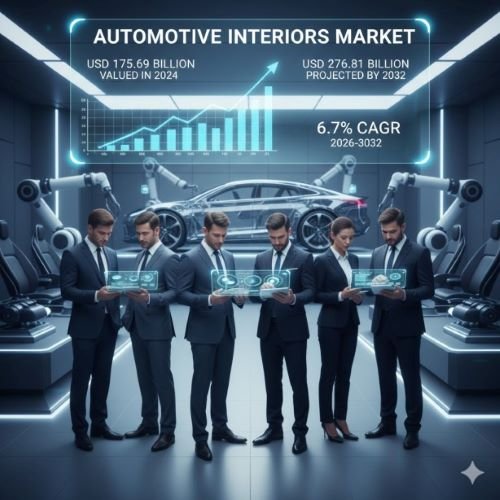
Automotive Interiors Market size was USD 175.69 Billion in 2024 and is expected to reach USD 276.81 Billion by 2032, growing at a CAGR of 6.7% from 2026 to 2032.

Automotive Interior Market by Component (HUD, Door Panel, Dome Module, Seat, Headliner, Center Console, Center Stack & Others), Material Type, Level of Autonomy, Electric Vehicle, Passenger Car Class, ICE Vehicle Type and Region - Global Forecast
Size, byProduct, 2024 - 2032{USD Billion}
CAGR: 6.70%
Automotive Interiors Market size is expected to reach USD 276.81 Billion by 2032, growing at a CAGR of 6.7% from 2026 to 2032. request a free sample copy
Automotive Interior Market by Component (HUD, Door Panel, Dome Module, Seat, Headliner, Center Console, Center Stack & Others), Material Type, Level of Autonomy, Electric Vehicle, Passenger Car Class, ICE Vehicle Type and Region - Global Forecast
Size, byProduct, 2024 - 2032{USD Billion}
Automotive Interiors Market size is expected to reach USD 276.81 Billion by 2032, growing at a CAGR of 6.7% from 2026 to 2032. request a free sample copy
Global Automotive Interiors Market Drivers
The Automotive Interiors Market is a dynamic segment of the overall automotive market, which specifically addresses the wide range of components that form the interior spaces of cars, such as seating, dashboards, headliners, door panels, and other functional and decorative features. The market is divided geographically into some key regions that have unique characteristics shaped by consumer behaviors, economic factors, and technologies.
In North America, the Automotive Interiors Market is spurred by strong consumer demand for technologically sophisticated and luxury interiors with a focus on sustainability and innovation. Europe does the same, with stringent regulatory requirements for sustainability resulting in the use of environmentally friendly materials and design efficiency. The Asia-Pacific region has become an important growth driver with its fast-industrializing economies, manufacturing centers, and rapidly expanding middle class, supporting a rise in vehicle ownership and personalization demand. At the same time, the Middle East and Africa are also experiencing growth fueled by increasing Blood incomes and expanding automotive industry, which is increasingly embracing Western design trends. Finally, Latin America is a region with distinct challenges and opportunities, with an expanding automotive market driven by globalization, regional tastes, and local manufacturing capabilities. All of these geographic regions not only indicate different levels of technological adoption and economic development but also influence the overall demand dynamics and product offerings in the Automotive Interiors Market.
Key Players
The major players in the Automotive Interiors Market are
- Adient
- Lear Corporation
- Faurecia
- Tata Elxsi
- Magna International
- IAC Group
- Seating System
- BASF
- Grupo Antolin
- Toyota Boshoku Corporation
Report Scope
REPORT ATTRIBUTES DETAILS STUDY PERIOD 2021-2032
BASE YEAR 2024
FORECAST PERIOD 2026-2032
Historical Period 2021-2023
UNIT Value (USD Billion)
KEY COMPANIES PROFILED Adient, Lear Corporation, Faurecia, Tata Elxsi, Magna International, Seating System, BASF, Grupo Antolin.
Segments Covered By Component, By Material, By Vehicle Type, and By Geography.
CUSTOMIZATION SCOPE Free report customization (equivalent to up to 4 analyst’s working days) with purchase. Addition or alteration to country, regional & segment scope.
Reasons to Buy this Report
• Qualitative and quantitative study of the market on the basis of segmentation taking into consideration economic as well as non-economic variables
• Presents market value (USD Billion) figures for each segment and sub-segment
• Identifies the region and segment that will grow at the highest rate and also lead the market
• Geographical analysis showing the usage of the service/product in the region and highlighting the factors that are impacting the market in every region
• Competitive landscape including the market ranking of the players, new product/service launches, partnerships, expansions, and acquisitions over the last five years by companies covered
• Comprehensive company profiles consisting of company overview, company insights, product benchmarking, and SWOT analysis of the key market players
• The present as well as the future market scenario of the industry in relation to recent trends which include growth opportunities and drivers as well as challenges and restraints of both emerging as well as developed markets
• Contains comprehensive examination of the market of different outlooks using Porter's five forces analysis
• Gives insights regarding the market through Value Chain
• Scenario of the market dynamics, including market growth opportunities during the years ahead
• 6-month after-sales analyst assistanceAutomotive Interiors Market – Detailed Segmentation & Regional Analysis
Market Segmentation
A. By Component
The market is divided into major interior elements such as infotainment systems, digital instrument clusters, head-up displays, seating systems, interior lighting, door panels, dashboard modules, flooring materials, headliners, and interior safety elements like airbags. These components together shape the vehicle’s comfort, safety, and digital experience.
B. By Material
Key materials used in automotive interiors include
-
Polymers and plastics such as PVC, PP, and ABS.
-
Fabrics used in seats, headliners, and trims.
-
Leather and synthetic leather for premium finishes.
-
Composites for lightweight and durable interior structures.
-
Metals, largely used in frames and internal structural parts.
C. By Vehicle Type
The market serves several vehicle categories
-
Passenger cars including sedans, hatchbacks, and SUVs.
-
Light commercial vehicles (LCVs) used for logistics and transport.
-
Heavy commercial vehicles (HCVs) including buses and trucks.
-
Electric vehicles (EVs) which require more advanced digital cockpit solutions.
D. By Technology
Key technologies include
-
Advanced driver display systems such as multi-screen dashboards.
-
Smart materials that incorporate self-cleaning or temperature-regulating features.
-
Connectivity and telematics, enabling cloud-based services and wireless charging.
-
Ambient and adaptive lighting designed to enhance passenger comfort.
E. By Sales Channel
Two major sales channels exist
-
OEM installations, integrated into new vehicles directly from automakers.
-
Aftermarket upgrades, where users or service centers install custom interior components.
Regional Market Size (Share-Based Overview)
The Automotive Interiors Market shows strong geographic variation. Below is the regional size distribution, expressed in global market share terms.
Asia-Pacific
This region dominates the market with about 45% share. The dominance is due to large automotive manufacturing bases in China, India, Japan, and South Korea, rapid EV adoption, and cost-efficient production.
Europe
Europe accounts for around 25% of the market. It is driven by strong demand for advanced interior technologies, premium vehicle brands (Mercedes, BMW, Audi), and early adoption of digital cockpits and sustainable interior materials.
North America
This region represents approximately 20% share. Market growth is fueled by high demand for SUVs and pickup trucks, rising adoption of premium interior features, and technological innovation from U.S. OEMs.
Latin America
Latin America holds nearly 6% share. Brazil and Mexico—two major automotive manufacturing hubs—are the primary contributors to the region’s interior component demand.
Middle East & Africa
This region contributes about 4% share. Growth is driven by rising demand for luxury vehicles, off-road SUVs, and premium custom interior enhancements.
-