
Claim a Free Sample
Get a preview with key statistics, projections, and trends for this report. Ideal for quick insights.
Send Me a SampleNeed full access?
Purchase ReportCarbon Capture Utilization and Storage (CCUS) Market
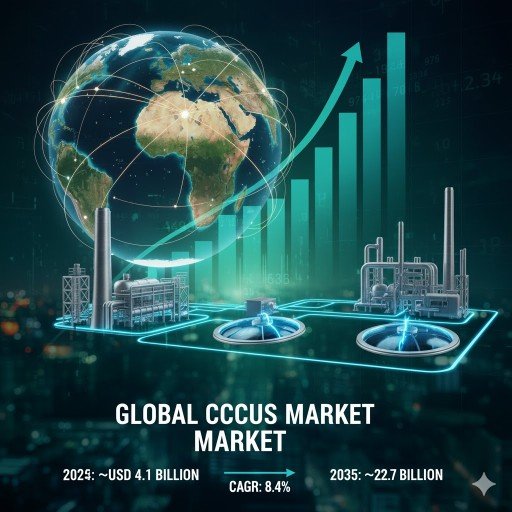
The global CCUS market was valued at USD 4.1 billion in 2025 and is projected to reach USD 22.7 billion by 2035, growing at a CAGR of 18.4%.Major trends include the rise of CO₂-to-fuel technologies, deployment of DAC hubs, utilization of captured carbon in concrete and chemicals, and the integration of CCUS into hydrogen and ammonia production. Emerging business models also include carbon credits and carbon-as-a-service.
Size, byProduct, 2024 - 2032{USD Billion} The global CCUS market was valued at USD 4.1 billion in 2025 and is projected to reach USD 22.7 billion by 2035, growing at a CAGR of 18.4%. request a free sample copy
Carbon Capture Utilization and Storage (CCUS) Market Outlook 2025–2035: Scaling Clean Transitions with Carbon Innovation
Reports Description
The Carbon Capture, Utilization, and Storage (CCUS) market is gaining critical momentum as governments and industries around the world pursue ambitious net-zero targets. CCUS technologies are emerging as pivotal solutions in decarbonizing hard-to-abate sectors such as cement, steel, chemicals, and power generation. This report delivers a detailed assessment of market potential, emerging innovations, and strategic opportunities across the CCUS value chain.
Market Significant Growth Factors
Key market drivers include increasing regulatory pressure to cut greenhouse gas emissions, favorable government incentives, rising demand for low-carbon industrial processes, and surging investments in clean tech. Technological advancements in direct air capture (DAC), utilization pathways, and long-term geological storage are unlocking scalability for large industrial emitters. Corporate carbon neutrality pledges further reinforce CCUS adoption as a compliance and ESG strategy.
Report Scope
|
Parameter |
Details |
|
Base Year |
2024 |
|
Forecast Period |
2025–2035 |
|
Market Size in 2025 |
USD 4.1 Billion |
|
Projected Market Size |
USD 22.7 Billion by 2035 |
|
CAGR (2025–2035) |
18.4% |
|
Regions Covered |
North America, Europe, Asia Pacific, Latin America, Middle East & Africa |
|
Segments Covered |
Deployment, End-Use, Process, Offering, Region |
|
Key Deliverables |
Forecasts, Infrastructure Outlook, Market Drivers, Competitive Analysis |
Report Coverage & Deliverables
-
Market size forecasts and CAGR analysis (2025–2035)
-
Breakdown of capture, utilization, and storage technologies
-
Regional investments and policy frameworks
-
Key infrastructure projects and carbon management hubs
-
Competitive benchmarking and innovation outlook
Recent Developments
-
In March 2025, ExxonMobil began operations at a large-scale CCUS facility in Texas designed to capture 10 million metric tons of CO₂ annually.
-
In February 2025, CarbonCure launched a new carbon mineralization system for concrete, integrated with regional ready-mix facilities.
-
In late 2024, Shell, TotalEnergies, and Equinor announced joint investments in a North Sea CO₂ transport and storage network.
Regional Insights
North America leads in project count and investment value, particularly along the U.S. Gulf Coast and Canadian oil sands. Europe is scaling up cross-border CO₂ transport and storage under the Net Zero Industry Act. Asia Pacific, driven by China and Australia, is building CCUS hubs focused on heavy industry decarbonization and blue hydrogen.
| Region | Market Size (2025, USD Billion) | CAGR (2025–2035) | Market Size (2035, USD Billion) | Key Insights |
|---|
| North America | 1.55 | 17.8% | 7.95 | The U.S. leads with robust federal incentives such as the 45Q tax credit, large-scale CCUS hubs, and strong oil & gas sector integration. Canada also advances projects for decarbonizing heavy industries. |
| Europe | 1.00 | 18.2% | 5.25 | Supportive EU climate policies and investments in carbon-neutral industrial clusters, particularly in the U.K., Norway, and the Netherlands, accelerate regional CCUS deployment. |
| Asia-Pacific | 1.10 | 19.5% | 6.57 | Rapid industrialization, large CO₂ emissions, and government-backed decarbonization programs in China, Japan, Australia, and South Korea fuel adoption of CCUS solutions. |
| Latin America | 0.22 | 18.0% | 1.16 | Early-stage adoption is supported by pilot projects in Brazil and Mexico, focusing on emission reduction in the energy and manufacturing sectors. |
| Middle East & Africa | 0.23 | 19.0% | 1.25 | A strong focus on carbon-neutral energy transitions and blue hydrogen projects in Saudi Arabia, the UAE, and South Africa enhances regional potential. |
| Total | 4.10 | 18.4% (Global Average) | 22.70 | Growing investments, policy incentives, and integration with hydrogen and renewable projects are expected to make CCUS a cornerstone of global decarbonization by 2035. |
End-Use Insights
Key sectors deploying CCUS include power generation, cement and lime, steel manufacturing, chemicals and petrochemicals, and hydrogen production. The power sector remains the largest capture segment, but industrial CCUS is growing fastest due to sector-specific emissions reduction mandates.
Deployment Insights
Deployment types include point-source capture (from industrial flue gas), direct air capture (DAC), and bioenergy with CCS (BECCS). DAC and BECCS are increasingly favored for their potential to achieve negative emissions, while point-source remains dominant in current infrastructure.
Process Insights
Processes include post-combustion capture, pre-combustion capture, and oxy-fuel combustion. Geological storage methods involve saline aquifers and depleted oil and gas reservoirs. Utilization includes conversion to fuels, building materials, and enhanced oil recovery (EOR). Advances in membranes, solvents, and solid sorbents are optimizing capture efficiency.
Offerings Insight
-
Capture Technologies (Chemical, Physical, Membrane-Based)
-
CO₂ Utilization Systems (Fuel Synthesis, Concrete Mineralization, Polymers)
-
Storage Solutions (Geological Sequestration, EOR)
-
Carbon Transport Infrastructure (Pipelines, Shipping)
-
Monitoring & Verification Services
-
Carbon-as-a-Service Platforms
U.S. Market Trends
The U.S. is leading global CCUS deployment, supported by enhanced 45Q tax credits, DOE funding, and private investments. Key projects include DAC hubs in California, CO₂ pipelines in the Midwest, and storage fields in the Gulf Coast. The push for carbon-neutral power grids is boosting CCUS integration.
Europe Trends
Europe’s CCUS market is driven by policy under the EU Green Deal and the Innovation Fund. Projects like Northern Lights (Norway) and Porthos (Netherlands) are advancing shared infrastructure. The focus is on industrial clusters and transboundary CO₂ transport corridors
Germany Trends
Germany is cautiously entering the CCUS space, focusing on carbon utilization in industrial decarbonization and green hydrogen applications. Regulatory clarity is improving, with pilot projects around cement plants and synthetic fuel production gaining traction.
Asia Pacific Trends
Asia Pacific is accelerating CCUS adoption, with Japan, South Korea, and Australia leading in hydrogen-integrated CCUS. The region is investing in offshore storage and DAC in partnership with international firms. Coal-heavy economies like India are evaluating retrofits in thermal plants.
China Trends
China’s CCUS market is expanding via pilot zones for coal-to-chemical retrofits, blue hydrogen, and industrial CCUS hubs. With strong state-backed funding and integration into national emission trading systems, China is positioning CCUS as a strategic pillar in its decarbonization roadmap.
Key Players
-
ExxonMobil
-
TotalEnergies
-
CarbonCure Technologies
-
Linde Plc
-
Air Liquide
-
Mitsubishi Heavy Industries
CCUS Market Segmentation
|
Segment |
Categories |
|
By Deployment |
Point-Source Capture, Direct Air Capture, Bioenergy CCS |
|
By End-Use |
Power Generation, Cement, Steel, Chemicals, Hydrogen |
|
By Process |
Post-Combustion, Pre-Combustion, Oxy-Fuel, Storage, Utilization |
|
By Offering |
Capture Tech, Utilization Systems, Storage Solutions, CO₂ Transport, Monitoring |
|
By Region |
North America, Europe, Asia Pacific, Latin America, Middle East & Africa |