
Claim a Free Sample
Get a preview with key statistics, projections, and trends for this report. Ideal for quick insights.
Send Me a SampleNeed full access?
Purchase ReportWaterborne Silicone Market Size & Trends
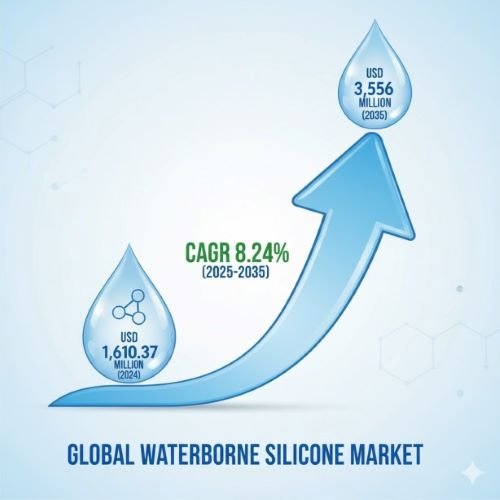
The size of the global waterborne silicone market was approximated at USD 1,610.37 million in 2024 and is expected to expand at a CAGR of 8.24% from 2025 to 2035.Size, byProduct, 2024 - 2032{USD Million} The size of the global waterborne silicone market is expected to expand at a CAGR of 8.24% from 2025 to 2035. request a free sample copy
Waterborne Silicone Market Size, Share & Trends Analysis Report By Type (Emulsions, Dispersions, Gels), By Application (Paints & Coatings, Personal Care, Adhesives & Sealants), By End-use, By Region, And Segment Forecasts, 2025 - 2035
The growing emphasis on eco-friendly construction practices is boosting applications of waterborne silicone in construction sealants and coatings due to their high durability, weather resistance, and minimal environmental footprint. More stringent green building codes and certification programs also drive market expansion.
The waterborne silicone market is seeing a sharp move toward environmentally friendly and sustainable solutions, especially in coatings and adhesives markets. As worldwide regulation gets tighter on volatile organic compounds (VOCs), makers are increasingly switching to waterborne silicones as a major replacement for solvent-borne formulations. The materials show excellent durability, weatherability, and adhesion without releasing poisonous fumes. Product areas like automotive, construction, and electronics are incorporating waterborne silicone technologies in order to achieve regulatory compliance with high performance.
This is part of a larger ESG (Environment, Social, and Governance) trend, confirming corporate sustainability commitments and minimizing carbon footprints across industrial use.
Report Coverage & Deliverables
Growing demand for high-end protective coatings in various industries is creating demand for waterborne silicones. These coatings provide superior resistance to water, UV light, and harsh temperatures and are therefore well-suited to applications within the construction, marine, and automotive industries. Development of infrastructure projects, especially in developing economies, is also driving adoption as governments and private developers look for weather-resistant, long-lasting materials.The electronics industry also gains with waterborne silicone coatings for protecting circuits and insulating products since they stop corrosion and improve product lifespan. The better functional properties of waterborne silicones, along with regulatory incentives for environmentally friendly formulations, are driving their market penetration.
The increasing use of waterborne silicones in biomedical and healthcare applications is a major market opportunity. The materials are being used more and more in medical adhesives, wound care products, and drug delivery systems because they are biocompatible and resistant to moisture.
With increasing demand for non-toxic and hypoallergenic material in medical devices, companies are looking into developments in silicone-based hydrogels and antimicrobial coatings. Also, improvements in waterborne silicone formulations allow breathable but tough protective films to be developed for wearable healthcare devices, paving the way for new market growth. As patient safety legislation and healthcare standards continue to become stricter, high-purity, skin-friendly silicones are poised to see strong demand.
Although beneficial, the waterborne silicone market is hampered by the issues of high production costs and difficulties in formulation. Production uses specialized raw materials and advanced processing methods, which add to total costs versus more traditional solvent-based compositions. Furthermore, the formulation of waterborne silicone products that provide the right balance of adhesion, strength, and flexibility demands significant R&D investment, which could be an obstacle for minor market participants. Compatibility problems with conventional application techniques and substrate surfaces further create technical obstacles, restricting general use of such materials in cost-sensitive markets. Consequently, cost-sensitive end consumers, especially from developing countries, might be slow to switch from conventional silicone-based products to more sophisticated waterborne products.
Type Insights
Emulsions led the market in terms of revenue in the type segmentation in 2024, holding a market share of 44.80%. Waterborne silicone emulsions are increasingly finding popularity in the textile market because they can increase fabric softness, water repellency, and durability without sacrificing breathability. As consumers increasingly look for high-performance, sustainable textiles, producers are adding silicone emulsions to functional apparel, upholstery, and industrial fabrics.The water-based silicone gel segment is growing extremely fast, especially in the skincare and medical markets where flexibility and biocompatibility are essential. They are applied broadly in cutting-edge wound care, transdermal drug delivery patches, and formulations for the treatment of scars based on their moisturizing properties and non-irritation potential. Increased demand for minimally invasive medical therapies and wearable health monitoring technology is expected to boost demand for soft, breathable silicones to ensure patient comfort and extended adhesion. With the healthcare industry shifting toward skin-friendly and hypoallergenic materials, waterborne silicone gels are emerging as a key ingredient in next-generation cosmetic and medical products.
Application Insights
Paints & coatings held the dominant position in the market in the application segmentation in revenue terms, with a market share of 36.64% in 2024. Demand for waterborne silicone in paints & coatings is gaining momentum with growing requirements for durable protection in extreme environmental conditions. Industrial and automotive applications are widely using these coatings for increasing resistance to extreme temperatures, corrosion, and chemical exposure. Besides, strict environmental laws restricting VOC emissions have prompted producers to substitute solvent-based coatings with waterborne silicone products. The increasing emphasis on energy-efficient buildings and reflective roof coatings further drives market demand since silicone-based coatings offer better thermal management and weatherproofing performance.In the personal care industry, waterborne silicone is becoming a key ingredient in skincare, haircare, and cosmetic formulations due to its lightweight texture and breathable properties. Unlike traditional oil-based silicones, waterborne variants offer a non-greasy feel, making them highly desirable in high-end skincare products, sunscreens, and anti-aging creams. Consumers' increasing preference for clean-label and water-based beauty products is pushing manufacturers to innovate with silicone emulsions and gels that provide smooth application and long-lasting hydration.
End-use Insights
Building led the market in terms of revenue, making up 27.72% of the market in 2024 across the end use segment. Waterborne silicone is becoming more crucial to the construction industry, with increased use in producing high-performance sealants and weatherproof coatings. With expansion of infrastructure projects taking place globally, there has been an escalating demand for resistant, flexible, and low-maintenance building products capable of weathering harsh climate conditions. Water-based silicone sealants exhibit better adhesion to a wide range of substrates, lowering the possibility of cracks and leaks in buildings over a period of time.Regional Insights
North America waterborne silicone market expansion is fueled by the aggressive trend towards sustainable industrial coatings, leading to the uptake of waterborne silicone in applications like aerospace, automotive, and energy. The environmental regulations by organizations such as the U.S. Environmental Protection Agency (EPA) and Canada's environmental regulators are restraining VOC emissions, which are encouraging manufacturers to switch from solvent-based to waterborne systems.Waterborne Silicone Market – Regional Size Breakdown (2024–2035)
| Region | 2024 Market Size (USD Million) | 2035 Market Size (USD Million) | Key Market Drivers |
|---|---|---|---|
| Asia Pacific | 724.67 | 1,678.01 | Strong coatings & construction sector, rising industrial output, rapid urbanization |
| North America | 338.18 | 744.35 | High adoption in automotive, construction & electronics; strong R&D focus |
| Europe | 305.97 | 672.54 | Demand for sustainable, low-VOC materials; expanding personal care sector |
| Latin America | 129.00 | 280.32 | Growing manufacturing, increasing use in protective coatings |
| Middle East & Africa | 112.55 | 253.68 | Infrastructure development, increasing silicone use in industrial coatings |
| Total (Global) | 1,610.37 | 3,728.90 | Aligned with global CAGR of 8.24% |
U.S. Waterborne Silicone Market Trends
The U.S. waterborne silicone market is being propelled by the growing use of waterborne silicone in medical and healthcare applications. The nation is home to numerous medical device makers and pharmaceutical companies that are progressively incorporating silicone-based coatings, adhesives, and hydrogels into wound care, drug delivery systems, and surgical equipment. With increasing healthcare costs and an aging population that needs sophisticated medical treatment, the demand for hypoallergenic and biocompatible materials is growing. Additionally, regulatory requirements from the U.S. Food and Drug Administration (FDA) are promoting the utilization of safer, non-toxic materials in healthcare products, also propelling waterborne silicone development for healthcare use.Asia Pacific Waterborne Silicone Market Trends
Asia Pacific waterborne silicone market led globally with the maximum revenue share of 40.40% in 2024. The Asia Pacific region is also experiencing tremendous urbanization and infrastructure growth, propelling demand for waterborne silicone in the construction sector. India, Indonesia, and Vietnam are heavily investing in smart cities, residential construction, and industrial estates, with demands for hardy and power-saving building products. Waterborne silicone is becoming popular in sealants, coatings, and waterproofing applications because it offers superior adhesion, weather resistance, and environmental compatibility.China's waterborne silicone market is being driven by the fast-growing electronics and semiconductor production industry. With the nation at the forefront of global output of consumer electronics, electric vehicles, and 5G infrastructure, demand for high-performance, moisture-resistant coatings and adhesives has exploded. Waterborne silicone is finding greater application in protection of circuit boards, packaging of chips, and thermal management applications because of its excellent insulation and heat dissipation characteristics.
Europe Waterborne Silicone Market Trends
Europe waterborne silicone market is at the vanguard of green material uptake, as stringent policy measures like the European Green Deal and REACH (Registration, Evaluation, Authorisation and Restriction of Chemicals) framework fuel waterborne silicone demand. Construction, automotive, and consumer goods sectors are all proactively substituting conventional solvent-based silicones with waterborne ones to meet low-VOC specifications and carbon neutrality initiatives.Key Waterborne Silicone Company Insights
The waterborne silicone industry is highly competitive, with several key players dominating the landscape. The waterborne silicone industry is characterized by a competitive landscape with several key players driving innovation and market growth. Major companies in this sector are investing heavily in research and development to enhance the performance, cost-effectiveness, and sustainability of their types.Key Waterborne Silicone Companies
Following are the major companies operating in the market for waterborne silicone. Together, they account for the maximum market share and set the pace for industry trends.
Momentive Performance Materials
Dow Chemical Company
Shin-Etsu Chemical Co., Ltd.
Wacker Chemie AG
Elkem Silicones
Evonik Industries AG
BRB International BV
Siltech Corporation
Recent Developments
In March 2024, Shin-Etsu Chemical Co., Ltd. created the first water-based silicone resin without an emulsifier, the KRW-6000 Series. The resin has excellent film properties, rapid curing with heat, and high durability. Its water-solvent system excludes organic solvents, leading to VOC-free products and lower greenhouse gas emissions as a result of its low-temperature fast curing.
In June 2024, SioResin announced a new water-based, high-temperature graphene silicone resin coating using their SiO-715 silicone resin emulsion. This coating combines high-temperature resistance with water-based formulation and thermal conductivity, targeting applications in industrial pipelines, heating vessels, and domestic heating.
BUY THIS REPORT TODAY WITH 2 YEARS SERVICE
Waterborne Silicone Market Report Scope
|
Report Attribute |
Details |
|
Market size value in 2025 |
USD 1,670.68 million |
|
Revenue forecast in 2030 |
USD 2,369.07 million |
|
Growth rate |
CAGR of 7.24% from 2024 to 2030 |
|
Base Year |
2024 |
|
Historical data |
2018 - 2023 |
|
Forecast period |
2025 - 2030 |
|
Quantitative units |
Revenue in USD million, Volume in Kilotons, and CAGR from 2025 to 2030 |
|
Report coverage |
Revenue forecast, competitive landscape, growth factors, and trends |
|
Segments covered |
Type, application, end-use, region |
|
Regional scope |
North America; Europe; Asia Pacific; Central & South America; Middle East & Africa |
|
Country Scope |
U.S., Canada; Mexico; Germany; UK; France; Italy; Spain, China; India; Japan; South Korea, Australia Brazil; Argentina, Saudi Arabia, UAE, South Africa |
|
Key companies profiled |
Momentive Performance Materials; Dow Chemical Company; Shin-Etsu Chemical Co.; Ltd.; Wacker Chemie AG; Elkem Silicones; Evonik Industries AG; BRB International BV; Siltech Corporation |
|
Customization scope |
Free report customization (equivalent to up to 8 analyst’s working days) with purchase. Addition or alteration to country, regional & segment scope |