
Claim a Free Sample
Get a preview with key statistics, projections, and trends for this report. Ideal for quick insights.
Send Me a SampleNeed full access?
Purchase ReportMarket Size & Trends
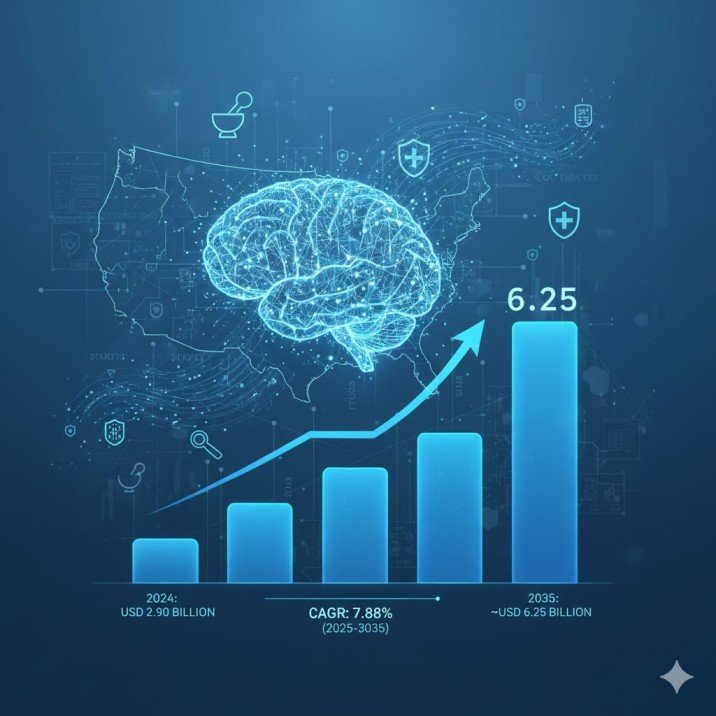
The size of the U.S. retail pharmacy de-identified health data market was estimated at USD 2.90 billion in 2024 and is anticipated to grow at a CAGR of 7.88% during the period from 2025 to 2035.
Size, byProduct, 2024 - 2032{USD Billion} U.S. retail pharmacy de-identified health data market is anticipated to grow at a CAGR of 7.88% during the period from 2025 to 2035. request a free sample copy
U.S. Retail Pharmacy De-identified Health Data Market Size, Share & Trends Analysis Report By Dataset Type (DSCSA Data, Market Basket Data, Inventory Data, Prior Authorization Data), And Segment Forecasts
The growth is mainly fueled by the increasing need for real-world evidence (RWE) and real-world data (RWD), as well as the ongoing growth of value-based care (VBC) and outcome-based reimbursement models. Also driving market growth are positive regulatory efforts, including adherence to the Drug Supply Chain Security Act (DSCSA). The VBC model's high-speed uptake is transforming the U.S. healthcare landscape by revolutionizing the manner in which care outcomes are measured, valued, and incented.
De-identified health information is critical in clinical research because it enables researchers to examine large sets of data without compromising patient privacy. This information reveals trends, measures the success of treatment, and aids in population health research without invading individual identities. Through the use of de-identified data, researchers can improve the integrity of their findings and enable the advancement of medical knowledge and practice.
For example, Philips and MIT's Institute for Medical Engineering and Science (IMES) partnered in April 2023 to create an advanced critical care dataset to drive clinical research and applications of AI in healthcare. The dataset features de-identified ICU patient data and combines rich clinical data to enable researchers and educators to learn more about critical care and enhance patient outcomes. The program promotes innovation in AI-based healthcare solutions for more precise diagnoses and tailored treatments.
The number and urgency of treatment authorizations involving COVID-19 generated high demand for de-identified information. Providers and payers leveraged such datasets to simplify access paths, standardize administrative processes, and enable quick decision-making. Such advancements also guided the development of policies to decrease friction in care delivery amid public health crises. Sweeping shortages of drugs and medical supplies made it imperative to have greater visibility into real-time inventory information at the pharmacy level. Pharmaceutical manufacturers, wholesalers, and health tech firms invested heavily in predictive analytics and AI-driven inventory tracking to manage stockouts proactively and ensure timely access to essential therapies.
Report Coverage & Deliverables
PDF report & online dashboard will help you understand
- Competitive benchmarking
- Historical data & forecasts
- Company revenue shares
- Regional opportunities
- Latest trends & dynamics
Market Concentration & Characteristics
The chart below illustrates the relationship between market concentration, industry characteristics, and industry participants. The x-axis represents the level of industry concentration, ranging from low to high. The y-axis represents various industry characteristics, including industry competition, impact of regulations, level of partnerships & collaborations activities, degree of innovation, and regional expansion. For instance, the U.S. retail pharmacy De-identified data market is slightly fragmented, with many product & service providers entering the market. The degree of innovation, the level of partnerships & collaboration activities, and the impact of regulations on the industry are high. However, moderate growth was observed in regional expansion.
The degree of innovation in the industry is high. The market is experiencing significant innovation as numerous players introduce new products. Major players like CVS Health, Walgreens, and Walmart are investing in advanced data platforms that aggregate pharmacy data with clinical, claims, and social determinants of health (SDoH) data, moving beyond basic prescription records toward richer, multi-source datasets.
The level of partnerships & collaboration activities by key players in the industry is high to increase their capabilities, expand product portfolios, and improve competencies. Many retail pharmacies partner with advanced analytics firms, health tech startups, and cloud providers to enhance data warehousing, AI-driven insights, and interoperability capabilities. For instance, in October 2022, Rite Aid partnered with Google Cloud in a multi-year collaboration to modernize its pharmacy operations and enhance the online customer experience. This partnership involves migrating key applications, such as vaccine scheduling tools and customer messaging infrastructure, to Google Cloud's Anthos platform.
The impact of regulations on the market is high. Various regulations significantly influence the U.S. retail pharmacy market. Acts such as HIPAA set the core framework by defining what counts as de-identified data and what safeguards must be applied. As long as data meets HIPAA’s de-identification standards (safe harbor or expert determination), it can generally be shared or sold without individual patient consent. However, companies must still ensure robust compliance practices, which limits how granular or linked datasets can be.
The level of regional expansion in industry is moderate. While most companies operate nationally, there is a growing focus on expanding into specific high-opportunity regions such as California, Texas, Florida, and New York, where large insured populations and advanced Medicaid or value-based care programs exist.
Dataset Type Insights
Based on dataset type, the prior authorization data segment held the largest revenue share of 33.12% in 2024. In addition, this segment is expected to grow at the fastest CAGR of 8.85% during the forecast period. The segment's dominance is driven by the high volume and frequency of prior authorization requests, growing regulatory and transparency requirements, and the critical.
De-identified Prior Authorization (PA) Data from retail pharmacies consists of anonymized records capturing prescription transactions requiring prior approval, including drug name, denial reasons, time-to-approval, payer requirements, and appeal outcomes, without containing any personally identifiable information (PII).
Based on the U.S. retail pharmacy de-identified health data market estimate of USD 2.90 billion in 2024 and a CAGR of 7.88% from 2025 to 2035, here’s a detailed regional market size table (assuming the U.S. is segmented into four standard Census regions — Northeast, Midwest, South, and West).
To estimate the regional split, we'll use approximate population-based weights (which is typical in absence of region-specific market studies)
| U.S. Census Region | Population Share (%) | 2024 Market Size (USD Billion) | 2035 Forecast (USD Billion) | 2025–2035 CAGR (%) |
|---|---|---|---|---|
| South | 38.3% | 1.11 | 2.44 | 7.88% |
| West | 23.9% | 0.69 | 1.52 | 7.88% |
| Midwest | 20.8% | 0.60 | 1.32 | 7.88% |
| Northeast | 17.0% | 0.49 | 1.08 | 7.88% |
| Total (U.S.) | 100% | 2.90 | 6.36 | 7.88% |
Key U.S. Retail Pharmacy De-identified Health Data Company Insights
The market is highly fragmented, with many small and large players operating in this space. This leads to intense competition between smaller players to sustain their position. Strategies such as new product launches and partnerships play a key role in propelling market growth.
Key U.S. Retail Pharmacy De-identified Health Data Companies
- CVS Health
- Walgreens Boots Alliance, Inc.
- Walmart Pharmacy
- The Kroger Co.
- Albertsons
- UnitedHealth Group
- Humana
- BrightSpring Health Services
- Costco Wholesale Corporation
- Centene Corporation
- Ahold Delhaize
- Rite Aid Corp
- H E B, LP
- Aurora Health Care (a part of Advocate Health)
- Big Y Foods, Inc.
- Brookshire Brothers
- Wakefern Food Corp.
- Publix
- Cub (subsidiary of United Natural Foods, Inc.)
Recent Developments
U.S. Retail Pharmacy De-identified Health Data Market Report Scope
|
Report Attribute |
Details |
|
Market size for 2025 |
USD 3.12 billion |
|
Revenue forecast in 2030 |
USD 4.56 billion |
|
Growth rate |
CAGR of 7.88% from 2025 to 2035 |
|
Actual data |
2018 - 2024 |
|
Forecast period |
2025 - 2035 |
|
Quantitative units |
Revenue in USD million/billion and CAGR from 2025 to 2035 |
|
Report coverage |
Revenue forecast, company ranking, competitive landscape, growth factors, and trends |
|
Segments covered |
Dataset type |
|
Key companies profiled |
CVS Health; Walgreens Boots Alliance, Inc.; Walmart Pharmacy; The Kroger Co.; Albertsons; UnitedHealth Group; Humana; BrightSpring Health Services; Costco Wholesale Corporation; Centene Corporation; Ahold Delhaize; Rite Aid Corp; H E B, LP; Aurora Health Care (a part of Advocate Health); Big Y Foods, Inc.; Brookshire Brothers; Wakefern Food Corp.; Publix; Cub (a subsidiary of United Natural Foods, Inc.). |
|
Customization scope |
Free report customization (equivalent up to 8 analysts working days) with purchase. Addition or alteration to country, regional & segment scope. |
|
Pricing and purchase options |
Avail customized purchase options to meet your exact research needs. Explore purchase options |
U.S. Retail Pharmacy De-identified Health Data Market Report Segmentation
Dataset Type Outlook (Revenue, USD Million; 2018 - 2035)
-
-
DSCSA Data
-
By Buyer Type
-
Pharmaceutical Manufacturers
-
Drug Distributors
-
Regulatory Tech Vendors (e.g., TraceLink, LSPedia)
-
Healthcare SaaS Vendors (compliance and recall management tools)
-
Others (Federal Agencies e.g., FDA, etc.)
-
-
-
Market Basket Data
-
By Buyer Type
-
CPG & Pharma Brands
-
Marketing & AdTech Firms
-
Health Insurers & PBMs
-
Retail Analytics Platforms
-
Others (Data Aggregators (e.g., NielsenIQ, IRI), etc.)
-
-
-
Prior Authorization Data
-
By Buyer Type
-
Payers & PBMs
-
Pharma Market Access Teams
-
Health IT Providers
-
Consulting & Policy Firms
-
Others (Advocacy Groups, etc.)
-
-
-
Inventory Data
-
By Buyer Type
-
Pharma Manufacturers
-
Distributors/Wholesalers
-
AI/ML Inventory Optimization Vendors
-
Others (Clinical Supply Vendors, etc.)
-
-
-
Episodic Data / Pharmacy Rx Claims Data
-
By Buyer Type
-
Value-based Payers & ACOs
-
Pharma Outcomes Teams
-
Real-world Evidence Vendors
-
CMS & Government Organizations
-
Others (AI/ML Healthtech Firms, etc.)
-
-
-