
Claim a Free Sample
Get a preview with key statistics, projections, and trends for this report. Ideal for quick insights.
Send Me a SampleNeed full access?
Purchase ReportMarket Size & Trends
The size of the U.S. interventional cardiology and peripheral market was approximately USD 7.88 billion in 2024 and is expected to advance at a CAGR of 6.0% during 2025-2030.
Size, byProduct, 2024 - 2032{USD Billion} U.S. interventional cardiology size is expected to advance at a CAGR of 6.0% during 2025-2030. request a free sample copy
U.S. Interventional Cardiology And Peripheral Market
The advancement is due to increasing prevalence of cardiovascular and peripheral vascular diseases, increasing demand for minimally invasive treatments, and ongoing improvements in device technology. The growing population of geriatrics, greater incidence of diabetes and hypertension, and favorable reimbursement policies further propel market growth. Increased acceptance by primary care providers and specialists of aggressive screening practices has caused referral volumes to interventionalists to grow. The coupling of preventive medicine with interventional therapy promotes a paradigm shift in treatment, making minimally invasive methods first-line interventions in most clinical settings. This advancement continues to drive the market's growth along coronary as well as peripheral segments.
Demographic shift of an ageing population is influencing interventional cardiology and peripheral care markets significantly.
In January 2024, the Population Reference Bureau issued a fact sheet that emphasized the record increase of the U.S. population aged 65 and older, which is expected to grow by 47% by 2050. It further highlighted the increasing racial and ethnic diversity of older Americans, which is expected to undergo a large transformation by the mid-century. Elderly patients generally have more than one comorbidity that renders them less ideal for open surgery, with greater dependence on catheter-based therapies. These minimally invasive procedures present a good option for the treatment of vascular obstructions and related conditions in high-risk individuals, keeping in mind preserving quality of life. innovations in interventional cardiology devices are remodeling treatment choice and procedural results.
Later generations of stents, balloons, and ancillary devices are intended to enhance accuracy, decrease complications, and improve long-term vessel patency. These technologies allow doctors to treat increasingly complicated lesions and increase the number of patients who can be treated. Better deliverability and trackability have increased device versatility across difficult anatomies. In January 2024, AngioDynamics was cleared for the FDA 510(k) of Auryon XL Radial Access Catheter, intended for Peripheral Arterial Disease (PAD) treatment. The catheter increases the scope of treatments available, minimizes bleeding complications, and promotes recovery by using radial access, providing a safer option compared to femoral access in atherectomy procedures. The advent of intravascular imaging modalities and physiology-guided evaluation methods has introduced an additional layer of procedural precision.
These technologies facilitate improved visualization and decision-making at the time of intervention, leading to greater procedural success rates. In the peripheral territory, devices like atherectomy systems and drug-coated devices have made it possible to treat long or calcified lesions effectively with decreased repeat intervention need. In February 2024, Biotronik and IMDS released the Micro Rx Rapid Exchange Microcatheter in the United States. This next-generation device provides enhanced guidewire support, with greater push transfer and tapered tip for enhanced penetration. It is designed specifically for percutaneous coronary interventions and seeks to decrease procedural time and reduce vascular trauma, overcoming difficulties in complex vascular anatomies. 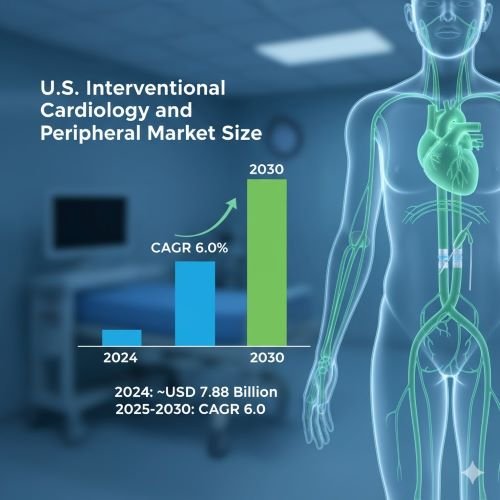
Market Concentration & Characteristics
The U.S. market for interventional cardiology and peripherals is evolving fast with technologies in minimally invasive therapies, structural heart treatments like TAVR and mitral valve repair, and new-generation stents like bioresorbable and drug-eluting stents. Advanced imaging integration (CCTA, IVUS, OCT) along with AI boosts diagnosis and procedural precision. Robotic interventions, regenerative medicine, reduced antiplatelet therapy regimens, and AR/VR technologies enhance safety, outcomes, and educator training, fueling future market expansion. In April 2025, Johnson & Johnson MedTech's Shockwave Medical began the FORWARD CAD IDE trial in the U.S. and U.K. to assess the Javelin IVL Catheter for calcified coronary lesions to meet unmet needs in coronary intervention.
The market is often seeing mergers, acquisitions, and strategic collaborations between top device companies and startups. These transactions widen product lines, facilitate entry into new markets like peripheral vascular devices, and gain access to sophisticated R&D and intellectual property, thus compelling market consolidation, innovation, and accelerated commercialization of new technologies. For example, in March 2025, Boston Scientific reported its acquisition of SoniVie Ltd., a privately owned medical device company in Israel, for about USD 360 million upfront, with possible additional payments, to broaden its interventional cardiology platform with ultrasound-based renal denervation therapy for hypertension.
The FDA regulates interventional cardiology device regulation under 21 CFR Part 870, categorizing devices as Class I (low-risk), Class II (moderate-risk, cleared through 510(k)), and Class III (high-risk, Premarket Approval required). Specific channels like HDE and EFS allow innovation in cases of rare diseases and early assessment. Post-market surveillance confirms continuing safety, with current trends including extended indications on the basis of registry data, balancing speedy access with standards of safety under regulatory and reimbursement pressures.
Substitution threat for fundamental interventional procedures like angioplasty, stent implantation, and TAVR is low to moderate, owing to their established clinical efficacy and minimally invasive nature. Non-invasive treatment and drugs can postpone treatment but do not substitute it. Imaging technologies like IVUS, OCT, and CCTA are complementary, creating minimal substitution risk and ensuring steady demand for sophisticated devices.
The U.S. has a dominant presence in key metropolitan and healthcare centers nationwide. The Northeast, such as New York, Boston, and Philadelphia, has premier academic centers and high volumes of patients. The Midwest, consisting of Chicago, Cleveland, and Minneapolis, boasts top cardiac centers and research. The San Francisco Bay Area and Los Angeles on the West Coast are renowned for innovation and clinical trials, whereas Texas and Florida cover high population bases with high rates of cardiovascular disease. In May 2025, at the SCAI Scientific Sessions in Washington, DC, the Society for Cardiovascular Angiography & Interventions unveiled its third "Ready to LaunchCareers in Cardiology" program, pairing U.S. residents and medical students with interventional cardiology leaders to facilitate diversity and mentorship.
Report Coverage & Deliverables
- Competitive benchmarking
- Historical data & forecasts
- Company revenue shares
- Regional opportunities
- Latest trends & dynamics
Product Insights
Coronary stents led the U.S. interventional cardiology and peripheral market and accounted for a share of 41.5% in 2024, fueled by technological advancements, rising cardiovascular disease prevalence, and increased use of minimally invasive procedures. Key players such as Abbott Laboratories, Boston Scientific, and Medtronic are innovating with drug-eluting stents such as XIENCE, Synergy, and Resolute Onyx to improve outcomes. Companies are adopting strategies such as R&D, product development, and expansion to drive market growth. For instance, in April 2024, Abbott received FDA approval in the U.S. for the Esprit BTK Resorbable Scaffold, a dissolving stent designed for below-the-knee arteries in peripheral artery disease patients. This innovative device supports vessel healing and offers a superior alternative to balloon angioplasty, improving long-term outcomes.
The guidewires segment is expected to grow at the fastest CAGR of 8.3% over the forecast period. Guidewires are essential for the precise positioning of balloon catheters and devices during angioplasty, serving as measurement tools for accurate device alignment. Key players are introducing technologically advanced products, such as radiofrequency (RF) guidewires that use RF energy to safely navigate occlusions, reducing vessel damage and improving outcomes in vascular interventions. These innovations are driving overall market growth in the evolving medical technology sector. In March 2024, Baylis Medical Technologies announced the U.S. launch and 510(k) clearance of the PowerWire Pro RF Guidewire, enhancing venous stent recanalization for total occlusions. This innovative device employs radiofrequency technology to safely cross in-stent and native occlusions, expanding treatment options for vascular professionals.
U.S. Interventional Cardiology and Peripheral Market – Regional Size Estimates
| Region | Market Size (2024, USD Billion) | Share (%) | Projected Market Size (2030, USD Billion) | CAGR (2025–2030) | Key Insights |
|---|---|---|---|---|---|
| Northeast (New York, Massachusetts, Pennsylvania, etc.) | 1.72 | 21.8% | 2.44 | 6.0% | High prevalence of cardiovascular diseases, strong hospital networks, and significant adoption of advanced interventional devices. |
| Midwest (Illinois, Ohio, Michigan, etc.) | 1.33 | 16.9% | 1.89 | 5.9% | Growth supported by expanding healthcare infrastructure and increasing peripheral artery disease treatment demand. |
| South (Texas, Florida, Georgia, etc.) | 2.91 | 36.9% | 4.13 | 6.1% | Largest regional market driven by high patient population, rising obesity-related cardiac issues, and growing investment in healthcare facilities. |
| West (California, Arizona, Washington, etc.) | 1.92 | 24.4% | 2.73 | 6.0% | Strong adoption of minimally invasive technologies, presence of top medical device manufacturers, and advanced cardiac centers. |
| Total (United States) | 7.88 | 100% | 11.19 | 6.0% | Sustained growth driven by aging population, increasing incidence of cardiovascular diseases, and technological advancements in stents and catheters. |
Application Insights
Angioplasty ruled the U.S. interventional cardiology and peripheral market and held a share of 59.2% in 2024. Angioplasty is a non-surgical, minimally invasive procedure that re-establishes blood flow by opening up blocked or narrowed coronary arteries, usually with balloons and stents. In an April 2024 University of Michigan article, more than 500,000 people in the U.S. get percutaneous coronary intervention (PCI) each year. Technological advancements like the Serranator SL-PRO, with proprietary micro-serration technology that applies up to 1,000 times more force, enhance arterial expansion, particularly in complex lesions. Increased procedure volume and cutting-edge devices fuel market expansion and improve outcomes.
Repair of congenital heart defects is expected to increase dramatically during the forecast period. Congenital heart defects (CHDs) are structural heart abnormalities present at birth that alter blood flow. It is estimated by a CDC report published in March 2025 that, in the United States, CHDs are the most prevalent birth defect, occurring in nearly 1% of all live births, or about 40,000 babies each year. Of these, one in four are critical congenital heart defects, requiring surgery or catheter procedures during the first year of life. Increasing prevalence and advances in technology are fueling growth in pediatric interventional cardiology.
Key U.S. Interventional Cardiology And Peripheral Company Insights
Some key companies operating in the market include B. Braun SE, BD, Cardinal Health, Medtronic, Teleflex Incorporated, and W. L. Gore & Associates Inc., among others. Organizations are undertaking various strategic initiatives, such as launching new products, geographic expansions, partnerships and collaborations, and innovations, to increase their market shares. Emerging players are adopting diverse strategies, such as new product launches, to strengthen their market presence.
-
B. Braun develops and markets medical products such as infusion therapy, pain management, clinical nutrition, dialysis, and pharmacy admixture systems, supported by divisions such as B. Braun Interventional Systems, Aesculap, and CAPS, to improve patient safety and clinical efficiency.
-
Teleflex Incorporated operates globally, providing diverse solutions in vascular and interventional access, surgical procedures, anesthesia, cardiac care, urology, emergency medicine, and respiratory care, aiming to enhance overall health and well-being.
Key U.S. Interventional Cardiology And Peripheral Companies
- B. Braun SE
- BD
- Cardinal Health
- Medtronic
- Teleflex Incorporated
- W. L. Gore & Associates Inc.
- Cook
- Boston Scientific Corporation
- AngioDynamics
- Abbott
- OrbusNeich Medical Group Holdings Limited
Recent Developments
-
In March 2025, GE HealthCare introduced Flyrcado (flurpiridaz F 18) in the United States, a first-in-class PET MPI agent for diagnosing coronary artery disease, with Medicare pass-through payment status support, to increase diagnostic precision and patient outcomes.
In October 2024, Gore reported three-year data from the ASSURED Study in the United States, showing long-term safety and 100% closure success of the GORE CARDIOFORM ASD Occluder with low rates of adverse events and an 84% clinical success rate at 36 months.
In February of 2024, Biotronik brought the PK Papyrus covered coronary stent to the United States market, offering a flexible, ultrathin stent for emergency use in acute coronary artery perforations to better the patient outcome while minimizing the requirement for bypass procedures.
In January 2024, AngioDynamics gained FDA 510(k) clearance for the Auryon XL Radial Access Catheter in the U.S., offering expanded atherectomy options for the treatment of PAD, minimizing access site complications, and enabling quicker patient recovery with cutting-edge laser technology.
U.S. Interventional Cardiology And Peripheral Market Report Scope
|
Report Attribute |
Details |
|
Market size value in 2024 |
USD 8.36 billion |
|
Revenue forecast in 2030 |
USD 11.19 billion |
|
Growth rate |
CAGR of 6.0% from 2025 to 2030 |
|
Base year for estimation |
2024 |
|
Historical data |
2018 - 2023 |
|
Forecast period |
2025 - 2030 |
|
Quantitative units |
Revenue in USD million/billion, and CAGR from 2025 to 2030 |
|
Report coverage |
Revenue forecast, company ranking, competitive landscape, growth factors, trends |
|
Segments covered |
Product, application |
|
Country scope |
U.S. |
|
Key companies profiled |
B. Braun SE; BD; Cardinal Health; Medtronic; Teleflex Incorporated; W. L. Gore & Associates Inc.; Cook; Boston Scientific Corporation; AngioDynamics; Abbott; OrbusNeich Medical Group Holdings Limited |
|
Customization scope |
Free report customization (equivalent up to 8 analysts working days) with purchase. Addition or alteration to country, regional & segment scope. |
|
Pricing and purchase options |
Avail customized purchase options to meet your exact research needs. Explore purchase options |
U.S. Interventional Cardiology And Peripheral Market Report Segmentation
This report forecasts revenue growth at the country level and provides an analysis of the latest industry trends in each of the sub-segments from 2018 to 2030. For this study, MIR has segmented the U.S. interventional cardiology and peripheral market report based on product, and application
-
Product Outlook (Revenue, USD Million, 2018 - 2030)
-
Interventional Catheters
-
Microcatheters
-
Support Microcatheters
-
Delivery Microcatheters
-
Others
-
-
Guidewires
-
Peripheral Stents
-
Self-expanding
-
Balloon-expandable
-
Drug-eluting Stents
-
-
Coronary Stents
-
Bioabsorbable Stents
-
Drug Eluting Stents
-
Bare Metal Stents
-
-
PTCA Balloon Catheters
-
Atherectomy Devices
-
Chronic Total Occlusion Devices
-
Synthetic Surgical Grafts
-
Embolic Protection Devices
-
IVC Filters
-
PTA Balloon Catheters
-
Thrombectomy Devices
-
-
Application Outlook (Revenue, USD Million, 2018 - 2030)
-
Angioplasty
-
Congenital Heart Defect Correction
-
Thrombectomy
-
Valvuloplasty
-
Percutaneous Valve Repair
-
Others
-