
Claim a Free Sample
Get a preview with key statistics, projections, and trends for this report. Ideal for quick insights.
Send Me a SampleNeed full access?
Purchase Reportself driving tractor Market Size
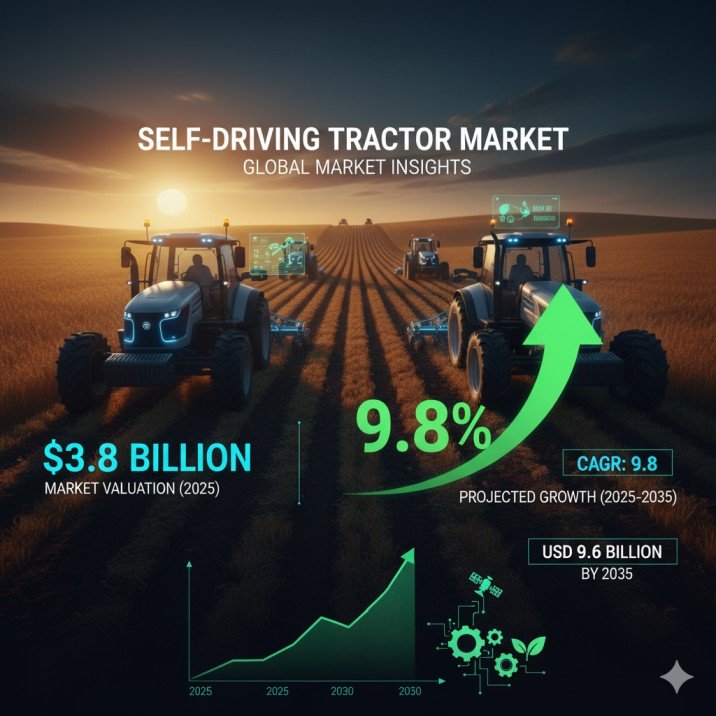
The global self-driving tractor market size is estimated at USD 3.8 billion in 2025 and is expected to surpass USD 9.6 billion by 2035, growing at a CAGR of 9.8%.
Self-Driving Tractor Market Size By Product (Fully Autonomous Tractors, Semi-Autonomous Tractors), By Application (Agriculture, Forestry, Construction), By End-use (Large Farms, Medium Farms, Small Farms), Industry Analysis Report, Regional Outlook, Appli
Size, byProduct, 2024 - 2032{USD Billion}
CAGR: 9.80%self-driving tractor market size is growing at a CAGR of 9.8%. request a free sample copy

To get key market trends
Key trends shaping the market include
-
Integration of GPS, IoT, and AI technologies for improved navigation and decision-making.
-
Growth in precision farming practices across major agricultural economies.
-
Rising investment in electric and hybrid-powered autonomous tractors.
Market Overview
The self-driving tractor market represents a significant shift toward precision agriculture and smart farming solutions. As the global agriculture industry faces labor shortages, rising operational costs, and the need for higher productivity, autonomous tractors are becoming a critical innovation, offering efficiency, accuracy, and reduced environmental impact.
Market Analysis
With the rise in global food demand and the increasing need for agricultural efficiency, self-driving tractors are becoming mainstream in both large-scale and small-scale farming operations. Manufacturers are focusing on providing flexible solutions adaptable for various crops, terrains, and weather conditions. Autonomous tractors are helping farmers optimize time, reduce labor dependence, and minimize fuel consumption.
Download Sample Ask for Discount Request Customization
Report Scope & Attributes
|
Attribute |
Details |
|
Base Year |
2024 |
|
Forecast Period |
2025–2035 |
|
Market Size in 2025 |
USD 3.8 Billion |
|
Market Size in 2035 |
USD 9.6 Billion |
|
CAGR (2025–2035) |
9.8% |
|
Segments Covered |
Product, Application, End-use |
|
Key Regions Covered |
North America, Europe, Asia Pacific, Latin America, Middle East & Africa |
|
Major Players |
John Deere, CNH Industrial, AGCO, Kubota, Trimble, Bear Flag Robotics |
|
Format Available |
PDF, Excel, PPT |
|
Deliverables |
Data Tables, Charts, Analyst Insights, Regional & Segment Forecasts |
Recent Developments
-
2025John Deere launched its next-generation fully autonomous tractor equipped with AI-assisted obstacle detection and smart path planning.
-
2025CNH Industrial acquired a robotics startup to accelerate its autonomous solutions portfolio.
-
2026Kubota Corporation partnered with NVIDIA to develop AI-powered navigation systems for self-driving tractors.
Regional Insights
-
North AmericaLeads the market due to strong adoption of precision agriculture and high technology penetration.
-
EuropeStrong focus on sustainable farming practices and subsidy programs for agri-tech innovations.
-
Asia PacificEmerging as the fastest-growing market, with China, India, and Japan investing heavily in smart farming initiatives.
-
Latin America and Middle East & AfricaGrowth driven by mechanization efforts in agriculture sectors.
Regional Market Size of the Self-Driving Tractor Market (2025)
Download Sample Ask for Discount Request Customization
Key Growth Drivers
-
Rising global demand for food and increasing farming efficiency requirements.
-
Shortage of skilled agricultural labor across developed and developing nations.
-
Technological advancements in AI, machine vision, and GPS-based navigation.
-
Government initiatives promoting agricultural mechanization and automation.
Key Drivers and Trends
-
Labor Shortages and Rising CostsA major factor propelling the adoption of autonomous tractors is the increasing scarcity and cost of skilled agricultural labor.
-
Demand for Enhanced Efficiency and ProductivityAutonomous tractors offer the potential for continuous operation, increased precision in tasks like planting and harvesting, and optimized resource utilization, leading to higher yields.
-
Technological AdvancementsProgress in artificial intelligence (AI), machine learning, GPS, sensor technologies (LiDAR, radar, cameras), and automation are making self-driving tractors more capable and reliable.
-
Precision AgricultureThe growing emphasis on precision farming techniques, which require accurate and data-driven operations, aligns well with the capabilities of autonomous tractors.
-
Government SupportInitiatives and subsidies from governments worldwide are encouraging the adoption of advanced agricultural machinery, including autonomous tractors.
-
SustainabilityThe development of electric autonomous tractors offers a more environmentally friendly alternative to traditional diesel-powered machines.
-
Focus on Different Farm SizesWhile larger farms have been early adopters, there's an increasing focus on developing modular and scalable autonomous solutions suitable for small and medium-sized farms.
-
Retrofit SolutionsThe emergence of autonomy kits that can be integrated into existing tractors provides a more accessible pathway to adopting self-driving technology.
List of Key Players
-
John Deere (Deere & Company)
-
CNH Industrial N.V.
-
Kubota Corporation
-
Yanmar Co., Ltd.
-
Mahindra & Mahindra Ltd.
-
Trimble Inc.
-
Bear Flag Robotics
In conclusion, the self-driving tractor market is poised for strong growth in the coming years, driven by the need for greater efficiency, sustainability, and solutions to labor challenges in the agricultural sector. Technological advancements and increasing adoption across different farm sizes will be key factors shaping the market's future.
Industry Background
The concept of autonomous tractors dates back to the late 20th century but gained commercial traction only with advancements in satellite navigation and AI technologies. Early prototypes focused on basic automated steering assistance, evolving into today’s fully autonomous solutions capable of seed planting, spraying, and harvesting with minimal or no human input. With the rise of smart farming and increasing investments in agricultural innovation, the self-driving tractor industry now stands at the forefront of the agri-tech revolution.
Market Segmentation
By Product
-
Fully Autonomous Tractors
-
Semi-Autonomous Tractors
By Application
-
Agriculture
-
Forestry
-
Construction
By End-use
-
Large Farms
-
Medium Farms
-
Small Farms
Frequently Asked Questions
The global autonomous tractors market size was estimated at USD 1.68 billion in 2023 and is expected to reach USD 1.86 billion in 2024.
The global autonomous tractors market is expected to grow at a compound annual growth rate of 14.6% from 2024 to 2030 to reach USD 4.22 billion by 2030.
The partially autonomous segment claimed the largest market share of 63.5% in 2023 in the agricultural autonomous tractors market, driven by cost-effectiveness, flexibility, safety enhancements, regulatory alignment, and industry innovation. Partially autonomous tractors offer a balance between automation and human control. Farmers appreciate the ability to operate the tractor autonomously for routine tasks such as plowing, seeding, or spraying, while still retaining the option to intervene manually when needed.
Some of the prominent players in the autonomous tractors market are Deere & Company, CNH Industrial, AGCO Corporation, Kubota Corporation, Claas KGaA mbH, Yanmar Co., Ltd., Mahindra & Mahindra, SDF Group, TYM Corporation, Monarch Tractor.
The agricultural autonomous tractors market is primarily driven by increasing demand for sustainable and efficient farming practices, as well as the need to address labor shortages in agriculture. Additionally, technological advancements in areas like GPS, computer vision, and artificial intelligence are enabling more capable autonomous tractors that can boost farm productivity and profits while reducing costs.