
Claim a Free Sample
Get a preview with key statistics, projections, and trends for this report. Ideal for quick insights.
Send Me a SampleNeed full access?
Purchase ReportRayon Fiber Market Size & Trends
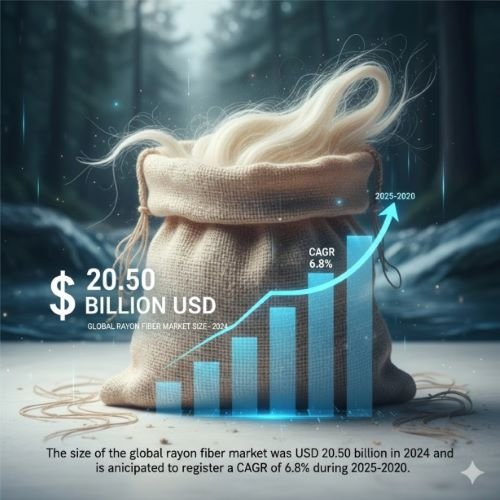
The size of the global rayon fiber market was USD 20.50 billion in 2024 and is anticipated to register a CAGR of 6.8% during 2025-2030.Size, byProduct, 2024 - 2032{USD Billion} The size of the global rayon fiber market was USD 20.50 billion in 2024 and is anticipated to register a CAGR of 6.8% during 2025-2030. request a free sample copy
Rayon Fiber Market Size, Share & Trends Analysis Report By Material Type (Viscose Rayon, Modal Rayon, Lyocell Rayon), By Application (Apparel, Home Textile, Health & Hygiene), By Region, And Segment Forecasts, 2025 - 2030
Rayon fibers, which are produced from natural cellulose, are picking up momentum with their green and biodegradable nature. In contrast to man-made fibers such as polyester, rayon fits into world sustainability strategies with its renewable nature. Both businesses and consumers are focusing on green materials, and rayon serves this purpose. Its biodegradable nature is especially attractive to green consumers and industries, thereby fueling its usage.
The swift growth of the textile industry, especially among the developing economies like China, India, and Bangladesh, is a key factor for the demand of rayon fiber. These nations are top textile exporters and enjoy high Blood incomes along with growing consumer demands for comfortable, fashionable clothes. Rayon is a favorite among both casual and formal wear due to its versatility, softness, and ease of blending with other fibers. Moreover, such government policies as subsidies and tax incentives in the regions also served to promote production of rayon fiber.
Rayon fibers are also much favored for their softness, great drape, and good dyeing properties. All these characteristics render them extremely popular in fashion uses from casual to upscale formal wear. Growing demand for comfort along with fashion apparel after the pandemic has also boosted the popularity of rayon fibers in loungewear and sportswear markets. Additionally, its application in home furnishings and sanitary products makes it more attractive to various consumer segments.
Sustained innovation in the manufacture of rayon fibers is improving its quality, performance, and longevity. Fiber strength and moisture-wicking ability are being enhanced with research aimed at minimizing environmental costs during production. Such improvements not only position rayon fibers competitively against man-made fibers but also open up new applications across sectors such as Automotive cleanliness.
Rayon fibers are also being used outside of the traditional textile world in many industries, such as Healthcare (e.g., hygienic products), Automotive (e.g., seats), and Industrial uses (e.g., filtration). The diversification increases the scope of markets and guarantees stable demand for different industries. Increased efficiency in global supply chains and logistics supports the adoption of rayon into manufacturing processes globally.
Environmental impact in the manufacturing of rayon fiber is one of the major challenges. The production Process includes Wood cellulose deforestation, high water usage, and the utilization of strong Process sulfide, that lead to pollution. These aspects create concerns regarding sustainability and potentially trigger stricter policies, which will affect market growth. Rayon fibers compete intensely with synthetic fibers, including polyester, which tend to be less expensive and more long-lasting, and plant fibers such as cotton, linen, and silk. This rivalry can restrict market growth and share, particularly in price-sensitive industries.
Report Coverage & Deliverables
PDF report & Online dashboard will enable you to seeCompetitive benchmarking
Historical data & forecasts
Company revenue shares
Regional opportunities
Latest trends & dynamics
Request a Free Sample Copy
The Grand Library - BI Enabled Market Research Database
Click on image to enlarge
Material Type Insights
The modal rayon fibers market is anticipated to advance with the highest CAGR of 7.4% during the forecast period from 2025 to 2030. Modal rayon is a high-wet-modulus fiber that is recognized by its sustainability, breathability, and moisture wicking. It is softer and lighter than viscose rayon and, therefore, enjoys popularity in sportswear, underwear, and premium bed linens. Its pilling resistance and smooth feel further add to its attractiveness for items worn next to the skin. The expansion of modal rayon is driven by growing consumer interest in comfortable but long-lasting materials in sportswear and household textiles. Also, its ability to be blended with silk or cotton makes it more versatile to use.
The market for viscose rayon fibers was valued at USD 9.59 billion in 2025. Viscose rayon is extensively employed for its silk-like feel, good drape, and retention of vibrant color. It is absorbent, breathable, and soft, thus suitable for garments like dresses and blouses and home furnishings like upholstery. Viscose rayon finds applications in a vast array of industries owing to its versatility. In apparel, it is used in dresses, blouses, shirts, and sportswear, and also in accessories like scarves. It is also used in home furnishings, such as curtains, bed sheets, tablecloths, and upholstery. Apart from these applications, viscose rayon finds important use in Industrial applications, such as tire cords and nonwoven fabrics for Blood items. The development of viscose rayon is propelled by its relative cheapness compared to natural silk, coupled with its adaptability to blending with other fibers to balance costs or improve attributes like softness and luster. Also, the rising need for environmentally friendly alternatives to man-made fibers has made viscose rayon a more popular choice among green consumers.
Application Insights
Health and hygiene uses of rayon fiber are anticipated to witness the highest CAGR of 7.4% between 2025 and 2030. Rayon fibers have important applications in Healthcare like Wound dressings, bandages, and Medical wipes owing to their high absorbance and non-irritating properties. They are soft and perfect for sensitive skin applications, whereas their biodegradability meets the increasing focus on sustainable
Regional Insights
North America rayon fiber market size accounted for USD 3.98 billion in 2024. The North America market is growing steadily, stimulated by rising demand for eco-friendly textiles and a well-developed textile and apparel industry in the region. The consumers in North America are environmentally conscious and tend to prefer biodegradable substances such as rayon over synthetics. This shift is consistent with the region's overall focus on sustainability, complemented by advances in eco-friendly manufacturing technologies. Rayon fibers are a common feature of apparel, home furnishings, and industrial uses, satisfying various consumer needs for comfort and functionality.
Global Rayon Fiber Market Size by Region (2024–2030)
| Region | 2024 | 2025 | 2026 | 2027 | 2028 | 2029 | 2030 | CAGR (2025–2030) |
|---|---|---|---|---|---|---|---|---|
| Asia Pacific (50%) | 10.25 | 10.95 | 11.69 | 12.49 | 13.34 | 14.25 | 15.22 | 6.8% |
| Europe (20%) | 4.10 | 4.38 | 4.68 | 4.99 | 5.33 | 5.70 | 6.09 | 6.8% |
| North America (18%) | 3.69 | 3.94 | 4.21 | 4.49 | 4.80 | 5.13 | 5.48 | 6.8% |
| Latin America (7%) | 1.44 | 1.54 | 1.64 | 1.75 | 1.87 | 2.00 | 2.13 | 6.8% |
| Middle East & Africa (5%) | 1.03 | 1.10 | 1.17 | 1.25 | 1.34 | 1.43 | 1.52 | 6.8% |
| Global Total | 20.50 | 21.92 | 23.39 | 24.97 | 26.68 | 28.52 | 30.49 |
U.S. Rayon Fiber Market Trends
The U.S. rayon fiber industry is anticipated to surpass USD 4.41 billion by 2030 with a CAGR of 6.3% during 2025-2030. Growing consumer demand for sustainable fabrics is one of the key drivers. With the increasing awareness about the environment, consumers are looking for environmentally friendly products as alternatives to man-made fibers, and since rayon is made from natural cellulose, it fulfills this need with a biodegradable solution. This movement towards sustainability is in line with international trends and favors the use of rayon fibers in numerous applications.
Asia Pacific Rayon Fiber Market Trends
The Asia Pacific rayon fiber market is expected to register a CAGR of 7.2% during the period 2025-2030, led by increasing manufacturing activity in the region. These countries include China, India, and Bangladesh, taking advantage of the richness in raw materials such as Wood pulp and cotton linters that render the production of rayon economically viable. Low labor costs and favorable government support in the form of subsidies and tax incentives also push industrial development and foreign investment into the textile industry. The enormous domestic market in the region, coupled with the fact that it is a Large world exporter of textiles, contributes further to the demand for rayon fibers.
Asian Pacific consumer behavior is another major driver of market expansion. The region's growing middle-class consumers with increasing disposable incomes are increasingly demanding low-cost yet high-quality textiles produced from rayon. Additionally, increasing consumer awareness of sustainability has promoted the use of biodegradable and environmentally friendly products such as rayon. Investments by governments in research and development (R&D) of sustainable textile technologies also support the region's position as a global center for rayon fiber manufacturing.
Rayon Fiber Market Report Scope
|
Report Attribute |
Details |
|
Market size value in 2025 |
USD 21.89 billion |
|
Revenue Forecast in 2030 |
USD 30.42 billion |
|
Growth Rate (Revenue) |
CAGR of 6.8% from 2025 to 2030 |
|
Actuals |
2018 - 2024 |
|
Forecast period |
2025 - 2030 |
|
Quantitative units |
Revenue in USD million/billion and CAGR from 2025 to 2030 |
|
Report Coverage |
Revenue forecast, company ranking, competitive landscape, growth factors, and trends |
|
Segments Covered |
Material type, application, region |
|
Regional scope |
North America; Europe; Asia Pacific; Central & South America; Middle East & Africa |
|
Country scope |
U.S, Canada, Mexico, Germany, U.K., France, Italy, Spain, China, Japan, India, Australia & New Zealand, South Korea, Brazil, Saudi Arabia |
|
Key companies profiled |
Aditya Birla Group; Lenzing AG; Kelheim Fibres GmbH; Grasim Industries Limited; Eastman Chemical Company; Asia Pacific Rayon Limited; Toray Industries Inc.; Sateri; Fulida (Zhejiang Fulida Holding Co., Ltd.); Aoyang Technology; Yibin Grace Group; CHTC Helon; Bohi Industry; Tembec, Inc.; Indo Rayon Utama Tbk |
|
Customization scope |
Free report customization (equivalent up to 8 analysts working days) with purchase. Addition or alteration to country, regional & segment scope. |
|
Pricing and purchase options |
Avail customized purchase options to meet your exact research needs. Explore purchase options |
Key Rayon Fiber Company Insights
The rayon fibers market has a dynamic competitive landscape with players emphasizing innovation, sustainability, and strategic partnerships to propel growth. With consumer demand for environmentally friendly materials escalating every day, players that adopt such trends will most likely be able to retain a dominant market position. Some of the key players in the rayon fibers market are Aditya Birla Group, Kelheim Fibres GmbH, The Lenzing Group, Toray Industries Inc., Asia Pacific Rayon Limited, Eastman Chemical Company, Goonvean Fibres Ltd., Grasim Industries Limited, Nanollose, Sateri, Zhejiang Fulida Holding Co., Ltd., and Zhong Tai International Development (HK) Limited. These firms are involved in a range of strategic initiatives, such as R&D spend to improve fiber quality and sustainability, acquisitions and mergers to enhance their product offerings, and partnerships with downstream customers to co-create tailored solutions.
Key Rayon Fiber Companies
The following are the leading companies in the rayon fiber market. These companies collectively hold the largest market share and dictate industry trends.
- Aditya Birla Group
- Lenzing AG
- Kelheim Fibres GmbH
- Grasim Industries Limited
- Eastman Chemical Company
- Asia Pacific Rayon Limited
- Toray Industries Inc.
- Sateri
- Fulida (Zhejiang Fulida Holding Co., Ltd.)
- Aoyang Technology
- Yibin Grace Group
- CHTC Helon
- Bohi Industry
- Tembec, Inc.
- Indo Rayon Utama Tbk
Global Rayon Fiber Market Report Segmentation
-
Application Outlook (Revenue, USD Billion, 2018 - 2030)
-
Apparel
-
Home textile
-
Health & Hygiene
-
Others
-
-
Material Type Outlook (Revenue, USD Billion, 2018 - 2030)
-
Viscose Rayon
-
Modal Rayon
-
Lyocell Rayon
-
Others
-
-
Regional Outlook (Revenue, USD Billion, 2018 - 2030)
-
North America
-
U.S.
-
Canada
-
Mexico
-
-
Europe
-
Germany
-
U.K.
-
France
-
Italy
-
Spain
-
-
Asia Pacific
-
China
-
Japan
-
India
-
Australia & New Zealand
-
South Korea
-
-
Central & South America
-
Brazil
-
-
Middle East & Africa
-
Saudi Arabia
-
-