
Railroad Market
Railroad Market Size, Share & Trends Analysis Report By Type (Passenger Rail, Rail Freight), By End Use (Mining, Construction, Agriculture, Others), By Region (North America, Europe, APAC), And Segment Forecasts
Published Date: June - 2025 | Publisher: MIR | No of Pages: 260 | Industry: consumer and goods | Format: Report available in PDF / Excel Format
View Details Download Free Sample Ask for Discount Request CustomizationClaim a Free Sample
Get a preview with key statistics, projections, and trends for this report. Ideal for quick insights.
Send Me a SampleNeed full access?
Purchase ReportRailroad Market Size & Trends
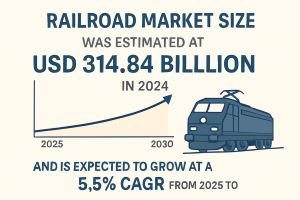
The global railroad market size was estimated at USD 314.84 billion in 2024 and is expected to grow at a CAGR of 5.5% from 2025 to 2030. We anticipate that ongoing investments in railway line projects and the expansion of railway networks worldwide will drive the market.Size, byProduct, 2024 - 2032{USD Billion} Railroad market size is expected to grow at a CAGR of 5.5% from 2025 to 2030. request a free sample copy![]()

Railroad Market
Key Highlights
- The railroad market in North America held a revenue share of 29.9% in 2024 and is expected to retain its lead throughout the forecast period.
- The railroad market in the U.S. is projected to grow at a CAGR of 5.5% from 2025 to 2030
- By type segment, passenger rail accounted for a revenue share of 59.0% of the global railroad industry in 2024.
- From 2025 to 2030, we expect rail freight demand to grow at a CAGR of 5.2% in the type segment.
- In the end-use segment, the agriculture sector held a revenue share of 34.1 % in 2024.
Several national and international railway projects, particularly in the Asia Pacific, are currently in the planning, development, or building stages, which bodes well for the future growth of the railroad industry. Railcar leasing has become a major trend around the world, and its continuation is predicted to have a favorable impact on railroad transportation. The safety and cost-effectiveness of transporting goods by rail depend on the nature of the cargo and the use of current technologies in railroad transportation. Moreover, advancements in storage facilities, power sources, and transportation timing improvements are likely to create new growth prospects for the railroad industry.
Growing use of digital technologies such as AI-driven robots and interconnected logistics is expected to fuel the adoption of freight rails for goods transportation. These technologies offer consumers security and assurance of their goods.
The digitization process is rapidly advancing globally; China Rail Corporation (CRC) is driving the digitization of the freight rail industry. China State Railway Group (CSRG), Sinotrans, and CRRC Corporation are China's major freight rail operators, and they are adopting digital technologies to optimize operations. These operators enhance efficiency, reduce costs, and contribute to China's push for a more sustainable and interconnected logistics system. For instance, China has introduced AI-driven robots in its freight railway sector, representing a significant technological advancement that greatly improves inspection efficiency and accuracy in fault detection. This intelligent system commenced operations in Cangzhou, Hebei Province, and indicates a nationwide initiative by China to modernize its freight transportation through automation and artificial intelligence.
Demand for consumer rails is increasing owing to the rising adoption of public transport instead of private transport. The increase is mainly attributed to the punctuality, comfort, and convenience offered by the passenger rail. High-speed trains offer a luxury to consumers with comfortable seats, Wi-Fi, and premium food. For instance, the Shinkansen is a trusted and worldwide symbol of Japan’s technological advancement. The trains are also known as Bullet Trains, which are a swift and efficient mode of transport. Tourists visiting Japan are eager to ride the Shinkansen train to experience a high-speed journey. The train is the safest mode of transport in Japan, with zero accidents since its launch. Issues for increasing speed involve minimizing both internal and external noise and vibrations during operation and also enhancing trains to be more energy-efficient, compact, lightweight, and easier to maintain. The Shinkansen saves travel time and is easily accessible. Commuting long distances quickly is feasible, which encourages people to live outside the city center for work and access to services. These factors led to the development of large, dense residential areas outside city centers.
Report Coverage & Deliverables
The PDF report and online dashboard will help you understand
- Competitive benchmarking
- Historical data & forecasts
- Company revenue shares
- Regional opportunities
- Latest trends & dynamics
Consumer Survey & Insights
According to the survey of UIC members, the railroad industry has experienced challenges, leading to decreased demand for passenger rail services, influenced by health and safety regulations, a growing emphasis on sustainability, and environmental awareness. Passenger rail companies face difficulties due to changes in passenger behavior, including a decline in travel demand as remote work and virtual meetings become more prevalent. Health and safety regulations are necessary, but they also present barriers to increasing ridership. Experiences differ across regions and modes of travel, and passenger rail traffic has yet to recover fully, particularly in North America and Western Europe. At the same time, the worsening impacts of climate change globally are affecting travel patterns.
Various governments and businesses are establishing ambitious targets to reduce their emissions. As a result, organizations are enhancing their efforts to encourage sustainable travel, with UIC members noting that many corporations are promoting rail travel over air travel where possible. Indian Railways introduced semi-high-speed self-propelled trains equipped with state-of-the-art features such as rapid acceleration, significantly shorter travel time, a top speed of 160 km/h, onboard entertainment options, and a GPS-driven passenger information system. The trains also have automatic sliding doors, retractable steps, zero-discharge vacuum bio-toilets, and CCTV surveillance systems.
Recently, consumers have become more conscious of environmental issues associated with different modes of transportation. As a result, we expect the overall usage of private cars to decrease by 20% to 70% in the next ten years, with regional variations. Higher adoption of railways and other sustainable modes of transportation is likely to replace this reeducation.
Consumer preferences are steadily shifting toward more sustainable, safe, quick, and robust modes of transportation. This can be identified from the growing adoption of public modes of transportation over private cars. North America maintains a strong lead in a shift away from private cars, suggesting sustained investment in rail infrastructure and technological advancements. Other key regions, such as Europe, East Asia, and Greater China, display moderate yet stable expansion, reflecting ongoing development, innovation in high-speed rail, and a growing emphasis on sustainable transport solutions.
Type Insights
Passenger rail accounted for a revenue share of 59.0% of the global railroad industry in 2024. The segment is projected to witness growth over the coming years as the tourism industry picks up speed, thanks to inexpensive passenger train fares. Furthermore, increased investments in the expansion of passenger railroad networks and the introduction of newer and faster trains, like bullet trains and metros, are likely to propel segment growth. The passenger rail segment is also expected to grow fastest in the forecast period.
Rail freight demand is expected to grow at a CAGR of 5.2% from 2025 to 2030. This is mainly due to the lower rail freight rates and the safety of goods as compared to other modes. Furthermore, the railroad network's strong connection facilitates the transportation of commodities in remote places that are otherwise impossible to reach by air. Even though global trade and cargo volumes were affected by the pandemic, the railroad industry is expected to recover over the projection period as freight and shipping volumes return to pre-pandemic levels.
End Use Insights
The agriculture sector had a revenue share of 34.1 % in 2024. Stable and efficient railroad service is especially crucial for the agriculture industry. Rail transportation is essentially the only cost-effective shipping option available for low-value, bulk commodities in rural areas far from sea transit and end markets. These factors have driven the agriculture railroad segment in the past. In India, the robust Indian railway network connects small farmers from the remotest parts of the country to the mainstream market, where they can sell their agricultural produce.
The mining sector is expected to grow at a CAGR of 5.8% over the forecast period to overtake the agriculture segment in terms of market size by 2030. Monorail systems are being increasingly employed in coal and ore mines because of their efficiency and cheap running costs. Monorail systems are quickly becoming essential components in all mining projects where transportation systems have been optimized and where road and rail transportation can be combined. Looking to capitalize on the opportunities in freight, the Indian Railways has been mapping mining districts across the country to connect them with the railroad network.
Regional Insights
The railroad market in North America held a revenue share of 29.9% in 2024 and is expected to retain its lead throughout the forecast period. Freight rail is a pillar of the American economy, according to the Association of American Railroads, and the U.S. is home to a top-tier network for freight rail. The growth of freight rail in the country can be linked to continued investments in the enhancement of equipment, infrastructure, and technology. Rising consumer demand, increased passenger safety measures, and technological and operational advancements drive passenger railroad services in the region.
U.S. Railroad Market Trends
The railroad market in the U.S. is projected to grow at a CAGR of 5.5% from 2025 to 2030, owing to several key factors. These include increased investments in rail infrastructure, rising demand for efficient freight transportation, and advancements in rail technology. Additionally, the emphasis on sustainable and eco-friendly transportation solutions is driving the adoption of rail over other modes. The growth is further supported by government initiatives aimed at modernizing the rail network and improving connectivity across regions.
Europe Railroad Market Trends
The European railroad market accounted for over 21% of the global railroad industry's revenue in 2024. This is driven by Europe's commitment to sustainable transportation, leading to significant investments in modernizing and expanding rail networks across the continent. Initiatives like the Trans-European Transport Network (TEN-T) aim to enhance cross-border connectivity, while the development of high-speed rail networks in countries such as France, Spain, and Germany further boosts market growth. Additionally, the adoption of digital technologies and smart rail infrastructure is improving operational efficiency and passenger experience, contributing to the market's expansion.
Asia Pacific Railroad Market Trends
The railroad market in Asia Pacific is expected to grow at a CAGR of 6.2% from 2025 to 2030 due to increased government investments in new railroad construction and the high reliance of the population on rail transport. For example, Timetric's Construction Intelligence Center (CIC) shows that the Asia Pacific leads the world in railroad investment. It is also the world's largest transport infrastructure market, with PwC forecasting annual spending of about USD 900 billion by 2025. Apart from this, increased imports and exports from Asian countries are predicted to boost the railroad industry's growth.
Key Railroad Company Insights
The market includes both international and domestic participants who focus on strategies such as innovation, mergers and acquisitions, and investments in technology, infrastructure, and expansions to enhance their position in the market. Some prominent companies in this market are Central Japan Railway Company, SNCF Group, OAO RZD (Russian Railways), Indian Railways, and BNSF Railway.
-
Central Japan Railway Company (JR Central) is a major railway operator in Japan, best known for its operation of the Shinkansen, or Bullet Train, which connects key cities like Tokyo, Nagoya, and Osaka. Established in 1987 after the privatization of Japan National Railways (JNR), JR Central is headquartered in Nagoya. The company is a leader in high-speed rail technology, renowned for its commitment to safety, punctuality, and innovation. It also operates conventional rail services and is involved in various real estate and retail businesses, contributing significantly to Japan's transportation infrastructure and economy.
-
SNCF (Société Nationale des Chemins de fer Français) is the national railway company of France, responsible for operating the majority of the country’s rail services, including high-speed trains like the TGV (Train à Grande Vitesse). Established in 1938, SNCF is a state-owned company that is crucial in France’s transportation infrastructure. It operates a wide range of services, from regional and intercity trains to international connections, and is known for its commitment to innovation, punctuality, and sustainability in rail transport. SNCF is also involved in logistics, freight services, and urban transport solutions, focusing on reducing the environmental impact of its operations.
Key Railroad Companies
The following are the leading companies in the railroad market. These companies collectively hold the largest market share and dictate industry trends.
- Central Japan Railway Company
- SNCF Group
- Union Pacific Corporation
- OAO RZD (Russian Railways)
- BNSF Railway
- Indian Railways
- Deutsche Bahn
- JSC Russian Railways
- CSX Corporation
- Canadian Pacific Railway
- Recent Developments
Recent Developments
-
In March 2025, The USA board approved the Canadian National and Iowa Northern merger. The deal strengthens logistics and opens new opportunities for clients. Iowa Northern connects its railway network with Canadian National in Iowa. Waterloo and Cedar Rapids stations now provide seamless cargo delivery to clients. Link
-
In May 2024,Spanish-based Rail manufacturer Danobat, a leader in the design and development of advanced manufacturing solutions, strengthened its position in the North American rail market with the acquisition of the American company Delta Wheel Truing Solutions.
Railroad Market Report Scope
|
Report Attribute |
Details |
|
Market size value in 2025 |
USD 334.20 billion |
|
Revenue forecast in 2030 |
USD 436.35 billion |
|
Growth rate |
CAGR of 5.5% from 2025 to 2030 |
|
Actuals |
2018-2024 |
|
Forecast |
2025-2030 |
|
Quantitative units |
Revenue in USD million/billion and CAGR from 2025 to 2030 |
|
Report coverage |
Revenue forecast, company ranking, competitive landscape, growth factors, and trends |
|
Segments covered |
Type, end use, region |
|
Regional scope |
North America, Europe, Asia Pacific, Central & South America, Middle East & Africa |
|
Country scope |
U.S.; Canada; Mexico; Germany; UK; France; Italy; Spain; India; China; Japan; Australia; Indonesia; Brazil; UAE; Saudi Arabia |
|
Key companies profiled |
Central Japan Railway Company; SNCF; Union Pacific CorporationRZD (Russian Railways); BNSF Railways; Indian Railways; Deutsche Bahn; JSC Russian Railways; CSX Corporation; Canadian Pacific Railway |
|
Customization scope |
We offer free report customization (equivalent to up to 8 analysts' working days) with every purchase. You can include or modify the scope of the country, region, and segment. |
|
Pricing and purchase options |
Avail yourself of customized purchase options to meet your exact research needs. Explore purchase options |
Global Railroad Market Report Segmentation
This report forecasts revenue growth at global, regional, and country levels and provides an analysis of the latest trends and opportunities in each of the subsegments from 2018 to 2030. For the purpose of this study, Grand View Research has segmented the railroad market on the basis of type, end-use, and region.
-
Type Outlook (Revenue, USD Billion, 2018-2030)
-
Rail Freight
-
Passenger Rail
-
-
End Use Outlook (Revenue, USD Billion, 2018-2030)
-
Mining
-
Construction
-
Agriculture
-
Others
-
-
Regional Outlook (Revenue, USD Billion, 2018-2030)
-
North America
-
U.S.
-
Canada
-
Mexico
-
-
Europe
-
Germany
-
UK
-
France
-
Italy
-
Spain
-
-
Asia Pacific
-
India
-
China
-
Japan
-
Australia
-
Indonesia
-
-
Central & South America
-
Brazil
-
-
Middle East & Africa
-
UAE
-
Saudi Arabia
-
-
Frequently Asked Questions
The global railroad market was estimated at USD 314.84 billion in 2024 and is expected to reach USD 334.20 billion in 2025.
The global railroad market is expected to grow at a compound annual growth rate of 5.5% from 2025 to 2030 to reach USD 436.35 billion by 2030.
North America held a revenue market share of 29.2% in 2024 and is expected to retain its lead throughout the forecast period. Freight rail is a pillar of the American economy, according to the Association of American Railroads, and the U.S. is home to a world-class freight rail network.
Some of the key players operating in the railroads market include Procter & Gamble; The Estée Lauder Companies Inc.; Mama Earth; Unilever; The Clorox Company; Honest Co.; The Body Shop; L’Oréal; FOM London Skincare; Bloomtown.
Key factors that are driving the railroad market growth include increasing investments by the governments in various countries to improve the railway infrastructure & build new lines and the growing tourism industry in the Asia Pacific and European countries.
Related Reports
- Laminated Labels Market Size - By Material Type (Polyester, Polypropylene, Vinyl), By Composition (Lamination layer, Fac...
- Liquid Pouch Packaging Market Size - By Packaging (Rigid, Flexible), By Material (Polyester, Polyethylene, Polystyrene, ...
- Confectionery Packaging Market Size - By Product Type (Chocolate packaging, Candy packaging, Gum packaging, Biscuits & C...
- Honeycomb Packaging Market Size - By Material Type (Paper-based, Plastic-based, Aluminium-based), By Packaging Type (Box...
- Consumer Electronics Packaging Market Size - By Material Type (Paper & Paperboard Packaging, Plastic Packaging, Metal Pa...
- Thermoform Packaging Market Size - By Material Type (Polyethylene (PE), Polyvinyl Chloride (PVC), Polyethylene Terephtha...
Table of Content
Table of Contents
Chapter 1. Methodology and Scope
1.1. Market Segmentation& Scope
1.2. Market Definition
1.3. Information Procurement
1.3.1. Purchased Database
1.3.2. GVR’s Internal Database
1.3.3. Secondary Sources & Third-Party Perspectives
1.3.4. Primary Research
1.4. Information Analysis
1.4.1. Data Analysis Models
1.5. Market Formulation & Data Visualization
1.6. Data Validation & Publishing
Chapter 2. Executive Summary
2.1. Market Outlook
2.2. Segmental Outlook
2.3. Competition Outlook
Chapter 3. Railroad Market Variables, Trends & Scope
3.1. Market Lineage Outlook
3.2. Industry Value Chain Analysis
3.3. Market Dynamics
3.3.1. Market driver analysis
3.3.2. Market restraint analysis
3.3.3. Industry challenges
3.3.4. Industry opportunities
3.4. Industry Analysis Tools
3.4.1. Industry Analysis - Porter’s
3.4.1.1. Supplier Power
3.4.1.2. Buyer Power
3.4.1.3. Substitution Threat
3.4.1.4. Threat from New Entrants
3.4.1.5. Competitive Rivalry
3.4.1.6. Industry opportunities
3.5. Market Entry Strategies
Chapter 4. Railroad Market: Type Estimates & Trend Analysis
4.1. Railroad Market, By Type: Key Takeaways
4.2. Type Movement Analysis & Market Share, 2024 & 2030
4.3. Market Estimates & Forecasts, by Type, 2018-2030 (USD Billion)
4.3.1. Rail Freight
4.3.1.1. Market estimates and forecast, 2018-2030 (USD Billion)
4.3.2. Passenger Rail
4.3.2.1. Market estimates and forecast, 2018-2030 (USD Billion)
Chapter 5. Railroad Market: End Use Estimates & Trend Analysis
5.1. Railroad Market, By End Use: Key Takeaways
5.2. End Use Movement Analysis & Market Share, 2024 & 2030
5.3. Market Estimates & Forecasts, by End Use, 2018-2030 (USD Billion)
5.3.1. Mining
5.3.1.1. Market estimates and forecast, 2018-2030 (USD Billion)
5.3.2. Construction
5.3.2.1. Market estimates and forecast, 2018-2030 (USD Billion)
5.3.3. Agriculture
5.3.3.1. Market estimates and forecast, 2018-2030 (USD Billion)
5.3.4. Others
5.3.4.1. Market estimates and forecast, 2018-2030 (USD Billion)
Chapter 6. Railroad Market: Regional Estimates & Trend Analysis
6.1. Railroad Market, By Region: Key Takeaways
6.2. Regional Movement Analysis & Market Share, 2024 & 2030
6.3. Market Estimates & Forecasts, by Region, 2018-2030 (USD Billion)
6.4. North America
6.4.1. North America railroads market estimates and forecast, 2018-2030 (USD Billion)
6.4.2. U.S.
6.4.2.1. Key country dynamics
6.4.2.2. U.S. railroads market estimates and forecast, 2018-2030 (USD Billion)
6.4.3. Canada
6.4.3.1. Key country dynamics
6.4.3.2. Canada railroads market estimates and forecast, 2018-2030 (USD Billion)
6.4.4. Mexico
6.4.4.1. Key country dynamics
6.4.4.2. Mexico railroads market estimates and forecast, 2018-2030 (USD Billion)
6.5. Europe
6.5.1. Europe railroads market estimates and forecast, 2018-2030 (USD Billion)
6.5.2. UK
6.5.2.1. Key country dynamics
6.5.2.2. UK railroads market estimates and forecast, 2018-2030 (USD Billion)
6.5.3. France
6.5.3.1. Key country dynamics
6.5.3.2. France railroads market estimates and forecast, 2018-2030 (USD Billion)
6.5.4. Germany
6.5.4.1. Key country dynamics
6.5.4.2. Germany railroads market estimates and forecast, 2018-2030 (USD Billion)
6.5.5. Spain
6.5.5.1. Key country dynamics
6.5.5.2. Spain railroads market estimates and forecast, 2018-2030 (USD Billion)
6.5.6. Italy
6.5.6.1. Key country dynamics
6.5.6.2. Italy railroads market estimates and forecast, 2018-2030 (USD Billion)
6.6. Asia Pacific
6.6.1. Asia Pacific railroads market estimates and forecast, 2018-2030 (USD Billion)
6.6.2. India
6.6.2.1. Key country dynamics
6.6.2.2. India railroads market estimates and forecast, 2018-2030 (USD Billion)
6.6.3. China
6.6.3.1. Key country dynamics
6.6.3.2. China railroads market estimates and forecast, 2018-2030 (USD Billion)
6.6.4. Japan
6.6.4.1. Key country dynamics
6.6.4.2. Japan railroads market estimates and forecast, 2018-2030 (USD Billion)
6.6.5. Indonesia
6.6.5.1. Key country dynamics
6.6.5.2. Indonesia railroads market estimates and forecast, 2018-2030 (USD Billion)
6.6.6. Australia
6.6.6.1. Key country dynamics
6.6.6.2. Australia railroads market estimates and forecast, 2018-2030 (USD Billion)
6.7. Central & South America
6.7.1. Central & South America railroads market estimates and forecast, 2018-2030 (USD Billion)
6.7.2. Brazil
6.7.2.1. Key country dynamics
6.7.2.2. Brazil railroads market estimates and forecast, 2018-2030 (USD Billion)
6.8. Middle East & Africa (MEA)
6.8.1. Middle East & Africa railroads market estimates and forecast, 2018-2030 (USD Billion)
6.8.2. UAE
6.8.2.1. Key country dynamics
6.8.2.2. UAE railroads market estimates and forecast, 2018-2030 (USD Billion)
6.8.3. Saudi Arabia
6.8.3.1. Key country dynamics
6.8.3.2. Saudi Arabia railroads market estimates and forecast, 2018-2030 (USD Billion)
Chapter 7. Competitive Analysis
7.1. Recent Developments & Impact Analysis, by Key Market Participants
7.2. Company Categorization
7.3. Participant’s Overview
7.4. Financial Performance
7.5. Service Benchmarking
7.6. Company Market Share Analysis, 2024 (%)
7.7. Company Heat Map Analysis, 2024
7.8. Strategy Mapping
7.9. Company Profiles
7.9.1. Central Japan Railway Company
7.9.1.1. Company Overview
7.9.1.2. Financial Performance
7.9.1.3. Service Portfolios
7.9.1.4. Strategic Initiatives
7.9.2. SNCF Group
7.9.2.1. Company Overview
7.9.2.2. Financial Performance
7.9.2.3. Service Portfolios
7.9.2.4. Strategic Initiatives
7.9.3. Union Pacific Corporation
7.9.3.1. Company Overview
7.9.3.2. Financial Performance
7.9.3.3. Service Portfolios
7.9.3.4. Strategic Initiatives
7.9.4. OAO RZD (Russian Railways)
7.9.4.1. Company Overview
7.9.4.2. Financial Performance
7.9.4.3. Service Portfolios
7.9.4.4. Strategic Initiatives
7.9.5. BNSF Railway
7.9.5.1. Company Overview
7.9.5.2. Financial Performance
7.9.5.3. Service Portfolios
7.9.5.4. Strategic Initiatives
7.9.6. Indian Railways
7.9.6.1. Company Overview
7.9.6.2. Financial Performance
7.9.6.3. Service Portfolios
7.9.6.4. Strategic Initiatives
7.9.7. Deutsche Bahn
7.9.7.1. Company Overview
7.9.7.2. Financial Performance
7.9.7.3. Service Portfolios
7.9.7.4. Strategic Initiatives
7.9.8. JSC Russian Railways
7.9.8.1. Company Overview
7.9.8.2. Financial Performance
7.9.8.3. Service Portfolios
7.9.8.4. Strategic Initiatives
7.9.9. CSX Corporation
7.9.9.1. Company Overview
7.9.9.2. Financial Performance
7.9.9.3. Service Portfolios
7.9.9.4. Strategic Initiatives
7.9.10. Canadian Pacific Railway
7.9.10.1. Company Overview
7.9.10.2. Financial Performance
7.9.10.3. Service Portfolios
7.9.10.4. Strategic Initiatives
List of Tables
Table 1 Railroad market: Key market driver analysis
Table 2 Railroad market: Key market restraint analysis
Table 3 Railroads market estimates & forecast, by type (USD Billion)
Table 4 Rail freight market estimates & forecast, 2018-2030 (USD Billion)
Table 5 Passenger rail market estimates & forecast, 2018-2030 (USD Billion)
Table 6 Railroad market estimates & forecast, by end use (USD Billion)
Table 7 Railroad market estimates & forecast for mining, 2018-2030 (USD Billion)
Table 8 Railroad market estimates & forecast for construction, 2018-2030 (USD Billion)
Table 9 Railroad market estimates & forecast for agriculture, 2018-2030 (USD Billion)
Table 10 Railroad market estimates & forecast for others, 2018-2030 (USD Billion)
Table 11 North America railroad market estimates and forecast, 2018-2030 (USD Billion)
Table 12 North America railroad market revenue estimates and forecast by type, 2018-2030 (USD Billion)
Table 13 North America railroad market revenue estimates and forecast by end use, 2018-2030 (USD Billion)
Table 14 U.S. macro-economic outlay
Table 15 U.S. railroad market estimates and forecast, 2018-2030 (USD Billion)
Table 16 U.S. railroad market revenue estimates and forecast by type, 2018-2030 (USD Billion)
Table 17 U.S. railroad market revenue estimates and forecast by end use, 2018-2030 (USD Billion)
Table 18 Canada's Macroeconomic Outlay
Table 19 Canada railroad market estimates and forecast, 2018-2030 (USD Billion)
Table 20 Canada railroad market revenue estimates and forecast by type, 2018-2030 (USD Billion)
Table 21 Canada railroad market revenue estimates and forecast by end use, 2018-2030 (USD Billion)
Table 22 Mexico macro-economic outlay
Table 23 Mexico railroad market estimates and forecast, 2018-2030 (USD Billion)
Table 24 Mexico railroad market revenue estimates and forecast by type, 2018-2030 (USD Billion)
Table 25 Mexico railroad market revenue estimates and forecast by end use, 2018-2030 (USD Billion)
Table 26 Europe railroad market estimates and forecast, 2018-2030 (USD Billion)
Table 27 Europe railroad market revenue estimates and forecast by type, 2018-2030 (USD Billion)
Table 28 Europe railroad market revenue estimates and forecast by end use, 2018-2030 (USD Billion)
Table 29 UK macro-economic outlay
Table 30 UK railroad market estimates and forecast, 2018-2030 (USD Billion)
Table 31 UK railroad market revenue estimates and forecast by type, 2018-2030 (USD Billion)
Table 32 UK railroad market revenue estimates and forecast by end use, 2018–2030 (USD Billion)
Table 33 Germany macro-economic outlay
Table 34 Germany railroad market estimates and forecast, 2018-2030 (USD Billion)
Table 35 Germany railroad market revenue estimates and forecast by type, 2018-2030 (USD Billion)
Table 36 Germany railroad market revenue estimates and forecast by end use, 2018-2030 (USD Billion)
Table 37 France's macroeconomic outlay
Table 38 France railroad market estimates and forecast, 2018-2030 (USD Billion)
Table 39 France railroad market revenue estimates and forecast by type, 2018-2030 (USD Billion)
Table 40 France railroad market revenue estimates and forecast by end use, 2018-2030 (USD Billion)
Table 41 Spain macro-economic outlay
Table 42 Spain railroad market estimates and forecast, 2018-2030 (USD Billion)
Table 43 Spain railroad market revenue estimates and forecast by type, 2018-2030 (USD Billion)
Table 44 Spain railroad market revenue estimates and forecast by end use, 2018–2030 (USD Billion)
Table 45 Italy macro-economic outlay
Table 46 Italy railroad market estimates and forecast, 2018-2030 (USD Billion)
Table 47 Italy railroad market revenue estimates and forecast by type, 2018-2030 (USD Billion)
Table 48 Italy railroad market revenue estimates and forecast by end use, 2018-2030 (USD Billion)
Table 49 Asia Pacific railroad market estimates and forecast, 2018-2030 (USD Billion)
Table 50 Asia Pacific railroad market revenue estimates and forecast by type, 2018-2030 (USD Billion)
Table 51 Asia Pacific railroad market revenue estimates and forecast by end use, 2018-2030 (USD Billion)
Table 52 India's -economic outlay
Table 53 India railroad market estimates and forecast, 2018-2030 (USD Billion)
Table 54 India railroad market revenue estimates and forecast by type, 2018-2030 (USD Billion)
Table 55 India railroad market revenue estimates and forecast by end use, 2018-2030 (USD Billion)
Table 56 China's -economic outlay
Table 57 China railroad market estimates and forecast, 2018-2030 (USD Billion)
Table 58 China railroad market revenue estimates and forecast by type, 2018-2030 (USD Billion)
Table 59 China railroad market revenue estimates and forecast by end use, 2018–2030 (USD Billion)
Table 60 Japan economic outlay
Table 61 Japan railroad market estimates and forecast, 2018-2030 (USD Billion)
Table 62 Japan railroad market revenue estimates and forecast by type, 2018-2030 (USD Billion)
Table 63 Japan railroad market revenue estimates and forecast by end use, 2018-2030 (USD Billion)
Table 64 Australia macro-economic outlay
Table 65 Australia railroad market estimates and forecast, 2018-2030 (USD Billion)
Table 66 Australia railroad market revenue estimates and forecast by type, 2018-2030 (USD Billion)
Table 67 Australia railroad market revenue estimates and forecast by end use, 2018-2030 (USD Billion)
Table 68 Indonesia macro-economic outlay
Table 69 Indonesia railroad market estimates and forecast, 2018-2030 (USD Billion)
Table 70 Indonesia railroad market revenue estimates and forecast by type, 2018-2030 (USD Billion)
Table 71 Indonesia railroad market revenue estimates and forecast by end use, 2018-2030 (USD Billion)
Table 72 Central & South America railroad market estimates and forecast, 2018-2030 (USD Billion)
Table 73 Central & South America railroad market revenue estimates and forecast by type, 2018-2030 (USD Billion)
Table 74 Central & South America railroad market revenue estimates and forecast by end use, 2018-2030 (USD Billion)
Table 75 Brazil macro-economic outlay
Table 76 Brazil railroad market estimates and forecast, 2018-2030 (USD Billion)
Table 77 Brazil railroad market revenue estimates and forecast by type, 2018-2030 (USD Billion)
Table 78 Brazil railroad market revenue estimates and forecast by end use, 2018-2030 (USD Billion)
Table 79 Middle East & Africa railroad market estimates and forecast, 2018-2030 (USD Billion)
Table 80 Middle East & Africa railroad market revenue estimates and forecast by type, 2018-2030 (USD Billion)
Table 81 Middle East & Africa railroad market revenue estimates and forecast by end use, 2018-2030 (USD Billion)
Table 82 UAE economic outlay
Table 83 UAE railroad market estimates and forecast, 2018-2030 (USD Billion)
Table 84 UAE railroad market revenue estimates and forecast by type, 2018-2030 (USD Billion)
Table 85 UAE railroad market revenue estimates and forecast by end use, 2018-2030 (USD Billion)
Table 86 Saudi Arabia macro-economic outlay
Table 87 Saudi Arabia railroad market estimates and forecast, 2018-2030 (USD Billion)
Table 88 Saudi Arabia railroad market revenue estimates and forecast by type, 2018-2030 (USD Billion)
Table 89 Saudi Arabia railroad market revenue estimates and forecast by end use, 2018-2030 (USD Billion)
Table 90 Recent developments & impact analysis, by key market participants
Table 91 Company market share, 2024
Table 92 Company heat map analysis, 2024
Table 93 Companies implementing key strategies
List of Figures
Fig. 1 Railroad market segmentation
Fig. 2 Information procurement
Fig. 3 Primary research pattern
Fig. 4 Primary research approaches
Fig. 5 Primary research process
Fig. 6 Market snapshot
Fig. 7 Segment snapshot
Fig. 8 Regional snapshot
Fig. 9 Competitive landscape Snapshot
Fig. 10 Global parent industry and railroad market size (USD Billion)
Fig. 11 Railroad market segmentation & scope
Fig. 12 Railroad market penetration & growth prospect mapping
Fig. 13 Railroad market value chain analysis
Fig. 14 Railroad market dynamics
Fig. 15 Railroad market porter's analysis
Fig. 16 Railroad market, by type: Key takeaways
Fig. 17 Railroad market, by type: Market share, 2024 & 2030
Fig. 18 Rail freight market estimates & forecasts, 2018-2030 (USD Billion)
Fig. 19 Passenger rail market estimates & forecasts, 2018-2030 (USD Billion)
Fig. 20 Railroad market, by end use: Key takeaways
Fig. 21 Railroad market, by end use: Market share, 2024 & 2030
Fig. 22 Railroad market estimates & forecasts for mining, 2018-2030 (USD Billion)
Fig. 23 Railroad market estimates & forecasts for construction, 2018-2030 (USD Billion)
Fig. 24 Railroad market estimates & forecasts for agriculture, 2018-2030 (USD Billion)
Fig. 25 Railroad market estimates & forecasts for others, 2018-2030 (USD Billion)
Fig. 26 Railroad market revenue, by region, 2024 & 2030 (USD Billion)
Fig. 27 Regional marketplace: Key takeaways
Fig. 28 North America railroad market estimates & forecast, 2018-2030 (USD Billion)
Fig. 29 US railroad market estimates & forecast, 2018-2030 (USD Billion)
Fig. 30 Mexico railroad market estimates & forecast, 2018-2030 (USD Billion)
Fig. 31 Canada railroad market estimates & forecast, 2018-2030 (USD Billion)
Fig. 32 Europe railroad market estimates & forecasts, 2018-2030 (USD Billion)
Fig. 33 UK railroad market estimates & forecasts, 2018-2030 (USD Billion)
Fig. 34 Germany railroad market estimates & forecasts, 2018-2030 (USD Billion)
Fig. 35 France railroad market estimates & forecasts, 2018-2030 (USD Billion)
Fig. 36 Spain railroad market estimates & forecasts, 2018-2030 (USD Billion)
Fig. 37 Italy railroad market estimates & forecasts, 2018-2030 (USD Billion)
Fig. 38 Asia Pacific railroad market estimates & forecast, 2018-2030 (USD Billion)
Fig. 39 India railroad market estimates & forecast, 2018-2030 (USD Billion)
Fig. 40 China railroad market estimates & forecast, 2018-2030 (USD Billion)
Fig. 41 Japan railroad market estimates & forecast, 2018-2030 (USD Billion)
Fig. 42 Australia railroad market estimates & forecast, 2018-2030 (USD Billion)
Fig. 43 Indonesia railroad market estimates & forecast, 2018-2030 (USD Billion)
Fig. 44 Central & South America railroad market estimates & forecast, 2018-2030 (USD Billion)
Fig. 45 Brazil railroad market estimates & forecast, 2018-2030 (USD Billion)
Fig. 46 Middle East & Africa railroad market estimates & forecast, 2018-2030 (USD Billion)
Fig. 47 UAE railroad market estimates & forecast, 2018-2030 (USD Billion)
Fig. 48 Saudi Arabia railroad market estimates & forecast, 2018-2030 (USD Billion)
Fig. 49 Key company categorization
Fig. 50 Company market share analysis, 2024 (Value % Share)
Fig. 51 Strategic framework
Key Railroad Companies:
The following are the leading companies in the railroad market. These companies collectively hold the largest market share and dictate industry trends.
- Central Japan Railway Company
- SNCF Group
- Union Pacific Corporation
- OAO RZD (Russian Railways)
- BNSF Railway
- Indian Railways
- Deutsche Bahn
- JSC Russian Railways
- CSX Corporation
- Canadian Pacific Railway
- Recent Developments