
Claim a Free Sample
Get a preview with key statistics, projections, and trends for this report. Ideal for quick insights.
Send Me a SampleNeed full access?
Purchase ReportMarket Size & Trends
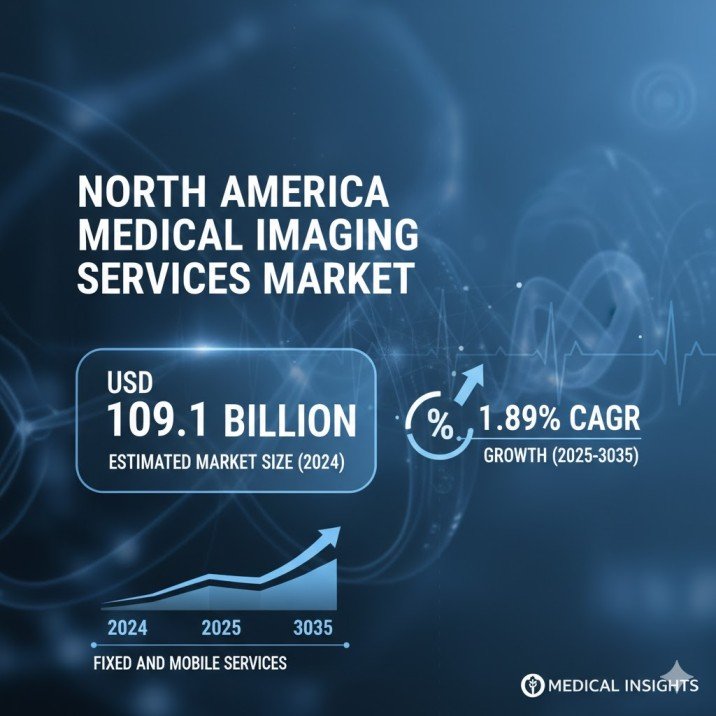
The size of the North America fixed and mobile medical imaging services market was estimated to be USD 109.1 billion in 2024 and is estimated to grow at a 1.89% CAGR from 2025 to 2035.Size, byProduct, 2024 - 2032{USD Billion} The North America fixed and mobile medical imaging services market was estimated to be USD 109.1 billion in 2024 and is estimated to grow at a 1.89% CAGR from 2025 to 2035. request a free sample copy
North America Mobile And Fixed Medical Imaging Services Market Size, Share & Trends Analysis Report By Technology (Mobile & Interim Imaging Services, Fixed Radiology Services), By Application, By End Use, By Country, And Segment Forecasts
The rising incidence of chronic diseases like cardiovascular diseases, diabetes, and respiratory disorders impacts the growth of the market. With these conditions necessitating continuous monitoring, diagnostics, and treatment, mobile imaging services provide an affordable, effective, and convenient option for patients and providers. High-technology imaging like MRI, CT, and PET scans are vital diagnostic and monitoring tools for chronic conditions, and mobile units make sure that access is provided beyond urban areas to rural and underserved areas.
The rising prevalence of chronic diseases like cancer, cardiovascular diseases, diabetes, and respiratory diseases is fueling demand for fixed and mobile imaging services in North America. For example, as of 2023, the American Lung Association has indicated that approximately 15.4 million U.S. adults have chronic obstructive pulmonary disease (COPD), whereas close to 34.7 million adults are suffering from chronic lung disease. In addition, the CDC reports that coronary artery disease (CAD) is the leading heart disease in America, affecting approximately 1 out of 20 adults aged 20 and above.
New imaging technologies, such as MRI, CT, and PET scans, are crucial to diagnose and track chronic disease, while mobile units facilitate access to rural and underserved populations outside of urban environments. The mounting disease burden expands hospital imaging volumes, and thus, providers must look for other means that keep patients waiting shorter periods and increase patient flow. Mobile imaging services serve to close the gap by making timely diagnoses directly in doctors' offices, nursing homes, or community clinics. With chronic disease prevalence expected to rise, the healthcare system will increasingly rely on flexible and scalable diagnostic tools like mobile imaging.
For instance, the American Cancer Society estimates approximately 2,041,910 new cancer cases in the U.S. for the year 2025, with approximately 618,120 cancer-related deaths. Similarly, the Canadian Cancer Society forecasts about 247,100 new cancer cases in Canada in 2025, together with an estimated 88,100 cancer-related deaths. Cancer has emerged as a major healthcare burden and a primary cause of mortality in the U.S. Accordingly, with a rise in preventive and diagnostic cancer operations, the requirement for imaging services is anticipated to experience unprecedented growth.
Secondly, the rapidly growing aging population in North America plays a major role in fueling the rising utilization of mobile and fixed imaging services. Seniors are particularly vulnerable to an array of chronic illnesses and ailments related to age, making it imperative to conduct regular diagnostic imaging early on and continue monitoring. The Population Reference Bureau (PRB) estimates that in the U.S., the population aged 65 and older will increase from 58 million in 2022 to 82 million by 2050, an increase of 47%. The proportion of this age group within the total population is expected to increase from 17% to 23%.
In Canada, the 65-and-older population was 7,820,121 in 2024, or 18.9% of the country's total. This population often faces barriers to using traditional hospital-based imaging services through reduced mobility, lack of access to transportation, or cognitive limitations. Mobile imaging facilities successfully mitigate these barriers by providing essential diagnostic care directly to long-term care settings, retirement homes, and personal residences. This trend improves patient comfort and convenience, reduces the burden on hospital resources, and eliminates unnecessary hospital visits, substantially increasing the demand for home and fixed imaging services in the market, thus driving market growth.
Growing focus on patient-centric care models substantially fuels the need for point-of-care and home-based healthcare services in North America. This demand is driven significantly by increasing healthcare expenditure and the imperative to keep hospital stays short. With healthcare systems placing greater emphasis on cost-effectiveness and enhanced patient satisfaction, fixed and mobile imaging services are seeing increasing demand. Such services provide various ranges of diagnostic imaging, like X-rays and ultrasounds, even cutting-edge modalities like CT, right to the patient's homes or outpatient clinics and long-term care facilities.
Market Concentration & Characteristics
The North American mobile & fixed medical imaging services market has moderate industry concentration with various important players having market dominance. Programs aimed at enhancing awareness and information on skin ailments and early detection also boost the market further.
The North American mobile and fixed medical imaging services industry is characterized by high innovation. Notable innovations have included portable imaging devices, such as compact MRI and ultrasound machines, and the integration of AI imaging software. The shift from 2D to 3D and 4D imaging technologies has further revolutionized the field, offering more detailed and accurate surgical planning and diagnosis visualizations.
Regulatory regimes have a big impact on the North American fixed and mobile medical imaging services industry, as many jurisdictions treat these products as medical devices. Compliance with regulation, for example US FDA requirements or EU CE marking, is necessary for access to the market and customer confidence. These regimes control many factors, such as product design, manufacturing, and post-market surveillance, and affect product development timetables and access to market. Changing regulatory environments require ongoing surveillance and adjustment on the part of industry participants to remain compliant and best manage market dynamics.
Mergers and acquisitions in the North American mobile & fixed medical imaging services market are increasing because of research and development needs, which indicate the nature of the industry as changing. Firms undertake mergers and acquisitions in order to diversify their product offerings, enter new territories, obtain innovative technologies, and gain economies of scale. These deals are intended to diversify portfolios, acquire AI capabilities, or enter new markets. There is a steady interest in medical device and traditional players and technology firms seeking to enter the digital health and diagnostics market.
The North American fixed and mobile medical imaging services market is challenged by conventional and new imaging techniques. Point-of-care (POC) imaging devices, including portable ultrasound and low-field MRI systems, allow bedside diagnosis in emergency departments, intensive care units, and even homes. The small, often cloud-based integrated devices allow for real-time image sharing and remote consultation, minimizing the need for conventional imaging centers.
The North America fixed & mobile medical imaging services market is growing geographically, with the U.S. and Canada at the forefront of adoption due to sophisticated healthcare infrastructure, increased awareness, and regulatory transparency. In April 2025, Probo Medical made an announcement regarding a partnership with GE HealthCare to distribute sophisticated ultrasound equipment, such as the Vivid, LOGIQ, Versana, Venue, and Vscan Air lines. This partnership reinforces Probo's commitment to offering high-quality medical imaging technology and services for healthcare professionals across the country.
Report Coverage & Deliverables
PDF report & online dashboard will help you understand
- Competitive benchmarking
- Historical data & forecasts
- Company revenue shares
- Regional opportunities
- Latest trends & dynamics
Technology Insights
The fixed radiology services segment held the highest market share of 93.8% in 2024. Fixed imaging services are defined as fixed systems that are installed within healthcare settings like hospitals, outpatient clinics, and dedicated imaging centers. They encompass diagnostic technology like MRI, CT, X-ray, ultrasound, and nuclear medicine systems. These yield high-resolution images of the internal body structures to detect, diagnose, and treat several medical conditions. Fixed imaging systems are usually regarded as the cornerstone of contemporary healthcare since they provide high-resolution, precise, and consistent diagnostic outcomes. These systems continue to be critical in offering comprehensive and sophisticated care, catering to different clinical requirements, and enabling complicated procedures.
The mobile & interim imaging services segment is likely to expand at the highest CAGR of 3.22% during the forecast period. Mobile imaging services also involve fully furnished, equipped, and climate-controlled trailers that provide adaptable radiology solutions. Interim imaging services are also placed at a healthcare facility on an interim basis, especially during construction or renovation periods. Over the last few years, the need for mobile medical imaging services has grown remarkably, driven by their ability to increase patient results and easy mobility. The rise in the volume of medical imaging procedures is another key driver for market growth.
Application Insights
Orthopedics segment dominated with the maximum share, 21.2%, of North America's fixed and mobile medical imaging services market 2024. Diagnostic imaging is crucial in the comprehension, diagnosis, and management of musculoskeletal ailments. It facilitates accurate detection of fractures and assessment of soft tissue injury by orthopedic professionals utilizing sophisticated imaging techniques, which provide in-depth insights for individualized treatment planning. Portable and fixed medical imaging equipment plays an important role in orthopedic services throughout North America, serving to diagnose and monitor conditions such as fractures, joint diseases, spinal trauma, and diseases such as osteoarthritis. They are widespread throughout hospitals and clinics, producing good images and diverse techniques.
These systems are critical for advanced surgeries, sports injury diagnostics, and long-term condition management. For example, in March 2025, Orthoscan, a subsidiary of Ziehm-Orthoscan, Inc., introduced VERSA, a mini C-arm for clinical imaging, which premiered at the American Academy of Orthopaedic Surgeons (AAOS) annual meeting. This system features a touchscreen interface, 180° rotation, and small footprint, enhancing mobility, workflow optimization, and imaging convenience in extremity and small-joint procedures.
The neurology segment is anticipated to expand considerably during the forecast period. In neurology, medical imaging plays a critical role in diagnosing and treating conditions like stroke, epilepsy, brain tumors, multiple sclerosis, and neurodegenerative diseases like Alzheimer's and Parkinson's. Mobile and fixed medical imaging services are central to providing timely and precise neurological care in the U.S. and Canada. Fixed imaging centers find their primary uses in the hospitals, the tertiary care hospitals, the clinics for neurology, and in the academic hospitals. These offer the range of different neuroimaging capabilities that include 3T MRI, fMRI, diffusion tensor imaging (DTI), and PET scan with expert-level tracers.
End Use Insights
The hospitals segment contributed the largest proportion in the North America mobile & fixed medical imaging services market. Hospitals serve as centers of broad diagnostic care, with fixed modalities seamlessly combined with mobile units that bring point-of-care X-ray, CT, and ultrasound to inpatient wards, emergency departments, and satellite clinics. Their on-site imaging departments, staffed by specialist radiologists, technologists, and support staff, enable swift scheduling, centralized workflow management, and cross-discipline collaboration. Further, continued investments in digital radiography, AI-supported image analysis, and mobile imaging fleets increase hospitals' ability to provide timely, high-quality diagnostics across urban centers and outreach locations, consolidating their market-leading position within the region. The mobile imaging providers market will grow considerably throughout the forecast period.
Mobile imaging vendors are an integral part of the medical imaging market, which offers flexible, on-demand diagnostic capabilities that fill gaps in access to care. These providers have fleets of mobile units with sophisticated imaging modalities like digital X-rays, ultrasound, CT, MRI, PET/CT, and mammography that provide scheduled and emergency services in different healthcare settings, including rural hospitals, long-term care facilities, outpatient clinics, correctional facilities, and corporate health programs.
North America Fixed and Mobile Medical Imaging Services Market Size (2024–2035)
Base Year (2024)USD 109.1 Billion
CAGR (2025–2035)1.89%
| Region/Country | Market Size (2024, USD Billion) | Forecast CAGR (2025–2035) | Market Size (2035, USD Billion) | Key Insights |
|---|---|---|---|---|
| United States | 85.7 | 1.92% | 102.9 | Largest share due to advanced healthcare infrastructure, high diagnostic imaging adoption, and strong presence of service providers. |
| Canada | 15.8 | 1.85% | 18.9 | Growth driven by expanding tele-radiology services, government healthcare initiatives, and increased demand for portable imaging. |
| Mexico | 7.6 | 1.70% | 9.1 | Growing healthcare investments and partnerships to improve diagnostic imaging accessibility in rural and semi-urban areas. |
| North America (Total) | 109.1 | 1.89% | 130.9 | Overall growth supported by AI-enabled imaging platforms, mobile imaging expansion, and increased chronic disease diagnostics. |
Country Insights
U.S. Mobile & Fixed Medical Imaging Services Market Trends
U.S. mobile & fixed medical imaging services market accounted for a major 93.8% share of North America's mobile & fixed medical imaging services market in 2024, attributed to the increasing prevalence of chronic diseases and technological advancements. Developments like high-resolution imaging, integration with AI, 3D visualization, optical coherence tomography, digital photography, and high-frequency ultrasound have improved the diagnostic strengths of dermatologists. For example, in April 2024, Stanford Medicine researchers found that artificial intelligence, specifically deep learning-based computer programs, enhances the accuracy of skin cancer diagnoses among physicians.
Canada Mobile & Fixed Medical Imaging Services Market Trends
Canada's mobile & fixed medical imaging services market represented a major proportion of North America's mobile & fixed medical imaging services market in 2024, supported by a growing population, the prevalence of chronic diseases, rising awareness about early diagnosis, and higher emphasis on early detection. Technological innovations also influence Canada's mobile and fixed medical imaging services market. Such advancements in technology include artificial intelligence (AI), cloud-based platforms, and advanced imaging modalities. There have been a number of strategic developments in Canada, for example, broadening Canada Diagnostic Centres (CDC) through the acquisition of Guardian Radiology and the Ultrasound Centre. These purchases have increased CDC's presence in Saskatchewan, Alberta, and British Columbia, further reinforcing its presence in the medical imaging industry.
Key North America Mobile And Fixed Medical Imaging Services Company Insights
The North American mobile and fixed medical imaging services market is highly competitive. Key players such as RAYUS Radiology, Probo Medical, DMS Health, RadNet, Inc., and Shared Medical Services hold significant positions.
Leading companies are pursuing a mix of organic and inorganic strategies, including new product development, partnerships, acquisitions, mergers, and regional growth, to address the unmet demands of their customers.
Key North America Mobile And Fixed Medical Services Companies
- RAYUS Radiology
- DMS Health Technologies
- TridentCare
- Akumin Inc.
- RadNet, Inc.
- Shared Medical Services (SMS)
- Christie Innomed
- Promed Medical Imaging
- Probo Medical
- Catalyst MedTech
- Heritage Imaging
- Shared Imaging
Recent Developments
-
In February 2025, TridentCare joined Southwestern Health Resources’ preferred provider network to offer portable diagnostic services to over 790,000 patients across North Texas. TridentCare will provide in-home X-ray and ultrasound services, enhancing care access, efficiency, and patient outcomes within SWHR’s accountable care organization.
-
In November 2024, Shared Medical Services and Nebraska Medicine collaborated to launch the first Mobile Philips MR 5300 BlueSeal in the U.S., featuring helium-free technology. This innovation enhances access to advanced MRI diagnostics, improves patient capacity, and streamlines operations while maintaining high-quality imaging standards
-
In November 2024, Akumin Inc. and United Imaging formed a multi-year strategic alliance to enhance imaging services. This partnership aims to integrate advanced imaging technologies across multiple modalities, improving patient care and operational efficiency in healthcare facilities.
-
In April 2024, Rayus Radiology partnered with an AI startup to launch a nationwide whole-body MRI service. This initiative aims to enhance diagnostic capabilities and accessibility for patients across the U.S., leveraging advanced technology to improve healthcare outcomes.
North America Mobile & Fixed Medical Imaging Services Market Report Scope
|
Report Attribute |
Details |
|
Market size value in 2025 |
USD 111.1 billion |
|
Revenue forecast in 2030 |
USD 122.1 billion |
|
Growth rate |
CAGR of 1.89% from 2025 to 2035 |
|
Actual data |
2018 - 2024 |
|
Forecast period |
2025 - 2035 |
|
Quantitative units |
Revenue in USD million/billion, and CAGR from 2025 to 2035 |
|
Report coverage |
Revenue forecast, company ranking, competitive landscape, growth factors, and trends |
|
Segments covered |
Technology, application, end use, country |
|
Regional scope |
North America |
|
Country scope |
U.S.; Canada |
|
Key companies profiled |
RAYUS Radiology; DMS Health Technologies; TridentCare; Akumin Inc.; RadNet, Inc.; Shared Medical Services (SMS); Christie Innomed; Promed Medical Imaging; Probo Medical; Catalyst MedTech; Heritage Imaging; Shared Imaging |
|
Customization scope |
Free report customization (equivalent up to 8 analysts working days) with purchase. Addition or alteration to country, regional & segment scope. |
|
Pricing and purchase options |
Avail customized purchase options to meet your exact research needs. Explore purchase options |
North America Mobile And Fixed Medical Imaging Services Market Report Segmentation
Technology Outlook (Revenue, USD Million, 2018 - 2035)
-
-
Mobile & Interim Imaging Services
-
Magnetic Resonance Imaging (MRI)
-
Positron Emission Tomography - Computed Tomography (PET/CT)
-
Catheterization & Angiography (Cath/Angio)
-
Nuclear Medicine
-
Bone Density (DEXA Scan)
-
Ultrasound
-
Mammography (2D & 3D)
-
-
Fixed Radiology Services
-
MRI (Open & Closed Systems)
-
CT (High-, Mid-, Low-end Cone Beam)
-
X-ray (Radiography & Fluoroscopy)
-
Mammography (Fixed)
-
Ultrasound (Handheld, Compact, Cart-based)
-
Nuclear Imaging (SPECT, PET)
-
-
-
Application Outlook (Revenue, USD Million 2018 - 2035)
-
Cardiology
-
Oncology
-
Neurology
-
Orthopedics
-
Gastroenterology
-
Gynecology
-
Other Applications
-
-
End Use Outlook (Revenue, USD Million 2018 - 2035)
-
Hospitals
-
Diagnostic Imaging Centers
-
Mobile Imaging Providers
-
Others
-
-
Region Outlook (Revenue, USD Million, 2018 - 2035)
-
North America
-
U.S.
-
Canada
-
-