
Claim a Free Sample
Get a preview with key statistics, projections, and trends for this report. Ideal for quick insights.
Send Me a SampleNeed full access?
Purchase ReportReports Description
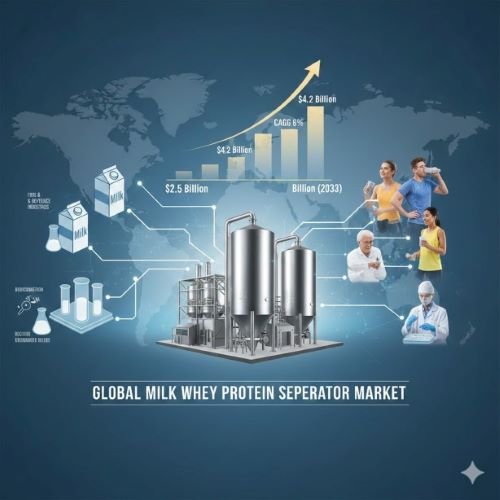
The global milk whey protein separator market is experiencing robust growth, driven by increasing demand for whey protein isolates and concentrates in the food and beverage, dietary supplement, and pharmaceutical industries. The market, valued at approximately $2.5 billion in 2025, is projected to exhibit a Compound Annual Growth Rate (CAGR) of 6% from 2025 to 2033, reaching an estimated market value of approximately $4.2 billion by 2033.
Size, byProduct, 2024 - 2032{USD Billion} Milk whey protein separator market size is projected to exhibit a Compound Annual Growth Rate (CAGR) of 6% from 2025 to 2033. request a free sample copy
Milk Whey Protein Separator Market Outlook 2025–2035: Precision Separation for Nutritional Purity
The Milk Whey Protein Separator Market is a key segment of the dairy processing industry, driving nutritional product innovation and purity. This report delivers an in-depth forecast from 2025 to 2035, highlighting evolving technologies and region-wise market adoption patterns.
Key Insights
This growth is fueled by several key factors, including the rising consumer preference for high-protein diets, the expanding applications of whey protein in functional foods and sports nutrition products, and ongoing technological advancements leading to more efficient and cost-effective separation techniques. Furthermore, the growing awareness of the health benefits associated with whey protein consumption, such as improved muscle growth, enhanced immune function, and satiety, is significantly contributing to market expansion.
Major market players, including Almac S.r.l., GEA Westfalia Separator, Tetra Pak, and Pieralisi, are investing in research and development to improve separator efficiency, reduce energy consumption, and enhance product quality. However, the market faces certain restraints, such as fluctuating raw material prices and stringent regulatory requirements regarding food safety and hygiene standards. Despite these challenges, the overall outlook for the milk whey protein separator market remains positive, with continued growth anticipated across various regions, particularly in developing economies experiencing rapid economic growth and rising disposable incomes. Segmentation within the market is based on separator type (e.g., decanter centrifuges, disc stack centrifuges), capacity, and end-use application, providing varied opportunities for market participants.
Market Significant Growth Factors
-
Rising global demand for high-protein nutritional products
-
Increasing applications in infant formula, sports nutrition, and functional foods
-
Technological advancements in membrane filtration and centrifugal separation
-
Strong dairy industry growth in Asia and the EU
-
Demand for sustainable, high-yield processing techniques
Report Scope
|
Element |
Details |
|
Forecast Period |
2025 to 2035 |
|
Base Year |
2025 |
|
Regions Covered |
North America, Europe, Asia Pacific, Latin America, Middle East & Africa |
|
Key Segments |
Process, Region, End-use, Deployment, Offerings |
Report Coverage & Deliverables
|
Feature |
Details |
|
Coverage |
Global + 5 Regions |
|
Forecast Span |
2025 to 2035 |
|
Formats |
PDF Report, Excel Models, Industry Charts |
|
Segmentation |
By Process, Region, End-use, Offering |
Recent Developments
-
Alfa Laval introduced a compact separator series with lower energy footprint
-
GEA Group expanded installations in India for high-capacity whey processing
-
SPX FLOW partnered with European dairy giants for integrated automation
Regional Insights
Global Milk Whey Protein Separator Market — Regional Market Size (2025–2033)
Values in USD Billion
| Region | 2025 | 2028 | 2030 | 2033 | CAGR (2025–2033) | Key Growth Drivers |
|---|---|---|---|---|---|---|
| North America | 0.72 | 0.85 | 0.95 | 1.08 | ~5.3% | High adoption of advanced dairy processing systems, rising sports nutrition market, strong presence of whey protein manufacturers. |
| Europe | 0.68 | 0.79 | 0.88 | 1.00 | ~5.1% | Mature dairy industry, stringent quality regulations, strong investments in automation and membrane filtration. |
| Asia-Pacific | 0.63 | 0.79 | 0.94 | 1.24 | ~8.1% | Rapid dairy expansion in China & India, growing demand for nutritional supplements, increasing processing capacity. |
| Latin America | 0.25 | 0.30 | 0.34 | 0.40 | ~6.0% | Rising dairy modernization, export-oriented whey production. |
| Middle East & Africa | 0.22 | 0.26 | 0.30 | 0.38 | ~7.2% | Growth in infant formula demand, increasing investment in dairy processing plants. |
| Total Market | 2.50 | 2.99 | 3.41 | 4.20 | 6.0% | Growing need for whey protein isolates & concentrates across ind |
U.S Market Trends
Focus on automation and demand from health-conscious consumers drives steady growth.
Europe Trends
Home to technological innovation; premiumization in dairy nutrition leading market share.
Germany Trends
Increased adoption of sustainable dairy separation; focus on export-ready protein concentrates.
Asia Pacific Trends
Strong expansion in India and China; rapid modernization of dairy processing units.
China Trends
Strategic investments in food security and domestic protein production.
End-use Insights
-
Dairy Processing PlantsCore application area
-
Infant Nutrition ManufacturersHigh-purity protein inputs
-
Sports & Wellness BrandsDemand for customized whey fractions
-
B2B Ingredient SuppliersBulk protein isolates and concentrates
Deployment Insights
-
On-site Industrial Units
-
Modular Containerized Solutions
Process Insights
-
Membrane Filtration (Micro, Ultra, Nano)
-
Centrifugal Separation
-
Ion Exchange Technology
Offerings Insight
-
ProductsStandalone Separators, Automated Lines
-
ServicesInstallation, Training, Maintenance
Key Players
-
Tetra Pak
-
Andritz Group
-
IDMC Limited
-
Krones AG
-
Triowin Intelligent Machinery
Milk Whey Protein Separator Market Segmented
1. By Process
-
Membrane Filtration (Microfiltration, Ultrafiltration, Nanofiltration)
-
Centrifugal Separation
-
Ion Exchange
-
Chromatography
2. By Deployment
-
On-site Industrial Units
-
Modular & Portable Units
3. By End-use
-
Dairy Processing Plants
-
Infant Nutrition Producers
-
Sports Nutrition Manufacturers
-
Functional Food & Beverage Companies
-
Ingredient Supply Chains
4. By Offerings
-
Products (Separators, Full System Lines)
-
Services (Installation, Support, Maintenance)
5. By Region
-
North America
-
Europe
-
Asia Pacific
-
Latin America
-
Middle East & Africa