
Claim a Free Sample
Get a preview with key statistics, projections, and trends for this report. Ideal for quick insights.
Send Me a SampleNeed full access?
Purchase ReportMicrobubbles/Ultrasound Contrast Agents Market Size And Forecast
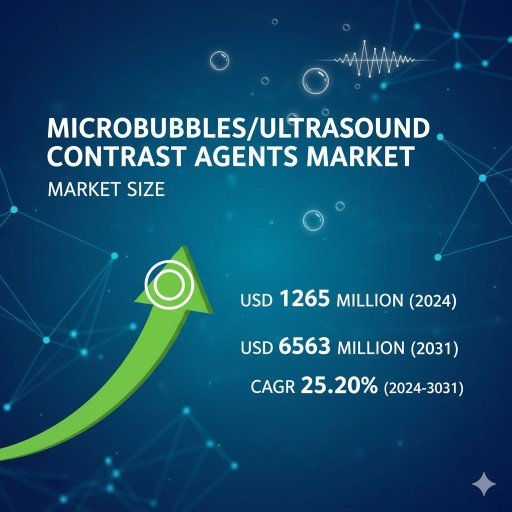
Microbubbles/Ultrasound Contrast Agents Market size was valued at USD 1265 Million in 2024 and is projected to reach USD 6563 Million by 2031, growing at a CAGR of 25.20% from 2024 to 2031.

Global Microbubbles/Ultrasound Contrast Agents Market Size By Therapeutic Area (Cardiovascular Diseases, Renal And Associated Diseases), By Application (Molecular Imaging, Gene Therapy, Drug Delivery), By Geographic Scope And Forecast
Size, byProduct, 2024 - 2032{USD Million}
The microbubble/ultrasound contrast agents market size was valued at USD 1265 million in 2024 and is projected to reach USD 6563 million by 2031, growing at a CAGR of 25.20% from 2024 to 2031. request a free sample copy
Microbubbles/Ultrasound Contrast Agents are representative of advanced medical technologies aimed at enhancing the visibility and clarity of ultrasound images. Unlike conventional contrast agents, which are dependent on iodine or gadolinium, microbubbles consist of gas-filled microspheres encapsulated within a biocompatible shell.
- Diagnostic imaging has been transformed by this innovative technology, providing real-time visualization of blood flow and tissue perfusion, thereby facilitating more accurate diagnosis and treatment planning.
- Through the utilization of mechanical or phase-change technology, microbubbles can be activated within the body to amplify ultrasound signals, thereby enhancing image resolution and contrast.
- Serving as a non-invasive and safe alternative to traditional imaging modalities, Microbubbles/Ultrasound Contrast Agents reduce the necessity for invasive procedures and minimize patient discomfort.
- Beyond enhancing diagnostic accuracy, potential therapeutic applications such as targeted drug delivery and localized tissue ablation have been demonstrated by microbubbles.
- Furthermore, the versatility and efficacy of microbubbles render them ideal for a broad spectrum of clinical applications, ranging from cardiovascular imaging to cancer detection and monitoring.
Global Microbubbles/Ultrasound Contrast Agents Market Dynamics
The key market dynamics that are shaping the Global Microbubbles/Ultrasound Contrast Agents Market include
Key Market Drivers
- Improvements in Diagnostic ImagingOngoing improvements in diagnostic imaging technologies, particularly ultrasound imaging, are driving the need for microbubbles and ultrasound contrast agents. The visibility and clarity of ultrasound images are enhanced by these agents, resulting in higher diagnostic accuracy and improved treatment planning.
- Growing Prevalence of Cardiovascular DisordersDemand for microbubbles and ultrasound contrast agents is being driven by the increasing prevalence of cardiovascular disorders globally. These agents play a crucial role in cardiovascular imaging by enabling the visualization of blood flow and tissue perfusion, essential for diagnosing and monitoring heart problems.
- Increased Adoption of Non-Invasive Imaging Techniques Non-invasive imaging techniques are becoming increasingly popular among both healthcare providers and patients. Microbubbles and ultrasound contrast agents serve as non-invasive alternatives to standard imaging techniques, eliminating the need for invasive treatments and reducing patient discomfort.
- Technological Innovations The industry is propelled forward by continuous technological advancements in microbubble compositions and ultrasound imaging equipment. New and improved microbubble formulations with greater stability, imaging features, and targeted distribution capabilities are constantly being developed by manufacturers, expanding the use of these agents in various therapeutic contexts.
- Rising Awareness and Adoption Greater awareness of the benefits of microbubbles and ultrasound contrast agents among healthcare professionals leads to increased acceptance and adoption. This heightened awareness results in expanded usage across a variety of medical specialties, contributing to market growth.
Key Challenges
- Stringent Regulatory Requirements Stringent regulatory requirements are imposed by the FDA (US Food and Drug Administration) and EMA (European Medicines Agency) on the testing and approval of microbubbles/ultrasound contrast agents, dissuading certain companies from market entry due to the lengthy and costly process.
- Potential Side Effects typically minor, may include headaches, nausea, and dizziness in some patients. Concerns also exist regarding their use in individuals with pre-existing medical conditions, such as allergies or heart difficulties, limiting their application in certain patient groups.
- Cost and Reimbursement These agents incur high costs for development, production, and testing. Additionally, their expenses may not be fully covered by healthcare organizations’ payment rules, thereby restricting patient access.
- Lack of Awareness Microbubble technology is less recognized than regular ultrasound procedures. Increasing understanding among healthcare professionals of the benefits and applications of microbubble-based ultrasonography is crucial for widespread adoption.
- Competition from Established Imaging Techniques are such as X-rays, CT scans, and MRIs poses a challenge. While microbubbles offer benefits such as real-time viewing and reduced invasiveness, convincing healthcare practitioners to switch from traditional approaches requires demonstrable evidence of their superiority in specific applications.
- Limited Availability of Skilled ProfessionalsThe effective utilization of microbubble-based ultrasound relies on competent specialists familiar with the technology and its applications. A scarcity of trained staff skilled in microbubble technology may hinder its wider implementation.
Key Trends
- Targeted Microbubbles Through research and development efforts, microbubbles are being designed with specific features in mind. These microbubbles can be tailored to bind to specific chemicals or cells, improving imaging of certain organs or disorders. For example, cancer diagnosis and treatment monitoring can be aided by tumor-targeted microbubbles.
- Theranostic microbubbles which serve both diagnostic and therapeutic purposes, are being developed. They can be utilized for imaging as well as the delivery of medications or therapeutic substances to specific bodily locations, enabling personalized medicine and focused treatment approaches.
- Artificial Intelligence (AI) Integration Artificial intelligence (AI) is increasingly utilized for the evaluation of microbubble-enhanced ultrasound images. AI systems analyze complex visual data to enhance diagnosis accuracy and efficiency, potentially leading to earlier disease detection and improved treatment planning.
- Advancements in Microbubble Production Techniques Constant refinement of microbubble production techniques is ongoing with the aim of improving uniformity, stability, and functionality. Consistent and reliable microbubbles are crucial for optimal performance and widespread clinical adoption.
- Growing Focus on Minimally Invasive Procedures The healthcare industry’s focus on minimally invasive procedures is driving increased demand for microbubble-based ultrasonography. This technique provides crucial diagnostic insights without the need for surgery or causing significant patient discomfort, aligning with the trend toward minimally invasive therapies.
- Expanding Applications in Therapeutic Areas Beyond diagnosis, microbubbles are being utilized for drug delivery, gene therapy, and disrupting the blood-brain barrier to treat neurological disorders. This expansion into medicinal applications creates new growth opportunities.
- Increasing Collaboration between Academia and IndustryCollaboration between academia and the pharmaceutical/medical device industry is growing, fostering innovation in the microbubbles/ultrasound contrast agents market. This collaborative approach promotes the rapid development and clinical application of novel microbubble technologies
Global Microbubbles/Ultrasound Contrast Agents Market Regional Analysis
Here is a more detailed regional analysis of the Global Microbubbles/Ultrasound Contrast Agents Market
North America
- North America is considered the dominant region in the global microbubbles/ultrasound contrast agent’s market. This dominance can be attributed to several factors.
- North America benefits from a robust healthcare infrastructure, with advanced medical facilities and a well-trained workforce proficient in ultrasound imaging techniques.
- The region benefits from an established regulatory framework, including clear guidelines from regulatory bodies like the FDA, which streamline the adoption process.
- Microbubble-based ultrasound technology is more widely accepted and utilized by healthcare professionals in North America. This widespread adoption contributes to the region’s leadership in the market.
- The strong focus on advanced diagnostics and patient care in North America drives the demand for innovative imaging solutions such as microbubbles.
Asia Pacific
- In contrast, the Asia Pacific region is expected to be the fastest growing region in the microbubbles/ultrasound contrast agents market during the forecast period.
- The region’s rapidly expanding economies will lead to increased healthcare spending and investments in advanced medical technologies.
- The rising prevalence of chronic diseases like cancer and cardiovascular diseases in Asia Pacific will drive demand for improved diagnostic tools, including microbubbles.
- The aging population in the region will necessitate better diagnostic solutions for early disease detection and treatment planning.
- Various initiatives promoting the adoption of advanced medical technologies, including microbubbles, are being undertaken by some Asian governments, contributing to market growth.
Global Microbubbles/Ultrasound Contrast Agents Market Segmentation Analysis
Global Microbubbles/Ultrasound Contrast Agents Market is segmented based on Therapeutic area, Application, And Geography.
Microbubbles/Ultrasound Contrast Agents Market, By Therapeutic Area
- Cardiovascular Diseases
- Renal And Associated Diseases
- Others
Based on Therapeutic Area, the market is segmented into Cardiovascular Diseases, Renal And Associated Diseases, and Others. The primary indication for using microbubbles or ultrasonic contrast agents is currently cardiovascular disorders. (CEUS) Contrast-enhanced ultrasound has been utilized extensively in cardiovascular imaging, including the evaluation of endocardial boundaries, detection of aberrant heart wall motion, and myocardial perfusion measurement. In cardiac imaging, microbubbles or ultrasound contrast substances are employed to make blood flow more visible and increase the precision of cardiovascular problem diagnosis and assessment.
Conversely, although they may not be as common as cardiovascular disorders in terms of market demand, renal and related diseases are also a significant clinical use for microbubbles or ultrasonic contrast agents. Renal perfusion, renal lesions, and renal function can all be determined using contrast-enhanced ultrasonography. Microbubbles or ultrasound contrast agents may be used to diagnose renal disorders such as renal infarction, renal artery stenosis, and renal cysts as well as to characterize and distinguish between benign and malignant renal masses.
Microbubbles/Ultrasound Contrast Agents Market, By Application
- Molecular Imaging
- Gene Therapy
- Drug Delivery
- Stem Cells delivery
Based on Application, the market is segmented into Molecular Imaging, Gene Therapy, Drug Delivery, and Stem Cells delivery. The discipline of molecular imaging, which is expanding quickly, focuses on spotting and observing molecular and cellular processes in living things. When utilized in molecular imaging, microbubbles or acoustic contrast substances can be used to target certain molecule markers or receptors, enabling the viewing and evaluation of particular molecular routes or cellular activities. Applications for molecular imaging can be found in neurology, oncology, inflammation/infection imaging, and cardiology, among other specialties.
Microbubbles/Ultrasound Contrast Agents Market, By Geography
- North America
- Europe
- Asia Pacific
- Latin America
- Middle East and Africa
On the basis of Geography, the Global Microbubbles/Ultrasound Contrast Agents Market is classified into North America, Europe, Asia Pacific, Latin America, and Middle East and Africa. North America is considered the dominant region in the global microbubbles/ultrasound contrast agent’s market. This dominance can be attributed to several factors. North America benefits from a robust healthcare infrastructure, with advanced medical facilities and a well-trained workforce proficient in ultrasound imaging techniques.
Key Players
The “Global Microbubbles/Ultrasound Contrast Agents Market” study report will provide valuable insight with an emphasis on the global market including some of the major players such as Lantheus Holdings, Bristl-Myers Squibb, Bracco, GE Healthcare, Daiichi Sankyo Company Limited, NanoPET Pharma GmbH, Leriva, Koninklijke Philips N.V., Siemens Healthineers AG and others.
Our market analysis also entails a section solely dedicated to such major players wherein our analysts provide an insight into the financial statements of all the major players, along with product benchmarking and SWOT analysis.
Key Developments
- In September 2023, Lantheus Holdings announced a strategic collaboration with a leading research institution to further develop and commercialize microbubble technology for enhanced ultrasound imaging applications.
- In April 2023, Daiichi Sankyo Company Limited announced significant progress in the development of targeted microbubble formulations for precise drug delivery and imaging in oncology, marking a milestone in personalized medicine.
- In August 2023, Leriva reported successful clinical trials of its microbubble technology for targeted drug delivery in cardiovascular diseases, paving the way for potential regulatory approvals and commercialization.
- In November 2022, GE Healthcare launched a new generation of microbubble-based ultrasound contrast agents with improved imaging capabilities and reduced adverse effects, addressing the growing demand for advanced diagnostic tools.
Report Scope
| REPORT ATTRIBUTES | DETAILS |
|---|---|
| Study Period | 2021-2031 |
| Base Year | 2024 |
| Forecast Period | 2024-2031 |
| Historical Period | 2021-2023 |
| Unit | Value (USD Million) |
| Key Companies Profiled | Lantheus Holdings, Bristl-Myers Squibb, Bracco, GE Healthcare, Daiichi Sankyo Company Limited, NanoPET Pharma GmbH, Leriva, Koninklijke Philips N.V., Siemens Healthineers AG |
| Segments Covered |
|
| Customization scope | Free report customization (equivalent up to 4 analyst’s working days) with purchase. Addition or alteration to country, regional & segment scope. |
Research Methodology of Market Research
To know more about the Research Methodology and other aspects of the research study, kindly get in touch with our .
Reasons to Purchase this Report
We'll take a good look at the market, breaking it down by customer groups using everything from their income to their lifestyles. You'll get the market size (in USD Billion) for each of these groups, big and small. We'll also pinpoint the area and customer group that's predicted to grow the fastest and be the biggest overall. Expect a breakdown by region, showing where the product or service is being used most and what's influencing the market in each place. We'll scope out the competition too, ranking the major players and highlighting new products, partnerships, expansions, and acquisitions from the last five years. Our company profiles will give you a complete picture, including company insights, product comparisons, and a SWOT analysis for the leading companies. We'll paint a picture of the industry's current state and future, considering recent developments, growth opportunities, and the challenges in both up-and-coming and established regions. Plus, we'll use Porter's Five Forces to really dig into the market from every angle and offer insight through a Value Chain analysis. You'll also get a look at market dynamics, including future growth opportunities. And to top it off, we're offering 6 months of post-sales support from our analysts.