
Micro Electric Vehicle Market Size, Share & Trends Analysis Report By Type (Quadricycle, Golf Carts), By Battery Type (Lithium-ion, Lead Acid), By Application (Commercial Use, Personal Use, Public Utilities), By Region, And Segment Forecasts,

Micro Electric Vehicle Market Size, Share & Trends Analysis Report By Type (Quadricycle, Golf Carts), By Battery Type (Lithium-ion, Lead Acid), By Application (Commercial Use, Personal Use, Public Utilities), By Region, And Segment Forecasts,

Published Date: August - 2025 | Publisher: MIR | No of Pages: 240 | Industry: technology | Format: Report available in PDF / Excel Format

View Details Download Free Sample Ask for Discount Request Customization
Claim a Free Sample

Get a preview with key statistics, projections, and trends for this report. Ideal for quick insights.

Send Me a Sample

Need full access?

Purchase Report

Micro Electric Vehicle Market Size & Trends

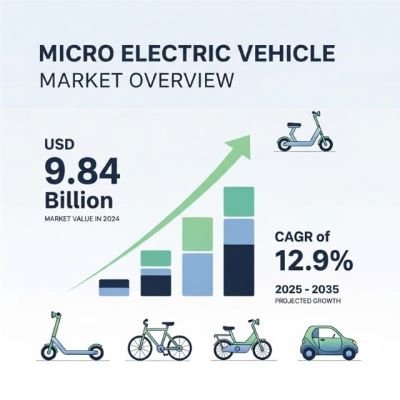
The size of the global micro electric vehicle market was valued at USD 9.84 billion in 2024 and is expected to expand at a CAGR of 12.9% from 2025 to 2035.

MIR Logo

Micro Electric Vehicle Market Size, Share & Trends Analysis Report By Type (Quadricycle, Golf Carts), By Battery Type (Lithium-ion, Lead Acid), By Application (Commercial Use, Personal Use, Public Utilities), By Region, And Segment Forecasts,

Size, byProduct, 2024 - 2032{USD Billion}

CAGR: 12.90%

micro electric vehicle market size is expected to expand at a CAGR of 12.9% from 2025 to 2035. request a free sample copy

Micro electric vehicles (MEVs) are battery-operated, small-scale vehicles intended for use in urban areas. They provide a convenient, zero-emission mode of mobility with commonly used benefits including small size, low speed, and excellent maneuverability.

Drivers like rising demand for urban mobility solutions, stringent emission policies and regulations to lower carbon footprints, and continuous technological innovations in battery technology are responsible for the expansion of the micro electric vehicle market.

The rise in urban population density and traffic congestion is compelling cities globally to look for compact and efficient transport solutions. Micro electric vehicles, with their low emission and small footprint, are proving themselves to be perfect substitutes for last-mile connectivity and short-distance travel. They are being promoted in cities through low-emission zones, congestion pricing, and the limitation of larger vehicles in city center areas. Planners concerned with sustainable mobility are increasingly including MEVs as a part of shared mobility fleets, campus shuttle, and delivery fleets, meeting environmental objectives and functional urban needs. Therefore, growing urban traffic and last-mile mobility demand are driving the development of the micro electric vehicle market.

Tough emission norms and liberal government incentives are significantly driving MEV uptake worldwide. Subsidies, tax credits, and grants on the purchase of electric vehicles, including micro-EVs, are being provided by numerous nations to make them cheaper for consumers. Regulatory schemes like the European Union's CO₂ goals, China's NEV credits, and India's FAME initiative are directly influencing market trends. These regulations are prompting consumers to move away from conventional combustion vehicles and manufacturers to increase their electric offerings, including micro-sized vehicles for urban application.

The world e-commerce boom has generated demand for cost-efficient, cost-effective last-mile delivery solutions, which is driving MEV adoption. These vehicles are now more frequently used by logistics providers and retailers to deliver packages in high-density, urban locations where larger vehicles have access restrictions. Their lower costs of operation, ease of handling, and integration with green delivery programs make them appealing for businesses seeking to cut carbon footprints and enhance delivery efficiency. The expansion of quick and same-day commerce services is making MEVs indispensable tools within urban logistics networks, thus driving market growth.

Advances in battery technology and the accelerated build-up of charging infrastructure are further pushing the adoption of MEVs. Advances in battery density, charging rate, and durability have increased the range and performance of micro EVs, thus rendering them more practical for everyday use. Furthermore, investments in public and private charging points, particularly in urban areas, are mitigating range anxiety and enhancing user convenience. The ongoing reduction in battery prices allows manufacturers to provide better-spec'd, cheaper micro EVs, increasing their appeal in developed and emerging economies.
Micro Electric Vehicle Market

Report Coverage & Deliverables

  • Competitive benchmarking
  • Historical data & forecasts
  • Company revenue shares
  • Regional opportunities
  • Latest trends & dynamics

Type Insights

The quadricycle segment dominated the market with a maximum revenue share of 60.0% in 2024. Quadricycles are compact, lightweight cars for short journeys and city traveling. Their smaller size benefits them to easily navigate narrow streets and congested city roads. They have low running costs and easy parking, which contributes to their convenience. With zero emissions, they find favor with eco-friendly consumers and cities looking to reduce congestion and pollution. Such drivers are likely to fuel the segment's growth.

The golf carts segment is likely to register the highest CAGR over the forecast period. These vehicles are increasingly being used for short-distance travel in gated communities, large campuses, and recreational grounds, where their small size and zero emissions are perfect. Increasing the need for green and efficient modes of transport among environmentally aware societies is driving electric golf cart growth. Additionally, the business industry is embracing the use of golf carts for resorts, airport last-mile delivery and maintenance, as well as huge shopping malls, thus propelling the segment growth.

Battery Type Insights

The lithium-ion battery segment held the highest revenue share in 2024. Growing use of lithium-ion batteries in MEVs due to their greater lifespan, high energy density, and quicker charging times compared to conventional battery types is responsible for the growth in the segment. As battery prices fall, makers are looking to lithium-ion technology to provide micro EVs with greater range and improved performance, making them more attractive for daily use and commercial purposes. The increasing focus on light, efficient, and environmentally friendly vehicles is also driving the move towards lithium-ion, particularly in urban areas where range and convenience of charging are paramount.

The lead acid battery segment is likely to hold the highest CAGR over the forecast period. Lead-acid batteries have a strong position in the micro electric vehicle market, particularly in price-sensitive areas and bottom-of-the-line models. They are lower in initial cost compared to other batteries, making them appealing for price-conscious consumers as well as for use in areas where distances traveled are short, like golf carts, campus shuttle buses, and neighborhood electric vehicles (NEVs). Although they are heavier and have a shorter lifespan than lithium-ion, lead-acid batteries remain in business in markets where price is paramount over performance. Yet as the environment becomes more regulated and customers increasingly demand greater efficiency, the segment is slowly transitioning, though it still holds relevance for low-cost, utilitarian MEVs in emerging economies.

Application Insights

The commercial use segment generated the highest revenue share in 2024. The growth of the segment is being fueled by the fast growth of e-commerce, last-mile delivery services, and urban logistics. Organizations are turning to MEVs in greater numbers to lower operating costs, achieve sustainability targets, and drive through congested city centers where large vehicles are subject to restrictions. Their small size, reduced emissions, and cheaper cost ensure that they are well-suited for applications like food delivery, package delivery, and intra-city freight transportation. Therefore, rising adoption of MEVs for commercial-use cases is driving the segment's growth.

The public utilities segment is expected to register the highest CAGR over the forecast period. Micro electric vehicles are being embraced by public utilities as a means of their fleet modernization and in favor of sustainable city infrastructure. Municipalities and governmental agencies are putting MEVs into use for duties like street cleaning, park care, security patrol, and collection of trash where noise and emission need to be reduced. Their low cost of operation, maneuverability, and appropriateness for repetitive, short-distance tasks make them a cost-effective vehicle for public sector deployment. As cities across the globe make green mobility and zero-emission goals a priority, their inclusion in public utility fleet deployment is anticipated to increase, further enhancing the segment's market prospects.

Regional Insights

North America led the micro electric vehicle market with the highest revenue share of 40.54% in 2024, led mainly by the high application of golf carts and quadricycles, particularly in the U.S. and Canada. The high level of infrastructure in the region and the demand for environmentally friendly transportation from consumers drive its high market share.

The market is segmented into key regionsAsia Pacific, Europe, North America, Latin America, and the Middle East & Africa. The estimated market size for each region is calculated based on factors like urbanization density, regulatory support, existing adoption rates, and infrastructure development.

Micro Electric Vehicle (Micro-EV) Market Size by Region (2024-2035)

Global Market Valued at USD 9.84 Billion in 2024, expected to grow at a CAGR of 12.9% from 2025 to 2035.

Region2024 Market Size (USD Billion)Estimated 2024 Market Share2035 Projected Market Size (USD Billion)Key Drivers and Notes
Asia-Pacific (APAC)5.41~55%20.8Dominant market leader. Driven by massive demand in China and India for affordable urban mobility, severe traffic congestion, strong government subsidies, and a well-established manufacturing base for electric vehicles.
Europe2.75~28%10.6Mature and regulated market. Growth is fueled by stringent emissions regulations, high urbanization, supportive EU policies, and consumer preference for sustainable last-mile transportation solutions.
North America1.18~12%4.5Steady growth market. Adoption is focused on niche applicationsurban commuters, university campuses, golf courses, and industrial facilities. Growing interest in low-speed vehicles (LSVs) as secondary cars.
Latin America (LATAM)0.39~4%1.5Emerging potential. Growth in densely populated megacities facing traffic and pollution challenges. Rising interest for use in shared mobility services and tourist areas.
Middle East & Africa (MEA)0.10~1%0.4Nascent market. Potential is centered in GCC countries for use in smart city projects, tourist zones, and gated communities. Limited overall adoption currently.
Total9.84100%~37.8

U.S. Micro Electric Vehicle Market Trends
The U.S. micro electric vehicle market held the highest market revenue share in 2024 due to the growing urban traffic, growing environmental consciousness, and high demand for low-speed electric vehicles (LSEVs) like neighborhood electric vehicles (NEVs) and golf carts.

Europe Micro Electric Vehicle Market Trends
The European market for micro electric vehicles is anticipated to record a modest CAGR during 2025-2030. Europe is experiencing growth through stringent eco-laws and the ambitious climate targets of the European Union. Several countries have implemented policies that support electric mobility with subsidies for buying EVs and huge investments in charging facilities.

The UK micro electric vehicle market is anticipated to record a significant CAGR during the period 2025-2030.The micro electric vehicle sector in the UK is being boosted by the government's ambitious drive towards zero-emission transport, such as the proposed ban on new petrol and diesel cars by 2035. Increasing fuel prices and increased adoption of car-sharing and subscription services are also fueling demand for micro electric vehicles.

The German micro electric vehicle market controlled a significant market share in 2024 due to the tight CO₂ emission regulations, high subsidies offered for electric vehicles, and its robust domestic automotive sector that's moving toward greener mobility solutions.

Asia Pacific Micro Electric Vehicle Market Trends
The Asia Pacific micro electric vehicle market is expected to expand at a high CAGR of 15.2% over the forecast period. Asia Pacific is growing fast, with nations like China and India heavily investing in electric mobility programs to counter pollution and decrease dependence on fossil fuels. The establishment of large-scale charging networks and the spread of electric vehicle production favor the expansion of MEVs in this region.

The India micro electric vehicle market will grow at the highest CAGR over the forecast period. The market will be driven by high levels of urban congestion, high pollution rates, and robust government support through policies like the Faster Adoption and Manufacturing of Electric Vehicles (FAME) scheme.

China's micro electric vehicle market had a significant market share in 2024. China's aggressive EV policies, issues of urban air quality, and government subsidies made the environment most conducive to MEVs. Also, China's rapid urbanization and high-population cities mean that micro EVs are a natural choice for personal mobility, thus propelling the market's growth.

Key Micro Electric Vehicle Company Insights

Some of the most prominent companies operating in the micro electric vehicle market are Citroen, Toyota Motor Corporation, and Toyota Motor Corporation, among others. These companies are pursuing various strategic measures, including new product launches, business expansions, collaborations, partnerships, and agreements, among others.

Toyota Motor Corporation is a Japanese multinational automaker. The company designs, manufactures, and sells a full lineup of vehicles, including sedans, SUVs, trucks, and electrified vehicles. It also produces micro electric vehicles (MEVs). In March 2025, Toyota Motor Europe (TME) launched the FT-Me concept, a compact battery electric vehicle created to meet the needs of evolving cityscapes.

Citroën is a French automobile brand. The brand is known for its unique styling, comfort, and innovative vehicles and services, aiming to make mobility accessible to everyone. The company offers a micro electric vehicle called the Ami. The Ami is a 100% electric quadricycle, designed for urban use and short trips, offering easy maneuverability and parking in tight spaces.

Key Micro Electric Vehicle Companies

The following are the leading companies in the micro electric vehicle market. These companies collectively hold the largest market share and dictate industry trends.

  • Citroen
  • Club Car
  • Micro Mobility System AG (Microlino)
  • Nissan Motor
  • Polaris
  • Toyota Motor Corporation
  • Yamaha Motor
  • Eli Electric Vehicles
  • GEM (Waev Inc.)
  • ICON Electric Vehicles

Recent Developments

  • In March 2025, Rivian launched a micromobility startup called “Also,” with the goal of reshaping the electric micromobility landscape through the development of affordable, scalable electric vehicles tailored for urban and short-distance travel.

  • In May 2024, Eli Electric Vehicles expanded into the U.S. market with the launch of the Eli ZERO, a micro electric vehicle designed to reduce urban congestion and improve daily commutes.

Micro Electric Vehicle Market Report Scope

Report Attribute

Details

Market size value in 2025

USD 11.04 billion

Revenue forecast in 2030

USD 20.26 billion

Growth rate

CAGR of 12.9% from 2025 to 2035

Base year for estimation

2024

Historical data

2018 - 2023

Forecast period

2025 - 2035

Quantitative units

Revenue in USD million/billion, and CAGR from 2025 to 2035

Report coverage

Revenue forecast, company ranking, competitive landscape, growth factors, and trends

Segments covered

Type, battery type, application, region

Regional scope

North America; Europe; Asia Pacific; Latin America; MEA

Country scope

U.S.; Canada; Mexico; Germany; UK; France; China; Japan; India; South Korea; Australia; Brazil; KSA; UAE; South Africa

Key companies profiled

Citroen; Club Car; Micro Mobility System AG (Microlino); Nissan Motor; Polaris; Toyota Motor Corporation; Yamaha Motor; Eli Electric Vehicles; GEM (Waev Inc.); ICON Electric Vehicles

Customization scope

Free report customization (equivalent up to 8 analysts working days) with purchase. Addition or alteration to country, regional & segment scope.

Pricing and purchase options

Avail customized purchase options to meet your exact research needs. Explore purchase options

Global Micro Electric Vehicle Market Report Segmentation

Type Outlook (Revenue, USD Million, 2018 - 2035)

    • Quadricycle

    • Golf Carts

  • Battery Type Outlook (Revenue, USD Million, 2018 - 2035)

    • Lithium-ion Battery

    • Lead Acid Battery

  • Application Outlook (Revenue, USD Million, 2018 - 2035)

    • Commercial Use

    • Public Utilities

    • Personal Use

  • Regional Outlook (Revenue, USD Million, 2018 - 2035)

    • North America

      • U.S.

      • Canada

      • Mexico

    • Europe

      • Germany

      • UK

      • France

    • Asia Pacific

      • China

      • Japan

      • India

      • South Korea

      • Australia

    • Latin America

      • Brazil

    • Middle East and Africa (MEA)

      • KSA

      • UAE

      • South Africa

Frequently Asked Questions

The global micro electric vehicle market size was estimated at USD 9.84 billion in 2024 and is expected to reach USD 11.04 billion in 2025.

The global micro electric vehicle market is expected to grow at a compound annual growth rate of 12.9% from 2025 to 2030 to reach USD 20.26 billion by 2030.

The commercial use segment dominated the market in 2024. The segment’s growth is driven by the rapid expansion of e-commerce, last-mile delivery services, and urban logistics.

Some key players operating in the micro electric vehicle market include Citroen, Club Car, Micro Mobility System AG (Microlino), Nissan Motor, Polaris, Toyota Motor Corporation, Yamaha Motor, Eli Electric Vehicles, GEM (Waev Inc.), and ICON Electric Vehicles.

Factors such as increasing demand for urban mobility solutions, stringent emission policies and regulations aimed at reducing carbon footprints, and ongoing technological advancements in battery technology can be attributed to the growth of the micro electric vehicle market.

Table of Content

Table of Contents

Chapter 1. Methodology and Scope
                   1.1. Market Segmentation and Scope
                   1.2. Research Methodology
                       1.2.1. Information Procurement
                   1.3. Information or Data Analysis
                   1.4. Methodology
                   1.5. Research Scope and Assumptions
                   1.6. Market Formulation & Validation
                   1.7. Country Based Segment Share Calculation
                   1.8. List of Data Sources
Chapter 2. Executive Summary
                   2.1. Market Outlook
                   2.2. Segment Outlook
                   2.3. Competitive Insights
Chapter 3. Micro Electric Vehicle Market Variables, Trends, & Scope
                   3.1. Market Lineage Outlook
                   3.2. Market Dynamics
                       3.2.1. Market Driver Analysis
                       3.2.2. Market Restraint Analysis
                       3.2.3. Industry Challenge
                   3.3. Micro Electric Vehicle Market Analysis Tools
                       3.3.1. Industry Analysis - Porter’s
                           3.3.1.1. Bargaining power of the suppliers
                           3.3.1.2. Bargaining power of the buyers
                           3.3.1.3. Threats of substitution
                           3.3.1.4. Threats from new entrants
                           3.3.1.5. Competitive rivalry
                       3.3.2. PESTEL Analysis
                           3.3.2.1. Political landscape
                           3.3.2.2. Economic and social landscape
                           3.3.2.3. Technological landscape
Chapter 4. Micro Electric Vehicle Market: Type Estimates & Trend Analysis
                   4.1. Segment Dashboard
                   4.2. Micro Electric Vehicle Market: Type Movement Analysis, 2024 & 2030 (USD Million)
                   4.3. Quadricycle
                       4.3.1. Quadricycle Market Revenue Estimates and Forecasts, 2018 - 2030 (USD Million)
                   4.4. Golf Carts
                       4.4.1. Golf Carts Market Revenue Estimates and Forecasts, 2018 - 2030 (USD Million)
Chapter 5. Micro Electric Vehicle Market: Battery Type Estimates & Trend Analysis
                   5.1. Segment Dashboard
                   5.2. Micro Electric Vehicle Market: Battery Type Movement Analysis, 2024 & 2030 (USD Million)
                   5.3. Lithium-ion Battery
                       5.3.1. Lithium-ion Battery Market Revenue Estimates and Forecasts, 2018 - 2030 (USD Million)
                   5.4. Lead Acid Battery
                       5.4.1. Lead Acid Battery Market Revenue Estimates and Forecasts, 2018 - 2030 (USD Million)
Chapter 6. Micro Electric Vehicle Market: Application Estimates & Trend Analysis
                   6.1. Segment Dashboard
                   6.2. Micro Electric Vehicle Market: Application Movement Analysis, 2024 & 2030 (USD Million)
                   6.3. Commercial Use
                       6.3.1. Commercial Use Market Revenue Estimates and Forecasts, 2018 - 2030 (USD Million)
                   6.4. Public Utilities
                       6.4.1. Public Utilities Revenue Estimates and Forecasts, 2018 - 2030 (USD Million)
                   6.5. Personal Use
                       6.5.1. Personal Use Revenue Estimates and Forecasts, 2018 - 2030 (USD Million)
Chapter 7. Micro Electric Vehicle Market: Regional Estimates & Trend Analysis
                   7.1. Micro Electric Vehicle Market Share, By Region, 2024 & 2030, USD Million
                   7.2. North America
                       7.2.1. North America Micro Electric Vehicle Market Estimates and Forecasts, 2018 - 2030 (USD Million)
                       7.2.2. U.S.
                           7.2.2.1. U.S. Micro Electric Vehicle Market Estimates and Forecasts, 2018 - 2030 (USD Million)
                       7.2.3. Canada
                           7.2.3.1. Canada Micro Electric Vehicle Market Estimates and Forecasts, 2018 - 2030 (USD Million)
                       7.2.4. Mexico
                           7.2.4.1. Mexico Micro Electric Vehicle Market Estimates and Forecasts, 2018 - 2030 (USD Million)
                   7.3. Europe
                       7.3.1. Europe Micro Electric Vehicle Market Estimates and Forecasts, 2018 - 2030 (USD Million)
                       7.3.2. UK
                           7.3.2.1. UK Micro Electric Vehicle Market Estimates and Forecasts, 2018 - 2030 (USD Million)
                       7.3.3. Germany
                           7.3.3.1. Germany Micro Electric Vehicle Market Estimates and Forecasts, 2018 - 2030 (USD Million)
                       7.3.4. France
                           7.3.4.1. France Micro Electric Vehicle Market Estimates and Forecasts, 2018 - 2030 (USD Million)
                   7.4. Asia Pacific
                       7.4.1. Asia Pacific Micro Electric Vehicle Market Estimates and Forecasts, 2018 - 2030 (USD Million)
                       7.4.2. China
                           7.4.2.1. China Micro Electric Vehicle Market Estimates and Forecasts, 2018 - 2030 (USD Million)
                       7.4.3. Japan
                           7.4.3.1. Japan Micro Electric Vehicle Market Estimates and Forecasts, 2018 - 2030 (USD Million)
                       7.4.4. India
                           7.4.4.1. India Micro Electric Vehicle Market Estimates and Forecasts, 2018 - 2030 (USD Million)
                       7.4.5. South Korea
                           7.4.5.1. South Korea Micro Electric Vehicle Market Estimates and Forecasts, 2018 - 2030 (USD Million)
                       7.4.6. Australia
                           7.4.6.1. Australia Micro Electric Vehicle Market Estimates and Forecasts, 2018 - 2030 (USD Million)
                   7.5. Latin America
                       7.5.1. Latin America Micro Electric Vehicle Market Estimates and Forecasts, 2018 - 2030 (USD Million)
                       7.5.2. Brazil
                           7.5.2.1. Brazil Micro Electric Vehicle Market Estimates and Forecasts, 2018 - 2030 (USD Million)
                   7.6. Middle East and Africa
                       7.6.1. Middle East and Africa Micro Electric Vehicle Market Estimates and Forecasts, 2018 - 2030 (USD Million)
                       7.6.2. UAE
                           7.6.2.1. UAE Micro Electric Vehicle Market Estimates and Forecasts, 2018 - 2030 (USD Million)
                       7.6.3. KSA
                           7.6.3.1. KSA Micro Electric Vehicle Market Estimates and Forecasts, 2018 - 2030 (USD Million)
                       7.6.4. South Africa
                           7.6.4.1. South Africa Micro Electric Vehicle Market Estimates and Forecasts, 2018 - 2030 (USD Million)
Chapter 8. Competitive Landscape
                   8.1. Company Categorization
                   8.2. Company Market Positioning
                   8.3. Company Heat Map Analysis
                   8.4. Company Profiles/Listing
                       8.4.1. Citroen
                           8.4.1.1. Participant’s Overview
                           8.4.1.2. Financial Performance
                           8.4.1.3. Product Benchmarking
                           8.4.1.4. Strategic Initiatives
                       8.4.2. Club Car
                           8.4.2.1. Participant’s Overview
                           8.4.2.2. Financial Performance
                           8.4.2.3. Product Benchmarking
                           8.4.2.4. Strategic Initiatives
                       8.4.3. Micro Mobility System AG (Microlino)
                           8.4.3.1. Participant’s Overview
                           8.4.3.2. Financial Performance
                           8.4.3.3. Product Benchmarking
                           8.4.3.4. Strategic Initiatives
                       8.4.4. Nissan Motor
                           8.4.4.1. Participant’s Overview
                           8.4.4.2. Financial Performance
                           8.4.4.3. Product Benchmarking
                           8.4.4.4. Strategic Initiatives
                       8.4.5. Polaris
                           8.4.5.1. Participant’s Overview
                           8.4.5.2. Financial Performance
                           8.4.5.3. Product Benchmarking
                           8.4.5.4. Strategic Initiatives
                       8.4.6. Toyota Motor Corporation
                           8.4.6.1. Participant’s Overview
                           8.4.6.2. Financial Performance
                           8.4.6.3. Product Benchmarking
                           8.4.6.4. Strategic Initiatives
                       8.4.7. Yamaha Motor
                           8.4.7.1. Participant’s Overview
                           8.4.7.2. Financial Performance
                           8.4.7.3. Product Benchmarking
                           8.4.7.4. Strategic Initiatives
                       8.4.8. Eli Electric Vehicles
                           8.4.8.1. Participant’s Overview
                           8.4.8.2. Financial Performance
                           8.4.8.3. Product Benchmarking
                           8.4.8.4. Strategic Initiatives
                       8.4.9. GEM (Waev Inc.)
                           8.4.9.1. Participant’s Overview
                           8.4.9.2. Financial Performance
                           8.4.9.3. Product Benchmarking
                           8.4.9.4. Strategic Initiatives
                       8.4.10. ICON Electric Vehicles
                           8.4.10.1. Participant’s Overview
                           8.4.10.2. Financial Performance
                           8.4.10.3. Product Benchmarking
                           8.4.10.4. Strategic Initiatives


List of Tables

Table 1. Global Micro Electric Vehicle market size estimates & forecasts 2018 - 2030 (USD Million)
Table 2. Global Micro Electric Vehicle Market, By region 2018 - 2030 (USD Million)
Table 3. Global Micro Electric Vehicle Market, By Type 2018 - 2030 (USD Million)
Table 4. Global Micro Electric Vehicle Market, By Battery Type 2018 - 2030 (USD Million)
Table 5. Global Micro Electric Vehicle Market, By Application 2018 - 2030 (USD Million)
Table 6. Quadricycle Micro Electric Vehicles Market, By region 2018 - 2030 (USD Million)
Table 7. Golf Carts Micro Electric Vehicles Market, By region 2018 - 2030 (USD Million)
Table 8. Lithium-ion Battery Micro Electric Vehicle Market, By region 2018 - 2030 (USD Million)
Table 9. Lead Acid Battery Micro Electric Vehicle Market, By region 2018 - 2030 (USD Million)
Table 10. Commercial Use Micro Electric Vehicle Market, By region 2018 - 2030 (USD Million)
Table 11. Public Utilities Micro Electric Vehicle Market, By region 2018 - 2030 (USD Million)
Table 12. Personal Use Micro Electric Vehicle Market, By region 2018 - 2030 (USD Million)
Table 13. North America Micro Electric Vehicle Market, By Type 2018 - 2030 (USD Million)
Table 14. North America Micro Electric Vehicle Market, By Battery Type 2018 - 2030 (USD Million)
Table 15. North America Micro Electric Vehicle Market, By Application 2018 - 2030 (USD Million)
Table 16. U.S. Micro Electric Vehicle Market, By Type 2018 - 2030 (USD Million)
Table 17. U.S. Micro Electric Vehicle Market, By Battery Type 2018 - 2030 (USD Million)
Table 18. U.S. Micro Electric Vehicle Market, By Application 2018 - 2030 (USD Million)
Table 19. Canada Micro Electric Vehicle Market, By Type 2018 - 2030 (USD Million)
Table 20. Canada Micro Electric Vehicle Market, By Battery Type 2018 - 2030 (USD Million)
Table 21. Canada Micro Electric Vehicle Market, By Application 2018 - 2030 (USD Million)
Table 22. Mexico Micro Electric Vehicle Market, By Type 2018 - 2030 (USD Million)
Table 23. Mexico Micro Electric Vehicle Market, By Battery Type 2018 - 2030 (USD Million)
Table 24. Mexico Micro Electric Vehicle Market, By Application 2018 - 2030 (USD Million)
Table 25. Europe Micro Electric Vehicle Market, By Type 2018 - 2030 (USD Million)
Table 26. Europe Micro Electric Vehicle Market, By Battery Type 2018 - 2030 (USD Million)
Table 27. Europe Micro Electric Vehicle Market, By Application 2018 - 2030 (USD Million)
Table 28. UK Micro Electric Vehicle Market, By Type 2018 - 2030 (USD Million)
Table 29. UK Micro Electric Vehicle Market, By Battery Type 2018 - 2030 (USD Million)
Table 30. UK Micro Electric Vehicle Market, By Application 2018 - 2030 (USD Million)
Table 31. Germany Micro Electric Vehicle Market, By Type 2018 - 2030 (USD Million)
Table 32. Germany Micro Electric Vehicle Market, By Battery Type 2018 - 2030 (USD Million)
Table 33. Germany Micro Electric Vehicle Market, By Application 2018 - 2030 (USD Million)
Table 34. France Micro Electric Vehicle Market, By Type 2018 - 2030 (USD Million)
Table 35. France Micro Electric Vehicle Market, By Battery Type 2018 - 2030 (USD Million)
Table 36. France Micro Electric Vehicle Market, By Application 2018 - 2030 (USD Million)
Table 37. Asia Pacific Micro Electric Vehicle Market, By Type 2018 - 2030 (USD Million)
Table 38. Asia Pacific Micro Electric Vehicle Market, By Battery Type 2018 - 2030 (USD Million)
Table 39. Asia Pacific Micro Electric Vehicle Market, By Application 2018 - 2030 (USD Million)
Table 40. China Micro Electric Vehicle Market, By Type 2018 - 2030 (USD Million)
Table 41. China Micro Electric Vehicle Market, By Battery Type 2018 - 2030 (USD Million)
Table 42. China Micro Electric Vehicle Market, By Application 2018 - 2030 (USD Million)
Table 43. India Micro Electric Vehicle Market, By Type 2018 - 2030 (USD Million)
Table 44. India Micro Electric Vehicle Market, By Battery Type 2018 - 2030 (USD Million)
Table 45. India Micro Electric Vehicle Market, By Application 2018 - 2030 (USD Million)
Table 46. Japan Micro Electric Vehicle Market, By Type 2018 - 2030 (USD Million)
Table 47. Japan Micro Electric Vehicle Market, By Battery Type 2018 - 2030 (USD Million)
Table 48. Japan Micro Electric Vehicle Market, By Application 2018 - 2030 (USD Million)
Table 49. South Korea Micro Electric Vehicle Market, By Type 2018 - 2030 (USD Million)
Table 50. South Korea Micro Electric Vehicle Market, By Battery Type 2018 - 2030 (USD Million)
Table 51. South Korea Micro Electric Vehicle Market, By Application 2018 - 2030 (USD Million)
Table 52. Australia Micro Electric Vehicle Market, By Type 2018 - 2030 (USD Million)
Table 53. Australia Micro Electric Vehicle Market, By Battery Type 2018 - 2030 (USD Million)
Table 54. Australia Micro Electric Vehicle Market, By Application 2018 - 2030 (USD Million)
Table 55. Latin America Micro Electric Vehicle Market, By Type 2018 - 2030 (USD Million)
Table 56. Latin America Micro Electric Vehicle Market, By Battery Type 2018 - 2030 (USD Million)
Table 57. Latin America Micro Electric Vehicle Market, By Application 2018 - 2030 (USD Million)
Table 58. Brazil Micro Electric Vehicle Market, By Type 2018 - 2030 (USD Million)
Table 59. Brazil Micro Electric Vehicle Market, By Battery Type 2018 - 2030 (USD Million)
Table 60. Brazil Micro Electric Vehicle Market, By Application 2018 - 2030 (USD Million)
Table 61. MEA Micro Electric Vehicle Market, By Type 2018 - 2030 (USD Million)
Table 62. MEA Micro Electric Vehicle Market, By Battery Type 2018 - 2030 (USD Million)
Table 63. MEA Micro Electric Vehicle Market, By Application 2018 - 2030 (USD Million)
Table 64. UAE Micro Electric Vehicle Market, By Type 2018 - 2030 (USD Million)
Table 65. UAE Micro Electric Vehicle Market, By Battery Type 2018 - 2030 (USD Million)
Table 66. UAE Micro Electric Vehicle Market, By Application 2018 - 2030 (USD Million)
Table 67. KSA Micro Electric Vehicle Market, By Type 2018 - 2030 (USD Million)
Table 68. KSA Micro Electric Vehicle Market, By Battery Type 2018 - 2030 (USD Million)
Table 69. KSA Micro Electric Vehicle Market, By Application 2018 - 2030 (USD Million)
Table 70. South Africa Micro Electric Vehicle Market, By Type 2018 - 2030 (USD Million)
Table 71. South Africa Micro Electric Vehicle Market, By Battery Type 2018 - 2030 (USD Million)
Table 72. South Africa Micro Electric Vehicle Market, By Application 2018 - 2030 (USD Million)


List of Figures

Fig. 1 Micro Electric Vehicle market segmentation
Fig. 2 Market research process
Fig. 3 Information procurement
Fig. 4 Primary research pattern
Fig. 5 Market research approaches
Fig. 6 Value chain-based sizing & forecasting
Fig. 7 Parent market analysis
Fig. 8 Market formulation & validation
Fig. 9 Micro Electric Vehicle market snapshot
Fig. 10 Micro Electric Vehicle market segment snapshot
Fig. 11 Micro Electric Vehicle market competitive landscape snapshot
Fig. 12 Market research process
Fig. 13 Market driver relevance analysis (Current & future impact)
Fig. 14 Market restraint relevance analysis (Current & future impact)
Fig. 15 Micro Electric Vehicle market, Type outlook key takeaways (USD Million)
Fig. 16 Micro Electric Vehicle market, Type movement analysis 2024 & 2030 (USD Million)
Fig. 17 Quadricycle market revenue estimates and forecasts, 2018 - 2030 (USD Million)
Fig. 18 Golf Carts market revenue estimates and forecasts, 2018 - 2030 (USD Million)
Fig. 19 Micro Electric Vehicle market: Battery Type outlook key takeaways (USD Million)
Fig. 20 Micro Electric Vehicle market: Battery Type movement analysis 2024 & 2030 (USD Million)
Fig. 21 Lithium-ion Battery market revenue estimates and forecasts, 2018 - 2030 (USD Million)
Fig. 22 Lead Acid Battery market revenue estimates and forecasts, 2018 - 2030 (USD Million)
Fig. 23 Micro Electric Vehicle market: Application outlook key takeaways (USD Million)
Fig. 24 Micro Electric Vehicle market: Application movement analysis 2024 & 2030 (USD Million)
Fig. 25 Commercial Use market revenue estimates and forecasts, 2018 - 2030 (USD Million)
Fig. 26 Public Utilities market revenue estimates and forecasts, 2018 - 2030 (USD Million)
Fig. 27 Personal Use market revenue estimates and forecasts, 2018 - 2030 (USD Million)
Fig. 28 Regional marketplace: Key takeaways
Fig. 29 Micro Electric Vehicle market: Regional outlook, 2024 & 2030 (USD Million)
Fig. 30 North America Micro Electric Vehicle market estimates and forecasts, 2018 - 2030 (USD Million)
Fig. 31 US Micro Electric Vehicle market estimates and forecasts, 2018 - 2030 (USD Million)
Fig. 32 Canada Micro Electric Vehicle market estimates and forecasts, 2018 - 2030 (USD Million)
Fig. 33 Mexico Micro Electric Vehicle market estimates and forecasts, 2018 - 2030 (USD Million)
Fig. 34 Europe Micro Electric Vehicle market estimates and forecasts, 2018 - 2030 (USD Million)
Fig. 35 UK Micro Electric Vehicle market estimates and forecasts, 2018 - 2030 (USD Million)
Fig. 36 Germany Micro Electric Vehicle market estimates and forecasts, 2018 - 2030 (USD Million)
Fig. 37 France Micro Electric Vehicle market estimates and forecasts, 2018 - 2030 (USD Million)
Fig. 38 Asia Pacific Micro Electric Vehicle market estimates and forecasts, 2018 - 2030 (USD Million)
Fig. 39 China Micro Electric Vehicle market estimates and forecasts, 2018 - 2030 (USD Million)
Fig. 40 Japan Micro Electric Vehicle market estimates and forecasts, 2018 - 2030 (USD Million)
Fig. 41 India Micro Electric Vehicle market estimates and forecasts, 2018 - 2030 (USD Million)
Fig. 42 Australia Micro Electric Vehicle market estimates and forecasts, 2018 - 2030 (USD Million)
Fig. 43 South Korea Micro Electric Vehicle market estimates and forecasts, 2018 - 2030 (USD Million)
Fig. 44 Latin America Micro Electric Vehicle market estimates and forecasts, 2018 - 2030 (USD Million)
Fig. 45 Brazil Micro Electric Vehicle market estimates and forecasts, 2018 - 2030 (USD Million)
Fig. 46 MEA Micro Electric Vehicle market estimates and forecasts, 2018 - 2030 (USD Million)
Fig. 47 KSA Micro Electric Vehicle market estimates and forecasts, 2018 - 2030 (USD Million)
Fig. 48 UAE Micro Electric Vehicle market estimates and forecasts, 2018 - 2030 (USD Million)
Fig. 49 South Africa Micro Electric Vehicle market estimates and forecasts, 2018 - 2030 (USD Million)
Fig. 50 Strategy framework
Fig. 51 Company Categorization

Key Micro Electric Vehicle Companies:

The following are the leading companies in the micro electric vehicle market. These companies collectively hold the largest market share and dictate industry trends.

  • Citroen
  • Club Car
  • Micro Mobility System AG (Microlino)
  • Nissan Motor
  • Polaris
  • Toyota Motor Corporation
  • Yamaha Motor
  • Eli Electric Vehicles
  • GEM (Waev Inc.)
  • ICON Electric Vehicles