
Claim a Free Sample
Get a preview with key statistics, projections, and trends for this report. Ideal for quick insights.
Send Me a SampleNeed full access?
Purchase ReportIndustrial Protective Fabrics Market Size
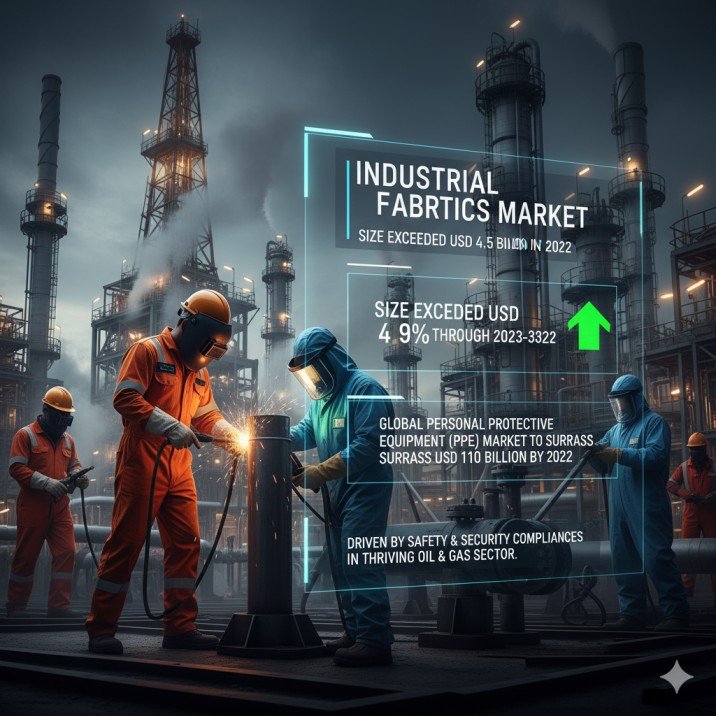
Industrial Protective Fabrics Market size exceeded USD 4.5 billion in 2022 and is slated to exhibit over 9% CAGR through 2023-2032, owing to the requirement for quality PPE in the thriving oil and gas sector. Global personal protective equipment (PPE) market is expected to surpass USD 110 billion by 2032 due to growing safety and security compliances at the workplace.Size, byProduct, 2024 - 2032{USD Billion} Industrial Protective Fabrics Market size exceeded USD 4.5 billion in 2022 and is slated to exhibit over 9% CAGR through 2023-2032 request a free sample copy
Industrial Protective Fabrics Market - By Raw Material (Aramid, Polyester, Polybenzimidazole Fiber, Cotton Fibers, Polyolefins, Polyamide), By Application (Firemen Suits, Industrial Protective Clothing, Space Suits, Arc Flash Suits), & Forecast, 2023 - 20
To get key market trends
Download Free Sample
Used extensively in technical clothing, industrial protective fabrics protect workers from the workplace and environmental hazards in oil and gas facilities and other high-risk environments. Over the years, the production of oil and gas has gained momentum, especially in North America. Based on BP statistics, oil production in the region rose from 14,345 thousand barrels per day to 23,940 thousand barrels per day from 2011 to 2021. This increasing production capacity will encourage workers to use reliable protective industrial apparel to safeguard from potential dangers.
Despite the upward trajectory, the availability of duplicates and low-quality industrial PPE fabrics may assert a negative influence on product manufacturers. Furthermore, the increased requirement for advanced and quality protective clothing results in high manufacturing costs, thereby creating roadblocks to industry expansion. However, consumers are gaining more awareness about the benefits of industrial fabrics, including protection against cuts, chemicals, abrasions, and punctures. The construction of manufacturing facilities and industrial operations will therefore present lucrative growth opportunities for the industrial protective fabrics market over the estimated timeline.
| Report Attribute | Details |
|---|---|
| Base Year | 2022 |
| Industrial Protective Fabrics Market Size in 2022 | 4.6 Billion (USD) |
| Forecast Period | 2023 to 2032 |
| Forecast Period 2023 to 2032 CAGR | 9% |
| 2032 Value Projection | 11.6 Billion (USD) |
| Historical Data for | 2018 to 2022 |
| No. of Pages | 372 |
| Tables, Charts & Figures | 400 |
| Segments covered | Raw Material, Application, and Region |
| Growth Drivers |
|
| Pitfalls & Challenges |
|
Download Free Sample
Industrial Protective Fabrics Market Analysis
Learn more about the key segments shaping this market
The protective fabrics market is on the rise, especially those made from aramid. These fabrics are highly valued for their resistance to fire, wear and tear, and electricity. Plus, they're incredibly strong and lightweight, even when exposed to extreme heat. Chemical companies are investing heavily in expanding their production facilities to meet the growing demand for these fabrics. For example, BASF recently announced a multi-million dollar investment to upgrade its plant in Louisiana. This increased production will lead to more widespread use of aramid in protective clothing for workers in chemical plants, as it offers excellent protection against chemical spills and exposure.
Learn more about the key segments shaping this market
Industrial protective fabrics market size from the fireman suit application segment is expected to be worth over USD 4 billion by 2032. Firemen suit fabrics are designed to offer three-layer protection, and generally include a moisture barrier and outer shell. Their thermal layer also ensures air circulation, moisture resistance, and chemical protection. With the increasing requirement for flame-resistant PEE in the construction, oil and gas, military, mining, and chemical industries, the usage of protective fabrics in firemen suits will thus surge globally.
Healthcare and laboratories segment will depict over 9% CAGR through 2023-2032, on account of the strong demand for PPE in medical labs and other healthcare facilities. Protective clothing is used mainly to safeguard workers against blood splashes, pathogen penetration, and infectious body fluids. The high risk of infectious disease transmission is likely to encourage the consumption of protective fabrics in the design of PPE for healthcare applications.
Looking for region specific data?
Regional Market Insights
Asia-Pacific holds the largest market share and is expected to be the fastest-growing region. This is due to large-scale expansion in construction, manufacturing, and petrochemical industries, and a massive industrial workforce. Governments in the region are increasingly focusing on improving occupational safety compliance, propelling the demand for standardized protective fabrics.
Europe is a highly influential market, largely driven by the most stringent safety and environmental regulations globally. The market is mature but sees continuous demand for high-performance and technologically advanced protective fabrics (like Aramid blends) to meet rigorous EU directives.
North America is characterized by a high-value market where the cost of non-compliance is significant. The region's market is strongly supported by the robust demand from the oil & gas sector (e.g., for Arc Flash and Fire-Resistant fabrics) and the development of specialized protective solutions for the military and law enforcement.
The LAMEA region's growth is heavily tied to major industrial projects in the Middle East (oil & gas, construction) and the mining and agricultural sectors in Latin America, where workers are exposed to extreme heat and chemical hazards.
Europe industrial protective fabrics market was valued at more than USD 1 billion in 2022. The introduction of supportive government policies and norms, such as Regulation (EU) 2017/425, to ensure the marketing of high-quality protective clothing is one of the key drivers for industry expansion. Government bodies have also been emphasizing grid expansion projects to improve renewable energy storage capacity. This will proliferate the usage of industrial protective apparel for protection against electric hazards, creating a favorable environment for regional market growth.
The Industrial Protective Fabrics Market size exceeded USD 4.5 billion in 2022 (using USD 4.6 billion for estimation) and is slated for a high growth trajectory. The regional market breakdown is estimated based on industrial concentration, workforce size, and regulatory stringency across key geographies.
Industrial Protective Fabrics MarketRegional Size and Growth Projections
Industrial Protective Fabrics Market Share
- TenCate Fabrics EU
- CETRIKO SL
- Cerex Advanced Fabrics Inc
- Klopman International
- W. Barnet GmbH & Co
- KOLON Industries
- Honeywell International Inc
- Milliken & Company
- Tejin Ltd
- Beijing BW Protect
- DuPont De Nemours
- WL Gore & Associates
- Glen Raven Inc
- Loyal Textiles Mills Ltd
- Tex Tech Industries
are some of the key players in the industrial protective fabrics market. These market participants are focusing on product launches and business expansions, among other strategies to reinforce their footprint in the industry.
Impact of COVID-19 Pandemic
Industrial operations witnessed a considerable decline during the initial months of the COVID-19 pandemic. These disruptions, mainly fueled by economic crises and temporary facility closures, may have adversely impacted the business of protective fabric manufacturers to some extent. However, in a bid to tackle the crisis, there has been a strong focus on PPE development for protection against the virus.
ustrial Protective Fabrics market research report includes in-depth coverage of the industry with estimates & forecast in terms of volume in Million Square Meter and revenue in USD Million from 2018 to 2032 for the following segments
Click here to Buy Section of this Report
By Raw Material
- Aramid
- Polyester
- Polybenzimidazole Fiber (PBI)
- Cotton Fibers
- Polyolefins
- Polyethylene
- Polypropylene
- Polyamide
By Application
- Firemen suits
- Flame Resistance
- Flame Retardant
- Industrial Protective Clothing
- Clean Room Clothing
- Mechanical Protective Clothing
- Chemical Defending Garment
- Space Suits
- Healthcare & Laboratories
- Arc flash suits
- Others
The above information is provided on a region basis for the following
- North America
- U.S.
- Canada
- Mexico
- Europe
- Germany
- UK
- France
- Italy
- Spain
- Russia
- Asia Pacific
- China
- India
- Japan
- South Korea
- Thailand
- Malaysia
- Australia
- Latin America
- Brazil
- Middle East & Africa
- South Africa
- UAE
- Saudi Arabia