
HMI Sensors In Wearables Market Size, Share & Trends Analysis Report By Sensor Type (Touch Sensors, Motion Sensors), By Device Type, By Application, By End Use, By Region, And Segment Forecasts

HMI Sensors In Wearables Market Size, Share & Trends Analysis Report By Sensor Type (Touch Sensors, Motion Sensors), By Device Type, By Application, By End Use, By Region, And Segment Forecasts

Published Date: August - 2025 | Publisher: MIR | No of Pages: 260 | Industry: technology | Format: Report available in PDF / Excel Format

View Details Download Free Sample Ask for Discount Request Customization
Claim a Free Sample

Get a preview with key statistics, projections, and trends for this report. Ideal for quick insights.

Send Me a Sample

Need full access?

Purchase Report

HMI Sensors In Wearables Market Trends

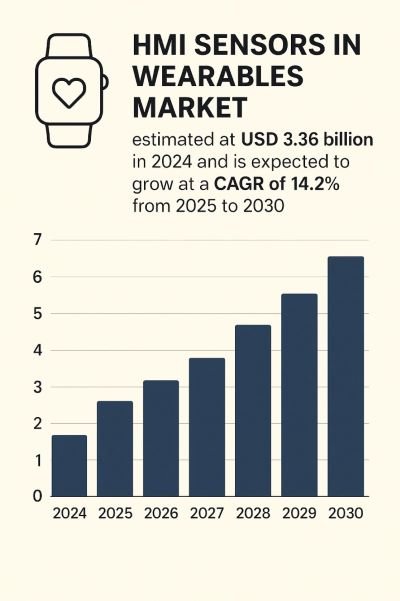
The size of the global HMI sensors in wearables market was estimated at USD 3.36 billion in 2024 and is expected to grow at a CAGR of 14.2% from 2025 to 2030.

MIR Logo

HMI Sensors In Wearables Market Size, Share & Trends Analysis Report By Sensor Type (Touch Sensors, Motion Sensors), By Device Type, By Application, By End Use, By Region, And Segment Forecasts

Size, byProduct, 2024 - 2032{USD Billion}

CAGR: 14.20%

HMI sensors in wearables market size is expected to grow at a CAGR of 14.2% from 2025 to 2030. request a free sample copy

Human-Machine Interface (HMI) sensors empower greater interaction by touch, gesture, voice, and biometric recognition and are an integral part of wearables including smartwatches, fitness trackers, and AR/VR headsets. These sensors allow easy communication between users and devices, enhancing health monitoring, fitness tracking, and real-time feedback capabilities.

Besides, the progress in sensor miniaturization and low-power consumption technologies is facilitating the integration of advanced Human-Machine Interface capabilities into small wearable designs, further driving market growth. The increasing popularity of smartwatches, fitness bands, AR/VR headsets, and hearables is driving the demand for advanced market considerably. These devices are no longer accessories but have become powerful communication, health monitoring, entertainment, and productivity tools. With consumers demanding more from their wearables in terms of functionality, manufacturers are incorporating advanced HMI sensors that allow users to interact with devices seamlessly and intuitively.

Development of multi-functional sensors is the key driver in HMI sensor growth in the wearables market. As devices continue to miniaturize and become lighter, there is an increasing requirement for devices that can do several functions without sacrificing size, power consumption, or responsiveness. Multi-functional HMI sensors address this by merging several sensing features-much like motion sensing, touch control, temperature sensing, and biometric sensing-into a miniature package. This not only simplifies device design but also maximizes the overall responsiveness and interactivity of the device.

Additionally, these sensors' increased responsiveness is essential in use cases where speed and accuracy are paramount, including fitness tracking, remote health monitoring, and immersive AR/VR experiences. In these applications, any lag or misinterpretation in the interface can greatly reduce user satisfaction or even jeopardize safety. Multi-functional HMI sensors, through providing fast signal processing and context-aware functionality, guarantee that wearable devices react promptly and accurately to both intentional commands and subtle environmental changes.

For example, in October 2024, Italian electronics manufacturer WEART released the announcement of TouchDIVER Pro, a new wearable haptic glove aimed at improving XR experiences for business use cases. The glove has six actuation points that provide force feedback, texture rendering, and thermal feelings on all five fingers and the palm. This design supports extremely realistic haptic interaction and is thus appropriate for use in augmented, virtual, and mixed reality applications in many professional applications.
Hmi Sensors In Wearables Market

Report Coverage & Deliverables

  • Competitive benchmarking
  • Historical data & forecasts
  • Company revenue shares
  • Regional opportunities
  • Latest trends & dynamics

Sensor Type Insights

Touch sensors segment led the market and commanded a revenue share of close to 24.0% in 2024, fueled by the growing popularity of seamless and intuitive interfaces, particularly in medical wearables, smartwatches, and fitness bands. The users want natural and efficient modes of interaction, and touch sensors provide real-time response, precision, and usability. Development in capacitive and resistive touch technology, along with ultra-thin and bendable designs, allows integration into various wearable devices.

Voice & audio sensors is expected to register a CAGR of 19.3% over the forecast period, driven by the growing use of voice-controlled virtual assistants like Siri, Google Assistant, and Alexa. Users now want their intelligent devices to be responsive to verbal commands for operations that span from reminding them to send messages to listening to music and delivering live updates. Voice sensors in wearables, especially smartwatches and smart headphones, enable users to interact with their devices more naturally and conveniently, especially if their hands are occupied.

Device Type Insights

The smartwatches & fitness bands segment held the largest market share in 2024 owing to growing health awareness, rising adoption of digital living, and surging demand for real-time insights on data. Devices increasingly use advanced HMI sensors to enable features such as stress tracking, sleep monitoring, and AI-based coaching. Smartphone and IoT ecosystem integration offers greater user convenience by opening up features such as voice assistants and gesture control. Interactive notifications also boost user interaction.

Smart glasses/AR glasses will grow at a high CAGR during the forecast period. The increasing enterprise deployment of AR wearables, wherein smart glasses are employed to offer real-time guidance, remote support, and increased situational awareness. These applications are highly dependent on accurate HMI sensors to identify user intent and react accordingly to head or eye movements, gestures, and environmental signals. In applications such as field service, maintenance, and warehouse operations, smart glasses with voice command and gesture control minimize manual labor and enhance safety by enabling employees to communicate with systems without taking their eyes off the work.

Application Insights

The health & fitness monitoring segment was the market leader in 2024 because of the spreading epidemics of chronic diseases, the growing demographic of older people, and the accelerating demand for ongoing, noninvasive health monitoring. HMI sensors allow precise tracking of vital signs like heart rate, oxygen saturation, and water content, facilitating preventive healthcare and timely diagnosis. Increased adoption of AI and data analytics increases the value of sensor-collected health data, fostering adoption in both clinical and consumer environments. Regulatory approval of remote patient monitoring and telehealth integration further promotes segment growth.

The gaming & immersive experience segment is likely to expand substantially during the forecast period on the back of increasing popularity for VR/AR gaming, metaverse use cases, and haptic feedback technologies. The next-gen motion tracking requirements drive development in 9-axis IMUs (inertial measurement units) and millimeter-wave radar sensors, which provide sub-millisecond latency support for natural avatar synchronization across platforms like Meta Quest Pro and Apple Vision Pro.

End Use Insights

The consumer electronics category led the market and held the revenue share of more than 41.0% in 2024. HMI sensors are being utilized to provide greater entertainment, gaming, and augmented reality experiences, particularly in earbuds, smart glasses, and hybrid wearables. Increasing adoption of 5G connectivity and edge computing allows for quicker, more responsive interfaces driven by HMI technologies. In addition, increasing demand for smart home integration and customized digital ecosystems promotes the use of wearables with sophisticated sensor features that can integrate easily with other consumer electronics.

The healthcare market is anticipated to expand at a high CAGR during the forecast period. The incorporation of AI-based diagnostics and machine learning algorithms in wearable healthcare devices is improving the capabilities of HMI sensors. These technologies allow wearables to gather and analyze information, providing meaningful insights to guide treatment plans or lifestyle adjustments. For instance, activity level, sleep rate, and stress-measuring wearables can produce customized wellness advice based on an individual's specific health profile.

Regional Insights

The Human-Machine Interface sensors in wearables North America market accounted for a major share of more than 34.0% in 2024, supported by the healthtech innovation and smart wearable adoption leadership of the region. Increasing demand for medical-grade biosensors in FDA-cleared wearables like the Apple Watch's ECG and Dexcom's CGM systems is driving the development of optical PPG sensors, capacitive electrophysiology arrays, and MEMS-based drug delivery monitors.

The global HMI (Human-Machine Interface) Sensors in Wearables market is a dynamic segment driven by the increasing sophistication of smartwatches, fitness trackers, AR/VR headsets, and hearables. These sensors, which include accelerometers, gyroscopes, magnetometers, optical heart rate monitors, and microphones, are crucial for user interaction and data collection. The market is projected to grow from USD 3.36 billion in 2024 to approximately USD 7.46 billion by 2030, at a CAGR of 14.2%.

The table below provides a detailed estimation of the market size for key regions. The figures for 2025-2030 are projections based on the given CAGR, with regional variations applied to reflect differing levels of consumer tech adoption, disposable income, and presence of manufacturing and design hubs.

TableHMI Sensors in Wearables Market Size by Region (USD Million)

Region2024 (Base Year)202520262027202820292030CAGR (2025-2030)Key Characteristics & Drivers
Asia-Pacific1,428.01,645.31,895.82,184.02,515.72,897.63,337.5~15.5%Largest & Fastest Growing Market. Dominated by massive manufacturing base (China), high consumer demand, and strong presence of OEMs (Samsung, Xiaomi, Oppo). A hub for innovation and cost-effective sensor production.
North America1,075.21,227.91,402.51,601.71,829.12,088.82,385.4~14.5%High-Value, Innovative Market. Characterized by high consumer spending on premium devices (Apple, Fitbit), early adoption of advanced health-tracking features, and a strong R&D ecosystem in the US and Canada.
Europe605.0686.1778.2882.61,001.11,135.31,287.3~14.2%Mature & Quality-Conscious Market. Steady growth driven by health and fitness trends, strong consumer electronics brands, and high demand for devices with accurate sensors and robust data privacy (adhering to GDPR).
Latin America151.2171.4194.3220.3249.8283.3321.2~14.2%Emerging Growth Market. Growth is fueled by increasing smartphone penetration, growing middle class, and rising health awareness. Price sensitivity is a key characteristic.
Middle East & Africa100.8114.2129.4146.7166.2188.4213.5~14.2%Nascent Market. Growth is driven by affluent consumer segments in GCC countries adopting premium wearables and increasing youth population interested in fitness and tech.
Global Total3,360.03,844.94,400.25,035.35,761.96,593.47,544.914.2%

U.S. HMI Sensors in Wearables Industry Trends
The U.S. wearables market for HMI sensors is anticipated to expand substantially at a CAGR of 12.8% during the period 2025-2030. The U.S. industrial and enterprise segment is quickly embracing haptic feedback gloves and AR smart glasses to increase worker productivity and safety. The Occupational Safety and Health Administration's (OSHA) 2023 guidelines for connected worker technologies have spurred intrinsically safe wearables with explosion-proof gas sensors and impact-detecting MEMS accelerometers deployments.

Europe HMI Sensors in Wearables Industry Trends
Wearables' Human-Machine Interface sensors in Europe market are expected to account for a significant growth between 2025 and 2030. The age population in Europe and the growth of chronic illnesses have increased demand for wearable sensors with HMI that are provided in wearable devices. These make remote patient monitoring possible, thus allowing continuous health monitoring and earlier diagnosis of illness, hence mitigating the health systems' load.

The UK HMI sensors in wearables market is likely to grow at a rapid pace in the future. Ongoing innovations in sensor technology, battery life, and connectivity (e.g., 5G and IoT) are enhancing the performance and functionality of wearable devices, and they are becoming increasingly desirable for consumers. The growing use of IoT and 5G technologies is enhancing the functionality of wearable devices, allowing data transmission at a faster speed and integrating wearables into smart ecosystems.

HMI sensors in wearables market in Germany had a significant market share in 2024. Usage of wearable sensors in industries is picking up steam in Germany. Manufacturing, logistics, and construction industries are largely embracing wearable devices to improve workers' safety and productivity.

Asia Pacific HMI Sensors in Wearables Industry Trends
The wearables market in Asia Pacific is anticipated to have the highest CAGR of 16.4% during 2025-2030. Major technology centers in China, Japan, and South Korea are at the cutting edge of sensor technology innovations such as accelerometers, gyroscopes, and temperature sensors. Miniaturization of these components allows for the creation of small, low-power wearables that do not sacrifice functionality for aesthetics.

Japan HMI sensors for wearables market is likely to expand significantly during the next few years. Japan's robust technological backbone supports the inclusion of sophisticated technologies like Artificial Intelligence (AI), Machine Learning (ML), and the Internet of Things (IoT) in wearable products. These interfaces support live analysis of data, customized health information, and a simple connection with other digital systems.

The wearables market in China for HMI sensors had a significant market share in 2024. The Made in China 2025 initiative supports China's industrial wearable innovation growth. The nation's smart factories are using 5G-enabled AR helmets with eye-tracking thermal sensors and haptic exoskeletons with force feedback strain gauges to improve worker productivity.

Key HMI Sensors In Wearables Company Insights

Key players operating in the HMI sensors in wearables industry are Synaptics Incorporated, Bosch Sensortec GmbH, ams-OSRAM AG, STMicroelectronics, and Infineon Technologies AG. The companies focus on various strategic initiatives, including new product development, partnerships & collaborations, and agreements to gain a competitive advantage over their rivals. The following are some instances of such initiatives.

Key HMI Sensors In Wearables Companies

The following are the leading companies in the human-machine interface sensors in wearables market. These companies collectively hold the largest market share and dictate industry trends.

Recent Developments

  • In April 2025, Sensirion AG inaugurated an enlarged manufacturing plant in Debrecen, Hungary, with some 7,000 square meters of new production and logistics area. The expansion dramatically increases the company's ability to manufacture sensor modules, underpinning its long-term growth strategy. Beyond expanding operations, Sensirion AG seeks to extend its position as a solid and desirable regional employer by providing secure jobs and good working conditions.

    In March 2025, STMicroelectronics released its STM32U3 microcontroller family targeting energy-efficient IoT and smart connected applications. Its Microcontrollers (MCUs) are tailored to low-power performance in applications where limited energy resources are available, including coin cell batteries or energy harvesting. Typical applications include utility meters, medical devices, environmental sensors, and consumer electronics like wearables and hearables.

HMI Sensors In Wearables Report Scope

Report Attribute

Details

Market size in 2025

USD 3.76 billion

Revenue forecast in 2030

USD 7.29 billion

Growth rate

CAGR of 14.2% from 2025 to 2030

Actual data

2018 - 2024

Forecast period

2025 - 2030

Quantitative units

Revenue in USD million/billion and CAGR from 2025 to 2030

Report enterprise size

Revenue forecast, company share, competitive landscape, growth factors, and trends

Segments covered

Sensor type, device type, application, end use, region

Regional scope

North America; Europe; Asia Pacific; Latin America; MEA

Country scope

U.S.; Canada; Mexico; UK; Germany; France; China; India; Japan; Australia; South Korea; Brazil; UAE; Kingdom of Saudi Arabia; South Africa

Key companies profiled

ams-OSRAM AG; Bosch Sensortec GmbH; Infineon Technologies AG; Shenzhen Goodix Technology Co., Ltd.; Microchip Technology Inc.; NXP Semiconductors; STMicroelectronics; Synaptics Incorporated; Sensirion AG; TDK Corporation; Texas Instruments Incorporated; UltraSense Systems Inc.

Customization scope

Free report customization (equivalent to 8 analysts working days) with purchase. Addition or alteration to country, regional & segment scope.

Pricing and purchase options

Avail customized purchase options to meet your exact research needs. Explore purchase options

Global HMI Sensors In Wearables Market Report Segmentation

Sensor Type Outlook (Revenue, USD Billion, 2018 - 2030)

    • Touch Sensors

    • Motion Sensors

    • Biometric Sensors

    • Voice & Audio Sensors

    • Environmental Sensors

    • Others

  • Device Type Outlook (Revenue, USD Billion, 2018 - 2030)

    • Smartwatches & Fitness Bands

    • Smart Glasses/AR Glasses

    • Smart Clothing

    • Smart Rings/Wristbands

    • Hearables/Earbuds

    • Head-Mounted Displays (HMDs)

    • Others

  • Application Outlook (Revenue, USD Billion, 2018 - 2030)

    • Health & Fitness Monitoring

    • Gesture and Motion Control

    • Communication & Voice Interaction

    • Ambient Sensing & Personalization

    • Gaming & Immersive Experience

    • Others

  • End Use Outlook (Revenue, USD Billion, 2018 - 2030)

    • Consumer Electronics

    • Healthcare

    • Enterprise & Industrial Applications

    • Others

  • Regional Outlook (Revenue, USD Billion, 2018 - 2030)

    • North America

      • U.S.

      • Canada

      • Mexico

    • Europe

      • UK

      • Germany

      • France

    • Asia Pacific

      • China

      • India

      • Japan

      • South Korea

      • Australia

    • Latin America

      • Brazil

    • Middle East & Africa

      • UAE

      • Saudi Arabia

      • South Africa

Frequently Asked Questions

The global HMI sensors in wearables market size was estimated at USD 3.36 billion in 2024 and is expected to reach USD 3.76 billion in 2025.

The global HMI sensors in wearables market is expected to grow at a compound annual growth rate of 14.2% from 2025 to 2030 to reach USD 7.29 billion by 2030.

HMI sensors enable enhanced interaction through touch, gesture, voice, and biometric recognition and are integral to wearables such as smartwatches, fitness trackers, and AR/VR headsets. These sensors facilitate seamless communication between users and devices, boosting health monitoring, fitness tracking, and real-time feedback functionality.

The touch sensors segment dominated the market and accounted for the revenue share of nearly 24.0% in 2024, driven by the increasing demand for seamless and user-friendly interfaces, especially in smartwatches, fitness bands, and medical wearables. Consumers seek more natural and efficient ways to interact with devices, and touch sensors offer real-time responsiveness, precision, and ease of use.

Some key players operating in the HMI sensors in wearables market include ams-OSRAM AG, Bosch Sensortec GmbH, Infineon Technologies AG, Shenzhen Goodix Technology Co., Ltd., Microchip Technology Inc., NXP Semiconductors, STMicroelectronics, Synaptics Incorporated, Sensirion AG, TDK Corporation, Texas Instruments Incorporated, UltraSense Systems Inc.

Table of Content

Table of Contents

Chapter 1. Methodology and Scope
                    1.1. Methodology segmentation & scope
                    1.2. Market Definitions
                    1.3. Research Methodology
                        1.3.1. Information Procurement
                        1.3.2. Information or Data Analysis
                        1.3.3. Market Formulation & Data Visualization
                        1.3.4. Data Validation & Publishing
                    1.4. Research Scope and Assumptions
                        1.4.1. List of Data Sources
Chapter 2. Executive Summary
                    2.1. Market Outlook
                    2.2. Segment Outlook
                    2.3. Competitive Insights
Chapter 3. HMI Sensors in Wearables: Variables, Trends & Scope
                    3.1. Market Introduction/Lineage Outlook
                    3.2. Industry Value Chain Analysis
                    3.3. Market Dynamics
                        3.3.1. Market Drivers Analysis
                        3.3.2. Market Restraints Analysis
                        3.3.3. Industry Opportunities
                    3.4. HMI Sensors in Wearables Analysis Tools
                        3.4.1. Porter’s Analysis
                            3.4.1.1. Bargaining power of the suppliers
                            3.4.1.2. Bargaining power of the buyers
                            3.4.1.3. Threats of substitution
                            3.4.1.4. Threats from new entrants
                        3.4.2. PESTEL Analysis
                            3.4.2.1. Political landscape
                            3.4.2.2. Economic and Social landscape
                            3.4.2.3. Technological landscape
                            3.4.2.4. Environmental landscape
                            3.4.2.5. Legal landscape
Chapter 4. HMI Sensors in Wearables Market: Sensor Type Estimates & Trend Analysis
                    4.1. Segment Dashboard
                    4.2. HMI Sensors in Wearables: Sensor Type Movement Analysis, 2024 & 2030 (USD Billion)
                    4.3. Touch Sensors
                        4.3.1. Market Size Estimates and Forecasts, 2018 - 2030 (USD Billion)
                    4.4. Motion Sensors
                        4.4.1. Market Size Estimates and Forecasts, 2018 - 2030 (USD Billion)
                    4.5. Biometric Sensors
                        4.5.1. Market Size Estimates and Forecasts, 2018 - 2030 (USD Billion)
                    4.6. Voice & Audio Sensors
                        4.6.1. Market Size Estimates and Forecasts, 2018 - 2030 (USD Billion)
                    4.7. Environmental Sensors
                        4.7.1. Market Size Estimates and Forecasts, 2018 - 2030 (USD Billion)
                    4.8. Others
                        4.8.1. Market Size Estimates and Forecasts, 2018 - 2030 (USD Billion)
Chapter 5. HMI Sensors in Wearables Market: Device Type Estimates & Trend Analysis
                    5.1. Segment Dashboard
                    5.2. HMI Sensors in Wearables: Device Type Movement Analysis, 2024 & 2030 (USD Billion)
                    5.3. Smartwatches & Fitness Bands
                        5.3.1. Market Size Estimates and Forecasts, 2018 - 2030 (USD Billion)
                    5.4. Smart Glasses/AR Glasses
                        5.4.1. Market Size Estimates and Forecasts, 2018 - 2030 (USD Billion)
                    5.5. Smart Clothing
                        5.5.1. Market Size Estimates and Forecasts, 2018 - 2030 (USD Billion)
                    5.6. Smart Rings/Wristbands
                        5.6.1. Market Size Estimates and Forecasts, 2018 - 2030 (USD Billion)
                    5.7. Hearables/Earbuds
                        5.7.1. Market Size Estimates and Forecasts, 2018 - 2030 (USD Billion)
                    5.8. Head-Mounted Displays (HMDs)
                        5.8.1. Market Size Estimates and Forecasts, 2018 - 2030 (USD Billion)
                    5.9. Others
                        5.9.1. Market Size Estimates and Forecasts, 2018 - 2030 (USD Billion)
Chapter 6. HMI Sensors in Wearables Market: Application Estimates & Trend Analysis
                    6.1. Segment Dashboard
                    6.2. HMI Sensors in Wearables: Application Movement Analysis, 2024 & 2030 (USD Billion)
                    6.3. Health & Fitness Monitoring
                        6.3.1. Market Size Estimates and Forecasts, 2018 - 2030 (USD Billion)
                    6.4. Gesture and Motion Control
                        6.4.1. Market Size Estimates and Forecasts, 2018 - 2030 (USD Billion)
                    6.5. Communication & Voice Interaction
                        6.5.1. Market Size Estimates and Forecasts, 2018 - 2030 (USD Billion)
                    6.6. Ambient Sensing & Personalization
                        6.6.1. Market Size Estimates and Forecasts, 2018 - 2030 (USD Billion)
                    6.7. Gaming & Immersive Experience
                        6.7.1. Market Size Estimates and Forecasts, 2018 - 2030 (USD Billion)
                    6.8. Others
                        6.8.1. Market Size Estimates and Forecasts, 2018 - 2030 (USD Billion)
Chapter 7. HMI Sensors in Wearables Market: End Use Estimates & Trend Analysis
                    7.1. Segment Dashboard
                    7.2. HMI Sensors in Wearables: End Use Movement Analysis, 2024 & 2030 (USD Billion)
                    7.3. Consumer Electronics
                        7.3.1. Market Size Estimates and Forecasts, 2018 - 2030 (USD Billion)
                    7.4. Healthcare
                        7.4.1. Market Size Estimates and Forecasts, 2018 - 2030 (USD Billion)
                    7.5. Enterprise & Industrial Applications
                        7.5.1. Market Size Estimates and Forecasts, 2018 - 2030 (USD Billion)
                    7.6. Others
                        7.6.1. Market Size Estimates and Forecasts, 2018 - 2030 (USD Billion)
Chapter 8. HMI Sensors in Wearables Market: Regional Estimates & Trend Analysis
                    8.1. HMI Sensors in Wearables Share, By Region, 2024 & 2030, USD Billion
                    8.2. North America
                        8.2.1. Market Estimates and Forecasts, 2018 - 2030 (USD Billion)
                        8.2.2. Market estimates and forecast by sensor type, 2018 - 2030 (USD Billion)
                        8.2.3. Market estimates and forecast by device type, 2018 - 2030 (USD Billion)
                        8.2.4. Market estimates and forecast by application, 2018 - 2030 (USD Billion)
                        8.2.5. Market estimates and forecast by end use, 2018 - 2030 (USD Billion)
                        8.2.6. U.S.
                            8.2.6.1. Market Estimates and Forecasts, 2018 - 2030 (USD Billion)
                            8.2.6.2. Market estimates and forecast by sensor type, 2018 - 2030 (USD Billion)
                            8.2.6.3. Market estimates and forecast by device type, 2018 - 2030 (USD Billion)
                            8.2.6.4. Market estimates and forecast by application, 2018 - 2030 (USD Billion)
                            8.2.6.5. Market estimates and forecast by end use, 2018 - 2030 (USD Billion)
                        8.2.7. Canada
                            8.2.7.1. Market Estimates and Forecasts, 2018 - 2030 (USD Billion)
                            8.2.7.2. Market estimates and forecast by sensor type, 2018 - 2030 (USD Billion)
                            8.2.7.3. Market estimates and forecast by device type, 2018 - 2030 (USD Billion)
                            8.2.7.4. Market estimates and forecast by application, 2018 - 2030 (USD Billion)
                            8.2.7.5. Market estimates and forecast by end use, 2018 - 2030 (USD Billion)
                        8.2.8. Mexico
                            8.2.8.1. Market Estimates and Forecasts, 2018 - 2030 (USD Billion)
                            8.2.8.2. Market estimates and forecast by sensor type, 2018 - 2030 (USD Billion)
                            8.2.8.3. Market estimates and forecast by device type, 2018 - 2030 (USD Billion)
                            8.2.8.4. Market estimates and forecast by application, 2018 - 2030 (USD Billion)
                            8.2.8.5. Market estimates and forecast by end use, 2018 - 2030 (USD Billion)
                    8.3. Europe
                        8.3.1. Market Estimates and Forecasts, 2018 - 2030 (USD Billion)
                        8.3.2. Market estimates and forecast by sensor type, 2018 - 2030 (USD Billion)
                        8.3.3. Market estimates and forecast by device type, 2018 - 2030 (USD Billion)
                        8.3.4. Market estimates and forecast by application, 2018 - 2030 (USD Billion)
                        8.3.5. Market estimates and forecast by end use, 2018 - 2030 (USD Billion)
                        8.3.6. UK
                            8.3.6.1. Market Estimates and Forecasts, 2018 - 2030 (USD Billion)
                            8.3.6.2. Market estimates and forecast by sensor type, 2018 - 2030 (USD Billion)
                            8.3.6.3. Market estimates and forecast by device type, 2018 - 2030 (USD Billion)
                            8.3.6.4. Market estimates and forecast by application, 2018 - 2030 (USD Billion)
                            8.3.6.5. Market estimates and forecast by end use, 2018 - 2030 (USD Billion)
                        8.3.7. Germany
                            8.3.7.1. Market Estimates and Forecasts, 2018 - 2030 (USD Billion)
                            8.3.7.2. Market estimates and forecast by sensor type, 2018 - 2030 (USD Billion)
                            8.3.7.3. Market estimates and forecast by device type, 2018 - 2030 (USD Billion)
                            8.3.7.4. Market estimates and forecast by application, 2018 - 2030 (USD Billion)
                            8.3.7.5. Market estimates and forecast by end use, 2018 - 2030 (USD Billion)
                        8.3.8. France
                            8.3.8.1. Market Estimates and Forecasts, 2018 - 2030 (USD Billion)
                            8.3.8.2. Market estimates and forecast by sensor type, 2018 - 2030 (USD Billion)
                            8.3.8.3. Market estimates and forecast by device type, 2018 - 2030 (USD Billion)
                            8.3.8.4. Market estimates and forecast by application, 2018 - 2030 (USD Billion)
                            8.3.8.5. Market estimates and forecast by end use, 2018 - 2030 (USD Billion)
                    8.4. Asia Pacific
                        8.4.1. Market Estimates and Forecasts, 2018 - 2030 (USD Billion)
                        8.4.2. Market estimates and forecast by sensor type, 2018 - 2030 (USD Billion)
                        8.4.3. Market estimates and forecast by device type, 2018 - 2030 (USD Billion)
                        8.4.4. Market estimates and forecast by application, 2018 - 2030 (USD Billion)
                        8.4.5. Market estimates and forecast by end use, 2018 - 2030 (USD Billion)
                        8.4.6. China
                            8.4.6.1. Market Estimates and Forecasts, 2018 - 2030 (USD Billion)
                            8.4.6.2. Market estimates and forecast by sensor type, 2018 - 2030 (USD Billion)
                            8.4.6.3. Market estimates and forecast by device type, 2018 - 2030 (USD Billion)
                            8.4.6.4. Market estimates and forecast by application, 2018 - 2030 (USD Billion)
                            8.4.6.5. Market estimates and forecast by end use, 2018 - 2030 (USD Billion)
                        8.4.7. India
                            8.4.7.1. Market Estimates and Forecasts, 2018 - 2030 (USD Billion)
                            8.4.7.2. Market estimates and forecast by sensor type, 2018 - 2030 (USD Billion)
                            8.4.7.3. Market estimates and forecast by device type, 2018 - 2030 (USD Billion)
                            8.4.7.4. Market estimates and forecast by application, 2018 - 2030 (USD Billion)
                            8.4.7.5. Market estimates and forecast by end use, 2018 - 2030 (USD Billion)
                        8.4.8. Japan
                            8.4.8.1. Market Estimates and Forecasts, 2018 - 2030 (USD Billion)
                            8.4.8.2. Market estimates and forecast by sensor type, 2018 - 2030 (USD Billion)
                            8.4.8.3. Market estimates and forecast by device type, 2018 - 2030 (USD Billion)
                            8.4.8.4. Market estimates and forecast by application, 2018 - 2030 (USD Billion)
                            8.4.8.5. Market estimates and forecast by end use, 2018 - 2030 (USD Billion)
                        8.4.9. Australia
                            8.4.9.1. Market Estimates and Forecasts, 2018 - 2030 (USD Billion)
                            8.4.9.2. Market estimates and forecast by sensor type, 2018 - 2030 (USD Billion)
                            8.4.9.3. Market estimates and forecast by device type, 2018 - 2030 (USD Billion)
                            8.4.9.4. Market estimates and forecast by application, 2018 - 2030 (USD Billion)
                            8.4.9.5. Market estimates and forecast by end use, 2018 - 2030 (USD Billion)
                        8.4.10. South Korea
                            8.4.10.1. Market Estimates and Forecasts, 2018 - 2030 (USD Billion)
                            8.4.10.2. Market estimates and forecast by sensor type, 2018 - 2030 (USD Billion)
                            8.4.10.3. Market estimates and forecast by device type, 2018 - 2030 (USD Billion)
                            8.4.10.4. Market estimates and forecast by application, 2018 - 2030 (USD Billion)
                            8.4.10.5. Market estimates and forecast by end use, 2018 - 2030 (USD Billion)
                    8.5. Latin America
                        8.5.1. Market Estimates and Forecasts, 2018 - 2030 (USD Billion)
                        8.5.2. Market estimates and forecast by sensor type, 2018 - 2030 (USD Billion)
                        8.5.3. Market estimates and forecast by device type, 2018 - 2030 (USD Billion)
                        8.5.4. Market estimates and forecast by application, 2018 - 2030 (USD Billion)
                        8.5.5. Market estimates and forecast by end use, 2018 - 2030 (USD Billion)
                        8.5.6. Brazil
                            8.5.6.1. Market Estimates and Forecasts, 2018 - 2030 (USD Billion)
                            8.5.6.2. Market estimates and forecast by sensor type, 2018 - 2030 (USD Billion)
                            8.5.6.3. Market estimates and forecast by device type, 2018 - 2030 (USD Billion)
                            8.5.6.4. Market estimates and forecast by application, 2018 - 2030 (USD Billion)
                            8.5.6.5. Market estimates and forecast by end use, 2018 - 2030 (USD Billion)
                    8.6. Middle East & Africa
                        8.6.1. Market Estimates and Forecasts, 2018 - 2030 (USD Billion)
                        8.6.2. Market estimates and forecast by sensor type, 2018 - 2030 (USD Billion)
                        8.6.3. Market estimates and forecast by device type, 2018 - 2030 (USD Billion)
                        8.6.4. Market estimates and forecast by application, 2018 - 2030 (USD Billion)
                        8.6.5. Market estimates and forecast by end use, 2018 - 2030 (USD Billion)
                        8.6.6. Saudi Arabia
                            8.6.6.1. Market Estimates and Forecasts, 2018 - 2030 (USD Billion)
                            8.6.6.2. Market estimates and forecast by sensor type, 2018 - 2030 (USD Billion)
                            8.6.6.3. Market estimates and forecast by device type, 2018 - 2030 (USD Billion)
                            8.6.6.4. Market estimates and forecast by application, 2018 - 2030 (USD Billion)
                            8.6.6.5. Market estimates and forecast by end use, 2018 - 2030 (USD Billion)
                        8.6.7. UAE
                            8.6.7.1. Market Estimates and Forecasts, 2018 - 2030 (USD Billion)
                            8.6.7.2. Market estimates and forecast by sensor type, 2018 - 2030 (USD Billion)
                            8.6.7.3. Market estimates and forecast by device type, 2018 - 2030 (USD Billion)
                            8.6.7.4. Market estimates and forecast by application, 2018 - 2030 (USD Billion)
                            8.6.7.5. Market estimates and forecast by end use, 2018 - 2030 (USD Billion)
                        8.6.8. South Africa
                            8.6.8.1. Market Estimates and Forecasts, 2018 - 2030 (USD Billion)
                            8.6.8.2. Market estimates and forecast by sensor type, 2018 - 2030 (USD Billion)
                            8.6.8.3. Market estimates and forecast by device type, 2018 - 2030 (USD Billion)
                            8.6.8.4. Market estimates and forecast by application, 2018 - 2030 (USD Billion)
                            8.6.8.5. Market estimates and forecast by end use, 2018 - 2030 (USD Billion)
Chapter 9. Competitive Landscape
                    9.1. Recent Developments & Impact Analysis by Key Market Participants
                    9.2. Company Categorization
                    9.3. Company Market Share Analysis
                    9.4. Company Heat Map Analysis
                    9.5. Strategy Mapping
                        9.5.1. Expansion
                        9.5.2. Mergers & Acquisition
                        9.5.3. Partnerships & Collaborations
                        9.5.4. New Product Launches
                        9.5.5. Research And Development
                    9.6. Company Profiles
                        9.6.1. ams-OSRAM AG
                            9.6.1.1. Participant’s Overview
                            9.6.1.2. Financial Performance
                            9.6.1.3. Product Benchmarking
                            9.6.1.4. Recent Developments
                        9.6.2. Bosch Sensortec GmbH
                            9.6.2.1. Participant’s Overview
                            9.6.2.2. Financial Performance
                            9.6.2.3. Product Benchmarking
                            9.6.2.4. Recent Developments
                        9.6.3. Infineon Technologies AG
                            9.6.3.1. Participant’s Overview
                            9.6.3.2. Financial Performance
                            9.6.3.3. Product Benchmarking
                            9.6.3.4. Recent Developments
                        9.6.4. Shenzhen Goodix Technology Co., Ltd.
                            9.6.4.1. Participant’s Overview
                            9.6.4.2. Financial Performance
                            9.6.4.3. Product Benchmarking
                            9.6.4.4. Recent Developments
                        9.6.5. Microchip Technology Inc.
                            9.6.5.1. Participant’s Overview
                            9.6.5.2. Financial Performance
                            9.6.5.3. Product Benchmarking
                            9.6.5.4. Recent Developments
                        9.6.6. NXP Semiconductors
                            9.6.6.1. Participant’s Overview
                            9.6.6.2. Financial Performance
                            9.6.6.3. Product Benchmarking
                            9.6.6.4. Recent Developments
                        9.6.7. STMicroelectronics
                            9.6.7.1. Participant’s Overview
                            9.6.7.2. Financial Performance
                            9.6.7.3. Product Benchmarking
                            9.6.7.4. Recent Developments
                        9.6.8. Synaptics Incorporated
                            9.6.8.1. Participant’s Overview
                            9.6.8.2. Financial Performance
                            9.6.8.3. Product Benchmarking
                            9.6.8.4. Recent Developments
                        9.6.9. Sensirion AG
                            9.6.9.1. Participant’s Overview
                            9.6.9.2. Financial Performance
                            9.6.9.3. Product Benchmarking
                            9.6.9.4. Recent Developments
                        9.6.10. TDK Corporation
                            9.6.10.1. Participant’s Overview
                            9.6.10.2. Financial Performance
                            9.6.10.3. Product Benchmarking
                            9.6.10.4. Recent Developments
                        9.6.11. Texas Instruments Incorporated
                            9.6.11.1. Participant’s Overview
                            9.6.11.2. Financial Performance
                            9.6.11.3. Product Benchmarking
                            9.6.11.4. Recent Developments
                        9.6.12. UltraSense Systems Inc.
                            9.6.12.1. Participant’s Overview
                            9.6.12.2. Financial Performance
                            9.6.12.3. Product Benchmarking
                            9.6.12.4. Recent Developments


List of Tables

Table 1 List of Abbreviation
Table 2 Global HMI sensors in wearables market, 2018 - 2030 (USD Billion)
Table 3 Global HMI sensors in wearables market, by region, 2018 - 2030 (USD Billion)
Table 4 Global HMI sensors in wearables market, by sensor type, 2018 - 2030 (USD Billion)
Table 5 Global HMI sensors in wearables market, by device type, 2018 - 2030 (USD Billion)
Table 6 Global HMI sensors in wearables market, by application, 2018 - 2030 (USD Billion)
Table 7 Global HMI sensors in wearables market, by end use, 2018 - 2030 (USD Billion)
Table 8 Global touch sensors market by region, 2018 - 2030 (USD Billion)
Table 9 Global motion sensors market by region, 2018 - 2030 (USD Billion)
Table 10 Global biometric sensors market by region, 2018 - 2030 (USD Billion)
Table 11 Global voice & audio sensors market by region, 2018 - 2030 (USD Billion)
Table 12 Global environmental sensors market by region, 2018 - 2030 (USD Billion)
Table 13 Global others market by region, 2018 - 2030 (USD Billion)
Table 14 Global smartwatches & fitness bands market by region, 2018 - 2030 (USD Billion)
Table 15 Global smart glasses/AR Glasses market by region, 2018 - 2030 (USD Billion)
Table 16 Global smart clothing market by region, 2018 - 2030 (USD Billion)
Table 17 Global smart rings/wristbands market by region, 2018 - 2030 (USD Billion)
Table 18 Global hearables/earbuds market by region, 2018 - 2030 (USD Billion)
Table 19 Global head-mounted displays (HMDs) market by region, 2018 - 2030 (USD Billion)
Table 20 Global others market by region, 2018 - 2030 (USD Billion)
Table 21 Global health & fitness monitoring market by region, 2018 - 2030 (USD Billion)
Table 22 Global gesture and motion control market by region, 2018 - 2030 (USD Billion)
Table 23 Global communication & voice interaction market by region, 2018 - 2030 (USD Billion)
Table 24 Global ambient sensing & personalization market by region, 2018 - 2030 (USD Billion)
Table 25 Global gaming & immersive experience market by region, 2018 - 2030 (USD Billion)
Table 26 Global others market by region, 2018 - 2030 (USD Billion)
Table 27 Global consumer electronics market by region, 2018 - 2030 (USD Billion)
Table 28 Global healthcare market by region, 2018 - 2030 (USD Billion)
Table 29 Global enterprise & industrial applications market by region, 2018 - 2030 (USD Billion)
Table 30 Global others market by region, 2018 - 2030 (USD Billion)
Table 31 North America HMI sensors in wearables market, by sensor type, 2018 - 2030 (USD Billion)
Table 32 North America HMI sensors in wearables market, by device type, 2018 - 2030 (USD Billion)
Table 33 North America HMI sensors in wearables market, by application, 2018 - 2030 (USD Billion)
Table 34 North America HMI sensors in wearables market, by end use, 2018 - 2030 (USD Billion)
Table 35 U.S. HMI sensors in wearables market, by sensor type, 2018 - 2030 (USD Billion)
Table 36 U.S. HMI sensors in wearables market, by device type, 2018 - 2030 (USD Billion)
Table 37 U.S. HMI sensors in wearables market, by application, 2018 - 2030 (USD Billion)
Table 38 U.S. HMI sensors in wearables market, by end use, 2018 - 2030 (USD Billion)
Table 39 Canada HMI sensors in wearables market, by sensor type, 2018 - 2030 (USD Billion)
Table 40 Canada HMI sensors in wearables market, by device type, 2018 - 2030 (USD Billion)
Table 41 Canada HMI sensors in wearables market, by application, 2018 - 2030 (USD Billion)
Table 42 Canada HMI sensors in wearables market, by end use,, 2018 - 2030 (USD Billion)
Table 43 Mexico HMI sensors in wearables market, by sensor type, 2018 - 2030 (USD Billion)
Table 44 Mexico HMI sensors in wearables market, by device type, 2018 - 2030 (USD Billion)
Table 45 Mexico HMI sensors in wearables market, by application, 2018 - 2030 (USD Billion)
Table 46 Mexico HMI sensors in wearables market, by end use, 2018 - 2030 (USD Billion)
Table 47 Europe HMI sensors in wearables market, by sensor type, 2018 - 2030 (USD Billion)
Table 48 Europe HMI sensors in wearables market, by device type, 2018 - 2030 (USD Billion)
Table 49 Europe HMI sensors in wearables market, by application, 2018 - 2030 (USD Billion)
Table 50 Europe HMI sensors in wearables market, by end use, 2018 - 2030 (USD Billion)
Table 51 UK HMI sensors in wearables market, by sensor type, 2018 - 2030 (USD Billion)
Table 52 UK HMI sensors in wearables market, by device type, 2018 - 2030 (USD Billion)
Table 53 UK HMI sensors in wearables market, by application, 2018 - 2030 (USD Billion)
Table 54 UK HMI sensors in wearables market, by end use, 2018 - 2030 (USD Billion)
Table 55 Germany HMI sensors in wearables market, by sensor type, 2018 - 2030 (USD Billion)
Table 56 Germany HMI sensors in wearables market, by device type, 2018 - 2030 (USD Billion)
Table 57 Germany HMI sensors in wearables market, by application, 2018 - 2030 (USD Billion)
Table 58 Germany HMI sensors in wearables market, by end use, 2018 - 2030 (USD Billion)
Table 59 France HMI sensors in wearables market, by sensor type, 2018 - 2030 (USD Billion)
Table 60 France HMI sensors in wearables market, by device type, 2018 - 2030 (USD Billion)
Table 61 France HMI sensors in wearables market, by application, 2018 - 2030 (USD Billion)
Table 62 France HMI sensors in wearables market, by end use, 2018 - 2030 (USD Billion)
Table 63 Asia Pacific HMI sensors in wearables market, by sensor type, 2018 - 2030 (USD Billion)
Table 64 Asia Pacific HMI sensors in wearables market, by device type, 2018 - 2030 (USD Billion)
Table 65 Asia Pacific HMI sensors in wearables market, by application, 2018 - 2030 (USD Billion)
Table 66 Asia Pacific HMI sensors in wearables market, by end use, 2018 - 2030 (USD Billion)
Table 67 China HMI sensors in wearables market, by sensor type, 2018 - 2030 (USD Billion)
Table 68 China HMI sensors in wearables market, by device type, 2018 - 2030 (USD Billion)
Table 69 China HMI sensors in wearables market, by application, 2018 - 2030 (USD Billion)
Table 70 China HMI sensors in wearables market, by end use, 2018 - 2030 (USD Billion)
Table 71 India HMI sensors in wearables market, by sensor type, 2018 - 2030 (USD Billion)
Table 72 India HMI sensors in wearables market, by device type, 2018 - 2030 (USD Billion)
Table 73 India HMI sensors in wearables market, by application, 2018 - 2030 (USD Billion)
Table 74 India HMI sensors in wearables market, by end use, 2018 - 2030 (USD Billion)
Table 75 Japan HMI sensors in wearables market, by sensor type, 2018 - 2030 (USD Billion)
Table 76 Japan HMI sensors in wearables market, by device type, 2018 - 2030 (USD Billion)
Table 77 Japan HMI sensors in wearables market, by application, 2018 - 2030 (USD Billion)
Table 78 Japan HMI sensors in wearables market, by end use, 2018 - 2030 (USD Billion)
Table 79 Australia HMI sensors in wearables market, by sensor type, 2018 - 2030 (USD Billion)
Table 80 Australia HMI sensors in wearables market, by device type, 2018 - 2030 (USD Billion)
Table 81 Australia HMI sensors in wearables market, by application, 2018 - 2030 (USD Billion)
Table 82 Australia HMI sensors in wearables market, by end use, 2018 - 2030 (USD Billion)
Table 83 South Korea HMI sensors in wearables market, by sensor type, 2018 - 2030 (USD Billion)
Table 84 South Korea HMI sensors in wearables market, by device type, 2018 - 2030 (USD Billion)
Table 85 South Korea HMI sensors in wearables market, by application, 2018 - 2030 (USD Billion)
Table 86 South Korea HMI sensors in wearables market, by end use, 2018 - 2030 (USD Billion)
Table 87 Latin America HMI sensors in wearables market, by sensor type, 2018 - 2030 (USD Billion)
Table 88 Latin America HMI sensors in wearables market, by device type, 2018 - 2030 (USD Billion)
Table 89 Latin America HMI sensors in wearables market, by application, 2018 - 2030 (USD Billion)
Table 90 Latin America HMI sensors in wearables market, by end use, 2018 - 2030 (USD Billion)
Table 91 Brazil HMI sensors in wearables market, by sensor type, 2018 - 2030 (USD Billion)
Table 92 Brazil HMI sensors in wearables market, by device type, 2018 - 2030 (USD Billion)
Table 93 Brazil HMI sensors in wearables market, by application, 2018 - 2030 (USD Billion)
Table 94 Brazil HMI sensors in wearables market, by end use, 2018 - 2030 (USD Billion)
Table 95 Middle East & Africa HMI sensors in wearables market, by sensor type, 2018 - 2030 (USD Billion)
Table 96 Middle East & Africa HMI sensors in wearables market, by device type, 2018 - 2030 (USD Billion)
Table 97 Middle East & Africa HMI sensors in wearables market, by application, 2018 - 2030 (USD Billion)
Table 98 Middle East & Africa HMI sensors in wearables market, by end use, 2018 - 2030 (USD Billion)
Table 99 UAE HMI sensors in wearables market, by sensor type, 2018 - 2030 (USD Billion)
Table 100 UAE HMI sensors in wearables market, by device type, 2018 - 2030 (USD Billion)
Table 101 UAE HMI sensors in wearables market, by application, 2018 - 2030 (USD Billion)
Table 102 UAE HMI sensors in wearables market, by end use, 2018 - 2030 (USD Billion)
Table 103 Saudi Arabia HMI sensors in wearables market, by sensor type, 2018 - 2030 (USD Billion)
Table 104 Saudi Arabia HMI sensors in wearables market, by device type, 2018 - 2030 (USD Billion)
Table 105 Saudi Arabia HMI sensors in wearables market, by application, 2018 - 2030 (USD Billion)
Table 106 Saudi Arabia HMI sensors in wearables market, by end use, 2018 - 2030 (USD Billion)
Table 107 South Africa HMI sensors in wearables market, by sensor type, 2018 - 2030 (USD Billion)
Table 108 South Africa HMI sensors in wearables market, by device type, 2018 - 2030 (USD Billion)
Table 109 South Africa HMI sensors in wearables market, by application, 2018 - 2030 (USD Billion)
Table 110 South Africa HMI sensors in wearables market, by end use, 2018 - 2030 (USD Billion)


List of Figures

Fig. 1 HMI Sensors in Wearables Market Segmentation
Fig. 2 Market landscape
Fig. 3 Information Procurement
Fig. 4 Data Analysis Models
Fig. 5 Market Formulation and Validation
Fig. 6 Data Validating & Publishing
Fig. 7 Market Snapshot
Fig. 8 Segment Snapshot
Fig. 9 Competitive Landscape Snapshot
Fig. 10 HMI Sensors in Wearables: Industry Value Chain Analysis
Fig. 11 HMI Sensors in Wearables: Market Dynamics
Fig. 12 HMI Sensors in Wearables: PORTER’s Analysis
Fig. 13 HMI Sensors in Wearables: PESTEL Analysis
Fig. 14 HMI Sensors in Wearables Share by Sensor Type, 2024 & 2030 (USD Billion)
Fig. 15 HMI Sensors in Wearables, by Sensor Type: Market Share, 2024 & 2030
Fig. 16 Touch Sensors Market Estimates and Forecasts, 2018 - 2030 (USD Billion)
Fig. 17 Motion Sensors Market Estimates and Forecasts, 2018 - 2030 (USD Billion)
Fig. 18 Biometric Sensors Market Estimates and Forecasts, 2018 - 2030 (USD Billion)
Fig. 19 Voice & Audio Sensors Market Estimates and Forecasts, 2018 - 2030 (USD Billion)
Fig. 20 Environmental Sensors Market Estimates and Forecasts, 2018 - 2030 (USD Billion)
Fig. 21 Others Market Estimates and Forecasts, 2018 - 2030 (USD Billion)
Fig. 22 HMI Sensors in Wearables Share by Device Type, 2024 & 2030 (USD Billion)
Fig. 23 HMI Sensors in Wearables, by Device Type: Market Share, 2024 & 2030
Fig. 24 Smartwatches & Fitness Bands Market Estimates and Forecasts, 2018 - 2030 (USD Billion)
Fig. 25 Smart Glasses/AR Glasses Market Estimates and Forecasts, 2018 - 2030 (USD Billion)
Fig. 26 Smart Clothing Market Estimates and Forecasts, 2018 - 2030 (USD Billion)
Fig. 27 Smart Rings/Wristbands Market Estimates and Forecasts, 2018 - 2030 (USD Billion)
Fig. 28 Hearables/Earbuds Market Estimates and Forecasts, 2018 - 2030 (USD Billion)
Fig. 29 Head-Mounted Displays (HMDs) Market Estimates and Forecasts, 2018 - 2030 (USD Billion)
Fig. 30 Others Market Estimates and Forecasts, 2018 - 2030 (USD Billion)
Fig. 31 HMI Sensors in Wearables Share by Application, 2024 & 2030 (USD Billion)
Fig. 32 HMI Sensors in Wearables, by Application: Market Share, 2024 & 2030
Fig. 33 Health & Fitness Monitoring Market Estimates and Forecasts, 2018 - 2030 (USD Billion)
Fig. 34 Gesture and Motion Control Market Estimates and Forecasts, 2018 - 2030 (USD Billion)
Fig. 35 Communication & Voice Interaction Market Estimates and Forecasts, 2018 - 2030 (USD Billion)
Fig. 36 Ambient Sensing & Personalization Market Estimates and Forecasts, 2018 - 2030 (USD Billion)
Fig. 37 Gaming & Immersive Experience Market Estimates and Forecasts, 2018 - 2030 (USD Billion)
Fig. 38 Others Market Estimates and Forecasts, 2018 - 2030 (USD Billion)
Fig. 39 HMI Sensors in Wearables Share by End Use, 2024 & 2030 (USD Billion)
Fig. 40 HMI Sensors in Wearables, by End Use: Market Share, 2024 & 2030
Fig. 41 Consumer Electronics Market Estimates and Forecasts, 2018 - 2030 (USD Billion)
Fig. 42 Healthcare Market Estimates and Forecasts, 2018 - 2030 (USD Billion)
Fig. 43 Enterprise & Industrial Applications Market Estimates and Forecasts, 2018 - 2030 (USD Billion)
Fig. 44 Others Market Estimates and Forecasts, 2018 - 2030 (USD Billion)
Fig. 45 Regional Market place: Key Takeaways
Fig. 46 North America HMI Sensors in Wearables Market Estimates and Forecasts, 2018 - 2030 (USD Billion)
Fig. 47 U.S. HMI Sensors in Wearables Market Estimates and Forecasts, 2018 - 2030 (USD Billion)
Fig. 48 Canada HMI Sensors in Wearables Market Estimates and Forecasts, 2018 - 2030 (USD Billion)
Fig. 49 Mexico HMI Sensors in Wearables Market Estimates and Forecasts, 2018 - 2030 (USD Billion)
Fig. 50 Europe HMI Sensors in Wearables Market Estimates and Forecasts, 2018 - 2030 (USD Billion)
Fig. 51 UK HMI Sensors in Wearables Market Estimates and Forecasts, 2018 - 2030 (USD Billion)
Fig. 52 Germany HMI Sensors in Wearables Market Estimates and Forecasts, 2018 - 2030 (USD Billion)
Fig. 53 France HMI Sensors in Wearables Market Estimates and Forecasts, 2018 - 2030 (USD Billion)
Fig. 54 Asia Pacific HMI Sensors in Wearables Market Estimates and Forecast, 2018 - 2030 (USD Billion)
Fig. 55 China HMI Sensors in Wearables Market Estimates and Forecasts, 2018 - 2030 (USD Billion)
Fig. 56 India HMI Sensors in Wearables Market Estimates and Forecasts, 2018 - 2030 (USD Billion)
Fig. 57 Japan HMI Sensors in Wearables Market Estimates and Forecasts, 2018 - 2030 (USD Billion)
Fig. 58 Australia HMI Sensors in Wearables Market Estimates and Forecasts, 2018 - 2030 (USD Billion)
Fig. 59 South Korea HMI Sensors in Wearables Market Estimates and Forecasts, 2018 - 2030 (USD Billion)
Fig. 60 Latin America HMI Sensors in Wearables Market Estimates and Forecasts, 2018 - 2030 (USD Billion)
Fig. 61 Brazil HMI Sensors in Wearables Market Estimates and Forecasts, 2018 - 2030 (USD Billion)
Fig. 62 MEA HMI Sensors in Wearables Market Estimates and Forecasts, 2018 - 2030 (USD Billion)
Fig. 63 Saudi Arabia HMI Sensors in Wearables Market Estimates and Forecasts, 2018 - 2030 (USD Billion)
Fig. 64 UAE HMI Sensors in Wearables Market Estimates and Forecasts, 2018 - 2030 (USD Billion)
Fig. 65 South Africa HMI Sensors in Wearables Market Estimates and Forecasts, 2018 - 2030 (USD Billion)
Fig. 66 Key Company Categorization
Fig. 67 Company Market Positioning
Fig. 68 Key Company Market Share Analysis, 2024
Fig. 69 Strategic Framework

Key HMI Sensors In Wearables Companies:

The following are the leading companies in the human-machine interface sensors in wearables market. These companies collectively hold the largest market share and dictate industry trends.