
Claim a Free Sample
Get a preview with key statistics, projections, and trends for this report. Ideal for quick insights.
Send Me a SampleNeed full access?
Purchase ReportMarket Size & Trends
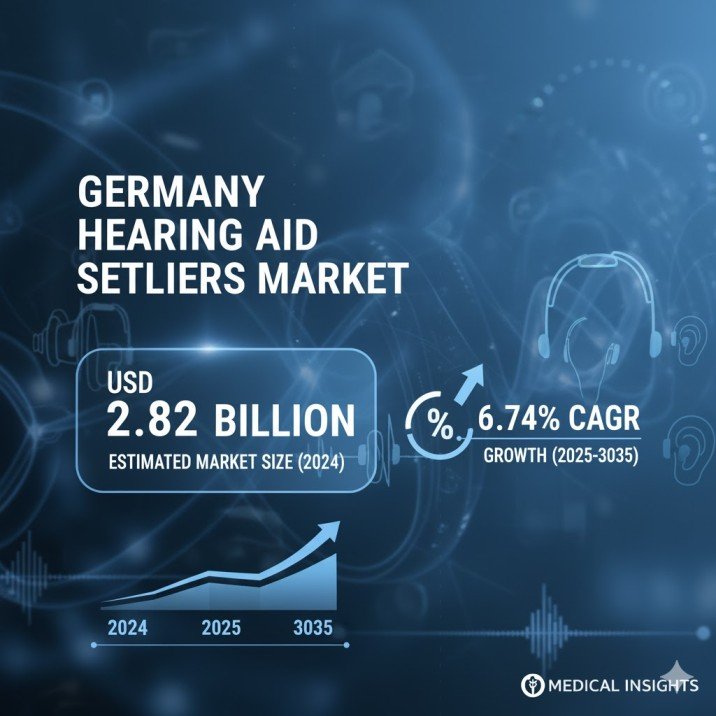
The Germany hearing aid retailers market size was estimated at USD 2.82 billion in 2024 and is expected to grow at a CAGR of 6.74% from 2025 to 2035.Size, byProduct, 2025 - 2032{USD Billion} The German hearing aid retailers market size was estimated at USD 2.82 billion in 2024 and is expected to grow at a CAGR of 6.74% from 2025 to 2035. request a free sample copy
Germany Hearing Aid Retailers Market Size, Share & Trends Analysis Report By Type (In-the-Ear Hearing Aids, Receiver-In-the-Ear Hearing Aids), By Technology (Digital, Analog), And Segment Forecasts,
The growth of the hearing aid market in Germany is largely propelled by the aging population, technology improvements, and rising awareness regarding hearing health. As per the report by Statistisches Bundesamt, around 22% of the population in Germany is 65 and above, as of 2023, which is estimated to grow to 26% by the year 2035. The demographic trend strongly goes hand-in-hand with increased prevalence of hearing loss, with nearly one-third of this age group suffering from disabling hearing loss.
The government in Germany has championed auditory wellbeing through several policies aimed at discouraging the stigmatization of hearing aids as well as the enhancement of accessibility for the needful. Technical advancements have also been instrumental; contemporary hearing aids boast newer features like connectivity via Bluetooth, noise cancellation, and artificial intelligence capabilities that broaden appeal and create a better experience for users. In March 2024, GN Group launched The New Norm, a revolutionary campaign targeting stigma related to hearing aids and myths around hearing loss. This was officially unveiled on World Hearing Day, March 3, 2024, with a focus to revolutionize how hearing aids are perceived in society, having historically been seen as connected with age and disability. This campaign gives a better impression about hearing aids by highlighting them as integral to the improvement of the quality of life and not as symbols of disability.
Commonly Asked Hearing Aids Features by German Consumers
The sector is now undergoing dramatic changes fueled by changing market forces, technological innovation, and a competitive environment that is growing more complex. Consumers are increasingly looking for premium services that improve their overall experience with hearing aids. This encompasses customization options based on individual requirements and extensive post-purchase care programs. For example, Amplifon has launched its Lifetime Aftercare program, which offers complimentary device checks and adjustments, so users can have constant support throughout the life of their devices.
Market Concentration & Characteristics
The following chart shows the connection between market concentration, characteristics, and participants. The x-axis is the degree of market concentration, from low to high. Different market attributes are portrayed on the y-axis, including level of innovation, industry competitiveness, service alternatives, and regulations' effect, partnerships & collaborations activities level, and geographic penetration. The industry is fragmented for Germany hearing aid retailers, where numerous local actors fight for high market share. The degree of innovation is medium, the level of merger and acquisition activities is low, the regulatory impact on the market is high, and expansion is low.
The level of innovation within the market is notably high due to quick technological developments and a keen emphasis on user experience design. Firms are more incorporating Bluetooth connectivity, artificial intelligence (AI), and rechargeable batteries into products, improving functionality and end-user experience. For example, in October 2023, Vibrosonic was in the spotlight for its cutting-edge Hearing Contact Lens technology. This technology promises to transform how hearing aids are viewed and used by incorporating sound assistance into contact lenses. ZEISS Ventures' support is important because it offers financial assistance, strategic counsel, and assets that can drive the development and marketing of this innovative product. The industry experienced significant consolidations as bigger players looked to increase their scope and functionality.
Sivantos, formerly Siemens Audiology, and Widex of Denmark agreed in May 2018 to merge to create a new entity worth more than USD 8.3 billion. This is a landmark deal in the hearing aid sector, bringing together two industry giants with long histories and experience in audiology. The Sivantos-Widex deal represents a turning point in the audiology sector, forming a dominant player that can innovate and compete on the international stage. Regulations have a high impact on the industry, with tight regulations governing device development and deployment.
The German hearing aids market is subject to strong regulations, particularly with the full implementation of the Medical Device Regulation (MDR) in 2021. The regulation replaced the older Medical Devices Directive (MDD) and mandated stronger clinical investigation requirements, safety guarantees, and documentation procedures. Consequently, companies such as Phonak have seen extended product approval times, with CE marking now taking six months rather than the one month it previously required. The market is witnessing substantial product expansion propelled by technological advancements and growing consumer demand. Not only do these innovations enhance sound quality, but they also meet consumers' lifestyle requirements, making products more attractive to the younger generation who might experience noise-induced hearing loss. In addition, businesses are more and more placing emphasis on customized solutions that meet unique hearing profiles, thereby boosting customer satisfaction and market growth.
Type Insights
Based on type, the receiver-in-the-ear hearing aids segment held the largest revenue share of 75.96% in 2024 and is expected to grow at the fastest CAGR during the forecast period. The growth of receiver-in-the-ear (RITE) hearing aids in Germany is driven by technological advancements, an aging population, and increasing awareness about hearing health. Modern RITE hearing aids incorporate advanced features such as Bluetooth connectivity, noise reduction algorithms, and real-time sound processing capabilities that enhance user experience. These advancements improve sound quality and make these devices more user-friendly and adaptable to different listening environments. For instance, the Styletto X is a significant advancement in hearing aid technology, being recognized as the world’s first slim receiver-in-the-canal (RIC) hearing aid. This innovative device is designed to provide users with enhanced auditory experiences across various environments by utilizing acoustic motion sensors.
The behind-the-ear hearing aids segment is expected to grow at a significant CAGR during the forecast period. Increasing awareness of hearing health drives the growth of behind-the-ear (BTE) hearing aids in Germany. BTE devices are particularly popular due to their effectiveness in treating various degrees of hearing loss, especially among older people, who constitute a significant portion of the market. Integrating advanced features such as wireless connectivity and innovative technology has enhanced user experience and functionality, making these devices more appealing. Furthermore, leading manufacturers' ongoing research and development efforts are focused on creating more discreet and powerful BTE models that cater to individual user needs, further fueling market growth.
Technology Insights
Technologically driven, the digital segment dominated the market in 2024 with a market share of 94.19% and is forecasted to have the highest CAGR growth in the forecast period. This accelerated growth is mostly due to the extensive use of mobile health applications (mHealth) and telehealth services that have become the indispensable tools for remote patient monitoring and healthcare delivery. The COVID-19 pandemic further fueled this trend by emphasizing the need for accessible healthcare services that reduce in-person visits. In addition, government efforts encouraging digitalization in the healthcare industry have provided a supportive environment for investment and innovation in digital health technologies.
The analog segment is anticipated to grow at a high CAGR over the forecast period. Analog hearing aids still hold a niche but significant market presence, fueled by particular demographic choice and cost considerations. Germany's aging population, set to grow from 22% of the population aged 65 and over in 2022 to 26% by 2035, is a key driver of continued demand for analog hearing aids. Most elderly users prefer the simple functionality of analog devices to the complexity of digital ones, which renders them appealing to users looking for basic auditory aid without high-tech features.
Additionally, affordability is the main driver for analog hearing aids. Analog hearing aids are relatively cheaper compared to digital hearing aids, thus appealing to customers with budget constraints or poor insurance cover. Such affordability complements government efforts aimed at enhancing access to vital healthcare solutions across all sections of society.
Germany Hearing Aid Retailers Market Size (2024–2035)
Base Year (2024)USD 2.82 Billion
CAGR (2025–2035)6.74%
| Region | Market Size (2024, USD Billion) | Forecast CAGR (2025–2035) | Market Size (2035, USD Billion) | Key Insights |
|---|---|---|---|---|
| Western Germany | 1.10 | 6.8% | 2.13 | Dominates the market with a dense population, advanced retail networks, and strong presence of major hearing aid chains such as KIND and GEERS. |
| Southern Germany | 0.72 | 6.7% | 1.38 | Growth driven by higher disposable income levels and adoption of premium digital hearing aids in regions like Bavaria and Baden-Württemberg. |
| Northern Germany | 0.54 | 6.6% | 1.03 | Increasing retail expansion and teleaudiology adoption support market growth. |
| Eastern Germany | 0.46 | 6.8% | 0.90 | Improving healthcare access and government initiatives boost hearing aid retail demand. |
| Germany (Total) | 2.82 | 6.74% | 5.44 | Steady growth supported by aging population, increasing awareness, and digital transformation in hearing care retail. |
Key Companies & Market Share Insights
The market is fragmented, with the presence of multiple major players. Key players are adopting growth strategies to enhance their market presence, including collaborations and mergers & acquisitions.
Key Companies in Germany Hearing Aid Retailers Market
- KIND GmbH & Co. KG
- GEERS
- Amplifon
- Hansaton
- Pro Akustik GmbH & Co KG.
- AUDILOGIK
- Hearly.de
- HÖREX Hör-Akustik eG
- HÖRGERÄTE SEIFERT
- Fielmann
- auric Management GmbH
Recent Developments
-
In February 2024, GN announced the expansion of the ReSound Nexia family, representing a major leap forward in hearing aid technology. With innovative features such as Bluetooth LE Audio, Auracast compatibility, superior noise management, and sustainable design practices, it sets a new standard for connectivity and user experience in the hearing aid industry.
Germany Hearing Aid Retailers Market Report Scope
|
Report Attribute |
Details |
|
Market size value in 2025 |
USD 3.02 billion |
|
Revenue forecast in 2030 |
USD 4.18 billion |
|
Growth rate |
CAGR of 6.74% from 2025 to 2035 |
|
Actual data |
2018 - 2024 |
|
Forecast data |
2025 - 2035 |
|
Quantitative units |
Revenue in USD million/billion, Volume in Units, and CAGR from 2025 to 2035 |
|
Report coverage |
Volume & revenue forecast, company ranking, competitive landscape, growth factors, and trends |
|
Segments covered |
Type, technology |
|
Country scope |
Germany |
|
Key companies profiled |
KIND GmbH & Co. KG; GEERS; Amplifon; Hansaton; Pro Akustik GmbH & Co KG.; AUDILOGIK; Hearly.de; HÖREX Hör-Akustik eG; HÖRGERÄTE SEIFERT; Fielmann; Auric Management GmbH |
|
Customization scope |
Free report customization (equivalent up to 8 analysts working days) with purchase. Addition or alteration to country, regional & segment scope. |
|
Pricing and purchase options |
Avail customized purchase options to meet your exact research needs. Explore purchase options |
Germany Hearing Aid Retailers Market Report Segmentation
Type Outlook (Revenue, USD Billion; 2018 - 2035)
-
-
In-The-Ear Hearing Aids
-
Receiver-In-The-Ear Hearing Aids
-
Behind-The-Ear Hearing Aids
-
Canal Hearing Aids
-
-
Technology Size Outlook (Revenue, USD Billion; 2018 - 2035)
-
Digital
-
Analog
-