
Clustering Software Market Size, Share & Trends Analysis Report By Type (Self-Service Clustering, Managed Clustering, Hybrid Clustering), By Deployment, By Enterprise Size, By End-use, By Region, And Segment Forecasts,
Published Date: September - 2025 | Publisher: MIR | No of Pages: 240 | Industry: technology | Format: Report available in PDF / Excel Format
View Details Download Free Sample Ask for Discount Request CustomizationClaim a Free Sample
Get a preview with key statistics, projections, and trends for this report. Ideal for quick insights.
Send Me a SampleNeed full access?
Purchase ReportClustering Software Market Size & Trends
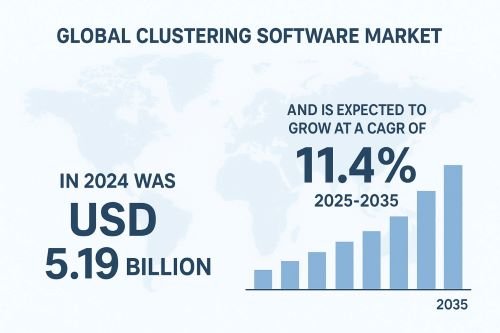
The size of the global clustering software market in 2024 was USD 5.19 billion and is expected to grow at a CAGR of 11.4% during the period 2025-2035.Clustering Software Market Size, Share & Trends Analysis Report By Type (Self-Service Clustering, Managed Clustering, Hybrid Clustering), By Deployment, By Enterprise Size, By End-use, By Region, And Segment Forecasts,

Size, byProduct, 2024 - 2032{USD Billion}
Clustering software market in 2024 was USD 5.19 billion and is expected to grow at a CAGR of 11.4% during the period 2025-2035. request a free sample copy
The growing amount of data created within industries is a key driver powering the clustering software market. Organizations generate huge quantities of structured as well as unstructured data every day with the rising number of connected devices, IoT networks, social media, and e-commerce activities. Handling and deriving insights from this massive data is increasingly becoming more complex and important to business success. Clustering software assists companies in categorizing big datasets into useful categories, making analysis, decision-making, and strategy development better.
As firms seek to harness big data to achieve competitive edge, the demand for advanced clustering solutions that are capable of automatically identifying patterns, segmenting markets, and optimizing operations is fast growing, thereby driving the market forward. The increasing uses of clustering software within cybersecurity also serve as a key growth driver. While cyberattacks become increasingly sophisticated, legacy security systems are not able to detect anomalies or advanced persistent threats (APTs). Clustering methods enable cybersecurity professionals to detect unusual patterns, isolate malicious activity, and rank threats by severity without direct human labeling. As the prevalence of data breaches, ransomware attacks, and other cyber attacks increases, organizations worldwide are heavily investing in security solutions based on clustering algorithms to improve threat detection and response. This emphasis on proactive and smart cybersecurity solutions builds strong opportunities for clustering software providers.
Furthermore, the introduction of cloud-based clustering solutions facilitates easy access and scalability, further promoting wider market adoption. Old-fashioned on-premises clustering software typically involves substantial initial investment in hardware and expert IT personnel. On the other hand, cloud-based clustering solutions provide scalability, flexibility, and economies of scale, enabling small, medium, and large enterprises alike to enjoy sophisticated clustering features without the strain of managing advanced infrastructure. With an increasing number of enterprises adopting digital transformation and migrating towards cloud-native architecture, demand for simple-to-deploy, subscription-based clustering solutions is growing exponentially. Cloud models of deployment also enable real-time processing of data and collaboration across distributed teams, further increasing the appeal of clustering software to contemporary organisations.
In addition, the spread of smart cities and IoT devices is fueling the expansion of the clustering software industry. Smart city projects, which are dependent on real-time data from IoT sensors, need advanced analytics tools to digest and interpret huge and varied streams of data. Clustering software plays a central role in managing data gathered from smart traffic systems, energy grids, waste management systems, and public safety systems. It allows urban planners and administrators to recognize patterns, streamline services, and respond to problems proactively. As governments across the globe are investing more in smart infrastructure, the application of clustering software to manage, analyze, and gain insights from IoT ecosystems will grow extensively.
Report Coverage & Deliverables
- Competitive benchmarking
- Historical data & forecasts
- Company revenue shares
- Regional opportunities
- Latest trends & dynamics
Type Insights
The self-service clustering segment represented the highest market share of more than 42.0% in 2024 in the clustering software industry. Merging self-service clustering tools with other enterprise software systems is fueling market growth. Contemporary companies commonly use a combination of platforms ranging from customer relationship management (CRM) and enterprise resource planning (ERP) platforms to marketing automation and business intelligence (BI) platforms. Combining self-service clustering solutions with these platforms allows users to cluster data inline within their current workflows, improving efficiency and end-user adoption. Integration abilities further facilitate deeper, multi-dimensional insights as datasets from multiple sources are combined. As organizations move toward more integrated and interoperable systems, demand for self-service clustering software to complement and add value to current enterprise tools is growing dramatically.
The hybrid clustering segment is expected to grow at a CAGR of 11.2% over the forecast period. Hybrid cloud adoption is increasing across industries, which is fueling the segment growth. Organizations increasingly use hybrid cloud strategies to achieve cost efficiency, performance optimization, and regulatory compliance. Hybrid clustering software is also very important in this architecture, as it allows organizations to perform clustering analysis on data no matter where it's located, either in public cloud environments, private clouds, or legacy data centers. This feature prevents companies from having data silos and provides end-to-end insights without the need to bring all the data together into one environment before. With hybrid cloud as the new standard for IT infrastructure, hybrid clustering solutions are experiencing increased demand.
Deployment Insights
On-premise was the biggest market of 2024 in the market for clustering software. The increased focus on the privacy and security of data is one of the primary drivers encouraging demand for the on-premise market in clustering software. These organizations handle sensitive information, for instance, finance companies, hospitals, and the government, preferring to use on-premise-based solutions to be in full command of their information. As cyberattack cases rise and cloud vulnerabilities become a top concern, most companies are wary of housing key data sets in the cloud. Clustering software on-site guarantees that sensitive data doesn't leave the company's safe network, thus reducing risks associated with data breaches, illicit access, and noncompliance. This high demand for tighter security continues to propel on-premise clustering solution investments.
The cloud segment is expected to exhibit the highest growth rate over the forecast period. Increasing use of remote and distributed work models is fueling market adoption. With the widespread adoption of hybrid and remote working models, organizations are increasingly requiring centralized systems that can be accessed from various locations without performance degradation. Cloud-based clustering solutions enable this demand through the capability of teams to collaborate and remotely access clustered compute resources, promoting business continuity and operational efficiency.
Enterprise Size Insights
The large enterprises segment led the market in 2024 in the clustering software market. The increasing emphasis on digital transformation projects among large enterprises is fueling the use of clustering software by large enterprises. As organizations transform their operations with cloud migration, advanced analytics, AI, and IoT integrations, there is an increasing demand for scalable, resilient, and high-performing IT infrastructures. Clustering software enables this change by allowing distributed application deployment, high processing capability, and minimizing latency. It also keeps mission-critical services running during periods of peak load or maintenance, making it a vital tool for enterprises looking to remain competitive in an increasingly digital economy.
The SMEs segment is anticipated to account for the highest CAGR between 2025 and 2030. Increased dependence on digital platforms and online services by SMEs is a key growth driver for clustering software adoption among small and medium enterprises (SMEs). Continuity in service delivery has emerged as a top priority with increased digital outreach by SMEs via e-commerce sites, cloud-based applications, and remote work collaboration tools. Clustering software ensures high availability and load balancing, keeping applications up and running even in the event of hardware failure or maintenance procedures. This feature is essential for SMEs to uphold customer confidence, streamline user experiences, and compete successfully in online marketplaces, where even small service interruptions can lead to lost business and reputational losses.
End Use Insights
The retail segment had the biggest market share in 2024 in the clustering software market. The growth in e-commerce and mobile commerce activities has generated an urgent need for scalable IT infrastructures within retail. During big sale days such as Black Friday or holidays, e-commerce sites face sudden peaks in traffic, which can crash conventional IT systems. Clustering software assists retailers in handling such traffic spikes efficiently by allocating resources dynamically and making websites and applications responsive even during heavy loads. This scalability keeps retailers safe from revenue loss possibilities through system crashes and improves their reputation for reliability and customer service excellence.
The healthcare & life sciences segment is expected to have the highest CAGR of 12.9% over the forecast period. The growing trend towards telemedicine and remote healthcare services fuels the demand for solid IT infrastructure in healthcare and life science industries. As more patients initiate online consultations and remote monitoring, healthcare providers need a scalable and reliable IT framework to manage these services. Clustering software allows healthcare organizations to provide seamless virtual care by making telemedicine platforms, patient portals, and remote monitoring systems function under fluctuating loads. This reliability is critical to sustaining patient satisfaction and trust in the healthcare system, particularly as the industry adopts digital health solutions.
Regional Insights
North America dominated the market share of over 34.0% in 2024. The growth of edge computing in North America fuels demand for clustering software. With increasing number of devices and applications shifting towards decentralized processing, edge computing is an integral aspect of digital infrastructure. Clustering software facilitates effective management of edge computing infrastructures through the processing and storage of data at several points of presence while providing high availability and low latency. This is very critical for manufacturing, transportation, and healthcare sectors, where real-time processing is necessary for the efficiency of operations. As North American businesses increasingly embrace edge computing technologies, clustering software will prove essential to help these systems run without a hitch and efficiently.
Here’s the regional clustering software market size forecast (2024–2035) in table format
| Year | North America (USD Bn) | Europe (USD Bn) | Asia-Pacific (USD Bn) | Latin America (USD Bn) | Middle East & Africa (USD Bn) |
|---|---|---|---|---|---|
| 2024 | 1.56 | 1.40 | 1.71 | 0.31 | 0.21 |
| 2025 | 1.73 | 1.56 | 1.91 | 0.35 | 0.23 |
| 2026 | 1.93 | 1.74 | 2.13 | 0.39 | 0.26 |
| 2027 | 2.15 | 1.94 | 2.37 | 0.43 | 0.29 |
| 2028 | 2.40 | 2.16 | 2.64 | 0.48 | 0.32 |
| 2029 | 2.67 | 2.41 | 2.94 | 0.54 | 0.35 |
| 2030 | 2.98 | 2.68 | 3.27 | 0.60 | 0.39 |
| 2031 | 3.32 | 2.99 | 3.64 | 0.67 | 0.44 |
| 2032 | 3.70 | 3.32 | 4.04 | 0.74 | 0.48 |
| 2033 | 4.12 | 3.70 | 4.49 | 0.82 | 0.55 |
| 2034 | 4.59 | 4.12 | 5.00 | 0.91 | 0.61 |
| 2035 | 5.11 | 4.58 | 5.55 | 1.01 | 0.67 |
U.S. Clustering Software Market Trends
The U.S. clustering software market is expected to expand over the forecast period. The rise in microservices architecture in software development is driving the demand for clustering software in the U.S. Microservices architecture decomposes applications into smaller, independent services that can be developed, deployed, and scaled separately. This architecture needs a highly available and scalable infrastructure to handle the large number of services and make them communicate efficiently. Clustering software is critical in microservice contexts as it enables orchestrating and managing a number of services executing across distributed systems. As firms increasingly embrace microservices for enhancing the scalability and agility of their applications, clustering software will be depended upon more and more to provide clean operation and high availability.
Europe Clustering Software Market Trends
The European clustering software market is anticipated to expand at a CAGR of 10.9% during the period from 2025 to 2035. Increasing demand for high-performance computing (HPC) is driving the growth of the clustering software market in Europe. HPC systems, utilized for complex simulations, scientific research, financial modeling, and artificial intelligence, need high computational power and the capability to process large datasets rapidly. Clustering software is a crucial component of HPC systems since it enables the effective allocation of tasks across servers and multiple processors, which facilitates faster data processing and increased computational power. With increasing investment in research and development in Europe, especially climate modeling, healthcare research, and advanced manufacturing, the demand for HPC solutions will remain a driver for clustering software adoption.
The UK's clustering software market will grow sizably over the forecast period. The UK is experiencing a steep pickup in adoption of IoT technology, which will spur the clustering software market as well. The increase of Internet of Things (IoT) devices across industries like smart cities, agriculture, healthcare, and transportation is producing vast amounts of data to be processed, analyzed, and reacted to in real-time. Clustering software is essential to process the high data volume of IoT devices by dispersing workload over multiple computing systems and maintaining high availability. As the IoT network increases in the UK, with increased interest in automated devices, intelligent infrastructure, and automation, clustering solutions become inevitable for dealing with the complexity of these networks and providing dependable processing of data.
The market for clustering software in Germany is expanding rapidly throughout the forecast period. Germany's leading technological and industrial status further pushes the market for clustering software. The nation has led the Industry 4.0 revolution, encompassing the use of smart manufacturing, automation, and Internet of Things (IoT) technologies. With the manufacturing facilities getting more interconnected, there is an increasing demand for strong IT infrastructure to manage sophisticated data operations. Clustering software plays a vital role in supporting the smooth operation of these cutting-edge manufacturing systems by distributing workloads, providing uptime, and facilitating real-time data analysis. The car manufacturing industry, one of the strong pillars of the German economy, depends on clustering solutions for it all, ranging from simulating autonomous driving to supply chain management, further driving the demand for clustering software.
Asia Pacific Clustering Software Market Trends
Demand for clustering software during the Asia Pacific is anticipated to increase at the highest CAGR of 13.0% during the forecast period from 2025 to 2030. Growing big data analytics adoption in the Asia Pacific is a key driver behind the demand for clustering software. With businesses in APAC leveraging the power of big data to enhance decision-making, marketing strategies, customer experience, and operational efficiency, the demand for data processing solutions increases. Clustering software plays an important role in processing and analyzing vast amounts of data by dividing workloads among a set of multiple servers or nodes, allowing faster and more accurate results. Retail, manufacturing, finance, and telecommunications sectors in the country are utilizing big data to improve their operations, and clustering software plays a crucial role in facilitating the large-scale processing of data necessary for such applications.
The market for clustering software in China is expected to increase over the forecast period. Growth in the digital economy in China is also contributing significantly to the growth of software clustering. China's e-commerce behemoths, financial tech firms, and digital entertainment portals are producing a humongous volume of data that needs massive infrastructure. Software clustering makes such platforms scalable and dependable, an absolute necessity with China's digital economy growing exponentially. E-commerce websites such as Alibaba and JD.com and fintech players such as Ant Group depend on clustering software to drive their data management requirements, providing rapid, continuous service to millions of clients.
The market for clustering software in India is expected to increase in the forecast period. Increased deployment of data centers in India is another major driver of the clustering software market. With increasing demand for cloud services, data storage, and data processing, India is experiencing an explosion in data center infrastructure development. With more companies in India transitioning their operations to the cloud and depending on data centers to hold and process information, clustering software demand is also on the rise. Clustering software optimizes data center functionality by offering load balancing, resource allocation, and high availability. With data centers playing a more pivotal role in India's digital economy, software clustering allows the data centers to manage massive operations and support the growing demand for digital services.
Key Clustering Software Company Insights
Some of the dominant companies in the market Oracle Corporation, Google LLC, and SAP SE., amongst others, are major players in the clustering software market.
Oracle Corporation is a multinational tech giant that has a large, broad range of enterprise software products in its portfolio, ranging from databases to cloud-based services, and enterprise applications. Oracle Real Application Clusters (RAC) is a premier architecture of clustering that allows multiple servers, or nodes, to execute Oracle Database instances in parallel while accessing a common, shared database. The architecture is characterized by high availability, scalability, and load balancing, and offers no downtime in database services even during hardware failure.
SAP SE is an international company that deals with enterprise resource planning (ERP) software, offering a complete set of business applications that enable organizations to simplify processes, enhance efficiency, and accelerate digital transformation. SAP SE has incorporated different clustering technologies into its software products, specifically in its SAP HANA platform and SAP Cloud Platform. SAP HANA is an in-memory data management platform that enables real-time analytics and applications. To manage the huge volume of data processing needed by today's businesses, SAP HANA uses clustering to improve performance, maintain high availability, and offer fault tolerance.
Qubole Inc., RapidMiner Inc., and Splunk Inc. are a few of the new market entrants in the clustering software industry.
Qubole Inc. is a cloud-native data platform business. The basis of Qubole offerings is the Qubole Data Service (QDS), an independent big data platform offering a single environment for managing different compute clusters. QDS hosts a variety of open-source data processing engines, such as Apache Spark, Hadoop, Presto, and Hive, enabling end-users to execute queries and programs in SQL, MapReduce, Pig, Scala, and Python.
RapidMiner Inc. is a data science platform company. RapidMiner provides an open-source, extensible platform to enable data preparation, machine learning, and predictive analytics. RapidMiner enables strong clustering capability within its platform, enabling customers to conduct unsupervised learning to detect inherent groupings and patterns in data. The platform supports a number of clustering algorithms such as K-Means, X-Means, and hierarchical clustering, which enable customers to select the most suitable method for their particular data and goals.
Key Clustering Software Companies
The following are the leading companies in the clustering software market. These companies collectively hold the largest market share and dictate industry trends.
- Alteryx Inc.
- Amazon Web Services Inc.
- Google LLC
- IBM Corporation
- Informatica Corporation
- Micro Focus International plc
- Microsoft Corporation
- Oracle Corporation
- Qubole Inc.
- RapidMiner Inc.
- SAP SE
- SAS Institute Inc.
- Splunk Inc.
- Teradata Corporation
- Tibco Software Inc.
Recent Developments
-
In January 2025, Google Cloud and Oracle revealed plans to grow with eight additional regions in addition to significant improvements in Oracle Database Google Cloud that will enable customers to secure database instances more strongly, save costs, and achieve higher flexibility and resilience. Furthermore, the single-node VM clusters of Oracle Exadata Database Service enable customers with greater flexibility to manage costs as well as infrastructure footprint. This allows them to leverage Oracle Exadata’s workload isolation, high performance, and simplified management. The new single-node clusters cater to use cases such as test and development environments and databases that don’t require RAC’s high availability features or licenses.
In November 2024, Nutanix, a hybrid multicloud computing leader, extended strategic partnership with Amazon Web Services, Inc. (AWS) to streamline cloud migration and provide customers with additional choices for managing workloads between on-premises and cloud environments. The extended partnership enables customers to run Nutanix Cloud Clusters (NC2) on AWS, allowing them to extend their on-premises Nutanix infrastructure seamlessly to AWS. Therefore, organizations can execute their applications in a homogeneous environment on both on-premises and AWS while having access to AWS services like AWS Databases, Amazon S3, and sophisticated AI and ML services, as well as AWS's security, scalability, and resiliency.
In September of 2024, Oracle and Amazon Web Services (AWS) introduced Oracle Database AWS. Oracle Database AWS makes available to its customers the access to the Oracle Exadata Database Service on AWS, featuring the Oracle Autonomous Database on dedicated hardware and workloads running Oracle Real Application Clusters. This offers businesses the chance to bring in their enterprise data and encourage generative innovation.
In November 2023, Amazon Web Services, Inc. (AWS) and NVIDIA have formed a strategic partnership to provide state-of-the-art infrastructure, software, and services to power generative artificial intelligence (AI) innovation. The partnership leverages NVIDIA's multi-node systems with AWS solutions, such as the Nitro System for enhanced virtualization and security, the Elastic Fabric Adapter interconnect, and UltraCluster scalability. These technologies are specifically designed to accelerate the training of foundation models and the creation of generative AI applications.
Clustering Software Market Report Scope
|
Report Attribute |
Details |
|
Market size value in 2025 |
USD 5.72 billion |
|
Revenue forecast in 2030 |
USD 9.80 billion |
|
Growth rate |
CAGR of 11.4% from 2025 to 2035 |
|
Actual data |
2018 - 2024 |
|
Forecast period |
2025 - 2035 |
|
Quantitative units |
Revenue in USD million/billion and CAGR from 2025 to 2030 |
|
Report coverage |
Revenue forecast, company share, competitive landscape, growth factors, and trends |
|
Segments covered |
Type, deployment, enterprise size, end use, region |
|
Regional scope |
North America; Europe; Asia Pacific; Latin America; MEA |
|
Country scope |
U.S.; Canada; Mexico; UK; Germany; France; China; India; Japan; Australia; South Korea; Brazil; UAE; Saudi Arabia; South Africa |
|
Key companies profiled |
Informatica Corporation; Splunk Inc.; Oracle Corporation; Google LLC; SAP SE; SAS Institute Inc.; Micro Focus International plc; Alteryx Inc.; Tibco Software Inc.; RapidMiner Inc.; Amazon Web Services Inc.; Microsoft Corporation; IBM Corporation; Qubole Inc.; Teradata Corporation |
|
Customization scope |
Free report customization (equivalent to 8 analysts working days) with purchase. Addition or alteration to country, regional & segment scope. |
|
Pricing and purchase options |
Avail customized purchase options to meet your exact research needs. Explore purchase options |
Global Clustering Software Market Report Segmentation
Type Outlook (Revenue, USD Million; 2018 - 2035)
-
-
Self-Service Clustering
-
Managed Clustering
-
Hybrid Clustering
-
-
Deployment Outlook (Revenue, USD Million; 2018 - 2035)
-
On-premise
-
Cloud
-
-
Enterprise Size Outlook (Revenue, USD Million; 2018 - 2035)
-
Large Enterprises
-
Small and Medium Enterprises (SMEs)
-
-
End Use Outlook (Revenue, USD Million; 2018 - 2035)
-
Retail
-
BFSI
-
Healthcare & Life Sciences
-
Manufacturing
-
IT & Telecommunications
-
Others
-
-
Regional Outlook (Revenue, USD Million; 2018 - 2035)
-
North America
-
U.S.
-
Canada
-
Mexico
-
-
Europe
-
Germany
-
UK
-
France
-
-
Asia Pacific
-
China
-
India
-
Japan
-
South Korea
-
Australia
-
-
Latin America
-
Brazil
-
-
Middle East & Africa
-
UAE
-
Saudi Arabia
-
South Africa
-
-
Frequently Asked Questions
The global clustering software market size was estimated at USD 5.19 billion in 2024 and is expected to reach USD 5.72 million in 2025.
The global clustering software market is expected to grow at a compound annual growth rate of 11.4% from 2025 to 2030 to reach USD 9.80 billion by 2030.
North America held the major share of over 34.0% of the clustering software industry in 2024. The rise of edge computing in North America is driving demand for clustering software.
Some key players operating in the market include Accenture, Tata Communications Limited, IBM, Microsoft, Rackspace Technology, Infosys Limited, NTT DATA Group Corporation, Spark NZ, Cisco Systems, Inc., Locuz
The increasing volume of data generated across industries is a major driver fueling the clustering software market and the increasing volume of data generated across industries is a major driver fueling the clustering software market
Related Reports
- Global Data Replication Software Market Size By Deployment Type (On-Premise, Cloud-Based), By Component (Software, Servi...
- Malaysia Customer Experience Business Process Outsourcing Market Size, Share & Trends Analysis Report By Outsourcing Typ...
- Premium Messaging Market Size, Share & Trends Analysis Report, By Region, By Application (BFSI, Retail, Entertainment & ...
- Intelligent Substation Inspection Robot Market: Growth, Trends, and Future Outlook Segment Forecasts, 2028 - 2035.
- Inline Printing Press Market Size, Share, Growth, and Industry Analysis, By Type (Less Than 8 Colour, 8-10 Colour, More ...
- Global Edge AI Box Market Size By Product Type (Box Computers, Embedded Systems), By Application (Industrial Automation,...
Table of Content
Table of Contents
Chapter 1. Methodology and Scope
1.1. Market Segmentation and Scope
1.2. Market Definitions
1.3. Research Methodology
1.3.1. Information Procurement
1.3.2. Information or Data Analysis
1.3.3. Market Formulation & Data Visualization
1.3.4. Data Validation & Publishing
1.4. Research Scope and Assumptions
1.4.1. List of Data Sources
Chapter 2. Executive Summary
2.1. Market Outlook
2.2. Segment Outlook
2.3. Competitive Insights
Chapter 3. Clustering Software Variables, Trends, & Scope
3.1. Market Introduction/Lineage Outlook
3.2. Industry Value Chain Analysis
3.3. Market Dynamics
3.3.1. Market Drivers Analysis
3.3.2. Market Restraints Analysis
3.3.3. Industry Opportunities
3.4. Clustering Software Analysis Tools
3.4.1. Porter’s Analysis
3.4.1.1. Bargaining power of the suppliers
3.4.1.2. Bargaining power of the buyers
3.4.1.3. Threats of substitution
3.4.1.4. Threats from new entrants
3.4.1.5. Competitive rivalry
3.4.2. PESTEL Analysis
3.4.2.1. Political landscape
3.4.2.2. Economic and Social landscape
3.4.2.3. Technological landscape
3.4.2.4. Environmental landscape
3.4.2.5. Legal landscape
Chapter 4. Clustering Software: Type Estimates & Trend Analysis
4.1. Clustering Software Market, By Type Analysis & Market Share, 2024 & 2030
4.2. Self-Service Clustering
4.2.1. Self-Service clustering market estimates and forecasts, 2018 - 2030 (USD Million)
4.3. Managed Clustering
4.3.1. Managed clustering market estimates and forecasts, 2018 - 2030 (USD Million)
4.4. Hybrid Clustering
4.4.1. Hybrid clustering market estimates and forecasts, 2018 - 2030 (USD Million)
Chapter 5. Clustering Software: Deployment Estimates & Trend Analysis
5.1. Clustering Software Market, By Deployment Analysis & Market Share, 2024 & 2030
5.2. On-premise
5.2.1. On-premise market estimates and forecasts, 2018 - 2030 (USD Million)
5.3. Cloud
5.3.1. Cloud market estimates and forecasts, 2018 - 2030 (USD Million)
Chapter 6. Clustering Software: Enterprise Size Estimates & Trend Analysis
6.1. Clustering Software Market, By Enterprise Size Analysis & Market Share, 2024 & 2030
6.2. Large Enterprises
6.2.1. Large enterprises market estimates and forecasts, 2018 - 2030 (USD Million)
6.3. Small and Medium Enterprises
6.3.1. Small and medium enterprises market estimates and forecasts, 2018 - 2030 (USD Million)
Chapter 7. Clustering Software: End Use Estimates & Trend Analysis
7.1. Clustering Software Market, By End Use Analysis & Market Share, 2024 & 2030
7.2. Retail
7.2.1. Retail market estimates and forecasts, 2018 - 2030 (USD Million)
7.3. BFSI
7.3.1. BFSI market estimates and forecasts, 2018 - 2030 (USD Million)
7.4. Healthcare & Life Sciences
7.4.1. Healthcare & life sciences market estimates and forecasts, 2018 - 2030 (USD Million)
7.5. Manufacturing
7.5.1. Manufacturing market estimates and forecasts, 2018 - 2030 (USD Million)
7.6. Others
7.6.1. Others market estimates and forecasts, 2018 - 2030 (USD Million)
Chapter 8. Clustering Software Market: Regional Estimates & Trend Analysis
8.1. Clustering Software Market Share, By Region, 2024 & 2030 (USD Million)
8.2. North America
8.2.1. Market Estimates and Forecasts, 2018 - 2030 (USD Million)
8.2.2. Market estimates and forecast by type, 2018 - 2030 (Revenue, USD Million)
8.2.3. Market estimates and forecast by deployment, 2018 - 2030 (Revenue, USD Million)
8.2.4. Market estimates and forecast by enterprise size, 2018 - 2030 (Revenue, USD Million)
8.2.5. Market estimates and forecast by end use, 2018 - 2030 (Revenue, USD Million)
8.2.6. U.S.
8.2.6.1. Market Estimates and Forecasts, 2018 - 2030 (USD Million)
8.2.6.2. Market estimates and forecast by type, 2018 - 2030 (Revenue, USD Million)
8.2.6.3. Market estimates and forecast by deployment, 2018 - 2030 (Revenue, USD Million)
8.2.6.4. Market estimates and forecast by enterprise size, 2018 - 2030 (Revenue, USD Million)
8.2.6.5. Market estimates and forecast by end use, 2018 - 2030 (Revenue, USD Million)
8.2.7. Canada
8.2.7.1. Market Estimates and Forecasts, 2018 - 2030 (USD Million)
8.2.7.2. Market estimates and forecast by type, 2018 - 2030 (Revenue, USD Million)
8.2.7.3. Market estimates and forecast by deployment, 2018 - 2030 (Revenue, USD Million)
8.2.7.4. Market estimates and forecast by enterprise size, 2018 - 2030 (Revenue, USD Million)
8.2.7.5. Market estimates and forecast by end use, 2018 - 2030 (Revenue, USD Million)
8.2.8. Mexico
8.2.8.1. Market Estimates and Forecasts, 2018 - 2030 (USD Million)
8.2.8.2. Market estimates and forecast by type, 2018 - 2030 (Revenue, USD Million)
8.2.8.3. Market estimates and forecast by deployment, 2018 - 2030 (Revenue, USD Million)
8.2.8.4. Market estimates and forecast by enterprise size, 2018 - 2030 (Revenue, USD Million)
8.2.8.5. Market estimates and forecast by end use, 2018 - 2030 (Revenue, USD Million)
8.3. Europe
8.3.1. Market estimates and forecast by type, 2018 - 2030 (Revenue, USD Million)
8.3.2. Market estimates and forecast by deployment, 2018 - 2030 (Revenue, USD Million)
8.3.3. Market estimates and forecast by enterprise size, 2018 - 2030 (Revenue, USD Million)
8.3.4. Market estimates and forecast by end use, 2018 - 2030 (Revenue, USD Million)
8.3.5. UK
8.3.5.1. Market Estimates and Forecasts, 2018 - 2030 (USD Million)
8.3.5.2. Market estimates and forecast by type, 2018 - 2030 (Revenue, USD Million)
8.3.5.3. Market estimates and forecast by deployment, 2018 - 2030 (Revenue, USD Million)
8.3.5.4. Market estimates and forecast by enterprise size, 2018 - 2030 (Revenue, USD Million)
8.3.5.5. Market estimates and forecast by end use, 2018 - 2030 (Revenue, USD Million)
8.3.6. Germany
8.3.6.1. Market Estimates and Forecasts, 2018 - 2030 (USD Million)
8.3.6.2. Market estimates and forecast by type, 2018 - 2030 (Revenue, USD Million)
8.3.6.3. Market estimates and forecast by deployment, 2018 - 2030 (Revenue, USD Million)
8.3.6.4. Market estimates and forecast by enterprise size, 2018 - 2030 (Revenue, USD Million)
8.3.6.5. Market estimates and forecast by end use, 2018 - 2030 (Revenue, USD Million)
8.3.7. France
8.3.7.1. Market Estimates and Forecasts, 2018 - 2030 (USD Million)
8.3.7.2. Market estimates and forecast by type, 2018 - 2030 (Revenue, USD Million)
8.3.7.3. Market estimates and forecast by deployment, 2018 - 2030 (Revenue, USD Million)
8.3.7.4. Market estimates and forecast by enterprise size, 2018 - 2030 (Revenue, USD Million)
8.3.7.5. Market estimates and forecast by end use, 2018 - 2030 (Revenue, USD Million)
8.4. Asia Pacific
8.4.1. Market Estimates and Forecasts, 2018 - 2030 (USD Million)
8.4.2. Market estimates and forecast by type, 2018 - 2030 (Revenue, USD Million)
8.4.3. Market estimates and forecast by deployment, 2018 - 2030 (Revenue, USD Million)
8.4.4. Market estimates and forecast by enterprise size, 2018 - 2030 (Revenue, USD Million)
8.4.5. Market estimates and forecast by end use, 2018 - 2030 (Revenue, USD Million)
8.4.6. China
8.4.6.1. Market Estimates and Forecasts, 2018 - 2030 (USD Million)
8.4.6.2. Market estimates and forecast by type, 2018 - 2030 (Revenue, USD Million)
8.4.6.3. Market estimates and forecast by deployment, 2018 - 2030 (Revenue, USD Million)
8.4.6.4. Market estimates and forecast by enterprise size, 2018 - 2030 (Revenue, USD Million)
8.4.6.5. Market estimates and forecast by end use, 2018 - 2030 (Revenue, USD Million)
8.4.7. India
8.4.7.1. Market Estimates and Forecasts, 2018 - 2030 (USD Million)
8.4.7.2. Market estimates and forecast by type, 2018 - 2030 (Revenue, USD Million)
8.4.7.3. Market estimates and forecast by deployment, 2018 - 2030 (Revenue, USD Million)
8.4.7.4. Market estimates and forecast by enterprise size, 2018 - 2030 (Revenue, USD Million)
8.4.7.5. Market estimates and forecast by end use, 2018 - 2030 (Revenue, USD Million)
8.4.8. Japan
8.4.8.1. Market Estimates and Forecasts, 2018 - 2030 (USD Million)
8.4.8.2. Market estimates and forecast by type, 2018 - 2030 (Revenue, USD Million)
8.4.8.3. Market estimates and forecast by deployment, 2018 - 2030 (Revenue, USD Million)
8.4.8.4. Market estimates and forecast by enterprise size, 2018 - 2030 (Revenue, USD Million)
8.4.8.5. Market estimates and forecast by end use, 2018 - 2030 (Revenue, USD Million)
8.4.9. Australia
8.4.9.1. Market Estimates and Forecasts, 2018 - 2030 (USD Million)
8.4.9.2. Market estimates and forecast by type, 2018 - 2030 (Revenue, USD Million)
8.4.9.3. Market estimates and forecast by deployment, 2018 - 2030 (Revenue, USD Million)
8.4.9.4. Market estimates and forecast by enterprise size, 2018 - 2030 (Revenue, USD Million)
8.4.9.5. Market estimates and forecast by end use, 2018 - 2030 (Revenue, USD Million)
8.4.10. South Korea
8.4.10.1. Market Estimates and Forecasts, 2018 - 2030 (USD Million)
8.4.10.2. Market estimates and forecast by type, 2018 - 2030 (Revenue, USD Million)
8.4.10.3. Market estimates and forecast by deployment, 2018 - 2030 (Revenue, USD Million)
8.4.10.4. Market estimates and forecast by enterprise size, 2018 - 2030 (Revenue, USD Million)
8.4.10.5. Market estimates and forecast by end use, 2018 - 2030 (Revenue, USD Million)
8.5. Latin America
8.5.1. Market Estimates and Forecasts, 2018 - 2030 (USD Million)
8.5.2. Market estimates and forecast by type, 2018 - 2030 (Revenue, USD Million)
8.5.3. Market estimates and forecast by deployment, 2018 - 2030 (Revenue, USD Million)
8.5.4. Market estimates and forecast by enterprise size, 2018 - 2030 (Revenue, USD Million)
8.5.5. Market estimates and forecast by end use, 2018 - 2030 (Revenue, USD Million)
8.5.6. Brazil
8.5.6.1. Market Estimates and Forecasts, 2018 - 2030 (USD Million)
8.5.6.2. Market estimates and forecast by type, 2018 - 2030 (Revenue, USD Million)
8.5.6.3. Market estimates and forecast by deployment, 2018 - 2030 (Revenue, USD Million)
8.5.6.4. Market estimates and forecast by enterprise size, 2018 - 2030 (Revenue, USD Million)
8.5.6.5. Market estimates and forecast by end use, 2018 - 2030 (Revenue, USD Million)
8.6. Middle East & Africa
8.6.1. Market Estimates and Forecasts, 2018 - 2030 (USD Million)
8.6.2. Market estimates and forecast by type, 2018 - 2030 (Revenue, USD Million)
8.6.3. Market estimates and forecast by deployment, 2018 - 2030 (Revenue, USD Million)
8.6.4. Market estimates and forecast by enterprise size, 2018 - 2030 (Revenue, USD Million)
8.6.5. Market estimates and forecast by end use, 2018 - 2030 (Revenue, USD Million)
8.6.6. UAE
8.6.6.1. Market Estimates and Forecasts, 2018 - 2030 (USD Million)
8.6.6.2. Market estimates and forecast by type, 2018 - 2030 (Revenue, USD Million)
8.6.6.3. Market estimates and forecast by deployment, 2018 - 2030 (Revenue, USD Million)
8.6.6.4. Market estimates and forecast by enterprise size, 2018 - 2030 (Revenue, USD Million)
8.6.6.5. Market estimates and forecast by end use, 2018 - 2030 (Revenue, USD Million)
8.6.7. Saudi Arabia
8.6.7.1. Market Estimates and Forecasts, 2018 - 2030 (USD Million)
8.6.7.2. Market estimates and forecast by type, 2018 - 2030 (Revenue, USD Million)
8.6.7.3. Market estimates and forecast by deployment, 2018 - 2030 (Revenue, USD Million)
8.6.7.4. Market estimates and forecast by enterprise size, 2018 - 2030 (Revenue, USD Million)
8.6.7.5. Market estimates and forecast by end use, 2018 - 2030 (Revenue, USD Million)
8.6.8. South Africa
8.6.8.1. Market Estimates and Forecasts, 2018 - 2030 (USD Million)
8.6.8.2. Market estimates and forecast by type, 2018 - 2030 (Revenue, USD Million)
8.6.8.3. Market estimates and forecast by deployment, 2018 - 2030 (Revenue, USD Million)
8.6.8.4. Market estimates and forecast by enterprise size, 2018 - 2030 (Revenue, USD Million)
8.6.8.5. Market estimates and forecast by end use, 2018 - 2030 (Revenue, USD Million)
Chapter 9. Competitive Landscape
9.1. Recent Developments & Impact Analysis by Key Market Participants
9.2. Company Categorization
9.3. Company Market Share Analysis, 2024
9.4. Company Heat Map Analysis
9.5. Strategy Mapping
9.5.1. Expansion
9.5.2. Mergers & Acquisition
9.5.3. Partnerships & Collaborations
9.5.4. Product Launches
9.5.5. Recent Developments
9.6. Company Profiles
9.6.1. Informatica Corporation
9.6.1.1. Participant’s Overview
9.6.1.2. Financial Performance
9.6.1.3. Product Benchmarking
9.6.1.4. Recent Developments
9.6.2. Splunk Inc.
9.6.2.1. Participant’s Overview
9.6.2.2. Financial Performance
9.6.2.3. Product Benchmarking
9.6.2.4. Recent Developments
9.6.3. Oracle Corporation
9.6.3.1. Participant’s Overview
9.6.3.2. Financial Performance
9.6.3.3. Product Benchmarking
9.6.3.4. Recent Developments
9.6.4. Google LLC
9.6.4.1. Participant’s Overview
9.6.4.2. Financial Performance
9.6.4.3. Product Benchmarking
9.6.4.4. Recent Developments
9.6.5. SAP SE
9.6.5.1. Participant’s Overview
9.6.5.2. Financial Performance
9.6.5.3. Product Benchmarking
9.6.5.4. Recent Developments
9.6.6. SAS Institute Inc.
9.6.6.1. Participant’s Overview
9.6.6.2. Financial Performance
9.6.6.3. Product Benchmarking
9.6.6.4. Recent Developments
9.6.7. Micro Focus International plc
9.6.7.1. Participant’s Overview
9.6.7.2. Financial Performance
9.6.7.3. Product Benchmarking
9.6.7.4. Recent Developments
9.6.8. Alteryx Inc.
9.6.8.1. Participant’s Overview
9.6.8.2. Financial Performance
9.6.8.3. Product Benchmarking
9.6.8.4. Recent Developments
9.6.9. Tibco Software Inc.
9.6.9.1. Participant’s Overview
9.6.9.2. Financial Performance
9.6.9.3. Product Benchmarking
9.6.9.4. Recent Developments
9.6.10. RapidMiner Inc.
9.6.10.1. Participant’s Overview
9.6.10.2. Financial Performance
9.6.10.3. Product Benchmarking
9.6.10.4. Recent Developments
9.6.11. Amazon Web Services Inc.
9.6.11.1. Participant’s Overview
9.6.11.2. Financial Performance
9.6.11.3. Product Benchmarking
9.6.11.4. Recent Developments
9.6.12. Microsoft Corporation
9.6.12.1. Participant’s Overview
9.6.12.2. Financial Performance
9.6.12.3. Product Benchmarking
9.6.12.4. Recent Developments
9.6.13. IBM Corporation
9.6.13.1. Participant’s Overview
9.6.13.2. Financial Performance
9.6.13.3. Product Benchmarking
9.6.13.4. Recent Developments
9.6.14. Qubole Inc.
9.6.14.1. Participant’s Overview
9.6.14.2. Financial Performance
9.6.14.3. Product Benchmarking
9.6.14.4. Recent Developments
9.6.15. Teradata Corporation
9.6.15.1. Participant’s Overview
9.6.15.2. Financial Performance
9.6.15.3. Product Benchmarking
9.6.15.4. Recent Developments
List of Tables
Table 1 Global clustering software market size estimates & forecasts, 2018 - 2030 (USD Million)
Table 2 Global clustering software market, by region, 2018 - 2030 (USD Million)
Table 3 Global clustering software market, by type, 2018 - 2030 (USD Million)
Table 4 Global clustering software market, by deployment, 2018 - 2030 (USD Million)
Table 5 Global clustering software market, by enterprise size, 2018 - 2030 (USD Million)
Table 6 Global clustering software market, by end use, 2018 - 2030 (USD Million)
Table 7 Self-service clustering market, by region, 2018 - 2030 (USD Million)
Table 8 Managed clustering market, by region, 2018 - 2030 (USD Million)
Table 9 Hybrid clustering market, by region, 2018 - 2030 (USD Million)
Table 10 On-premise market, by region, 2018 - 2030 (USD Million)
Table 11 Cloud market, by region, 2018 - 2030 (USD Million)
Table 12 Large enterprises clustering software market, by region, 2018 - 2030 (USD Million)
Table 13 Small and medium enterprises clustering software market, by region, 2018 - 2030 (USD Million)
Table 14 Retail clustering software market, by region, 2018 - 2030 (USD Million)
Table 15 BFSI clustering software market, by region, 2018 - 2030 (USD Million)
Table 16 Healthcare & life sciences clustering software market, by region, 2018 - 2030 (USD Million)
Table 17 Manufacturing clustering software market, by region, 2018 - 2030 (USD Million)
Table 18 IT & telecommunications clustering software market, by region, 2018 - 2030 (USD Million)
Table 19 Others clustering software market, by region, 2018 - 2030 (USD Million)
Table 20 North America clustering software market, by type, 2018 - 2030 (USD Million)
Table 21 North America clustering software market, by deployment, 2018 - 2030 (USD Million)
Table 22 North America clustering software market, by enterprise size, 2018 - 2030 (USD Million)
Table 23 North America clustering software market, by end use, 2018 - 2030 (USD Million)
Table 24 U.S. clustering software market, by type, 2018 - 2030 (USD Million)
Table 25 U.S. clustering software market, by deployment, 2018 - 2030 (USD Million)
Table 26 U.S. clustering software market, by enterprise size, 2018 - 2030 (USD Million)
Table 27 U.S. clustering software market, by end use, 2018 - 2030 (USD Million)
Table 28 Canada clustering software market, by type, 2018 - 2030 (USD Million)
Table 29 Canada clustering software market, by deployment, 2018 - 2030 (USD Million)
Table 30 Canada clustering software market, by enterprise size, 2018 - 2030 (USD Million)
Table 31 Canada clustering software market, by end use, 2018 - 2030 (USD Million)
Table 32 Mexico clustering software market, by type, 2018 - 2030 (USD Million)
Table 33 Mexico clustering software market, by deployment, 2018 - 2030 (USD Million)
Table 34 Mexico clustering software market, by enterprise size, 2018 - 2030 (USD Million)
Table 35 Mexico clustering software market, by end use, 2018 - 2030 (USD Million)
Table 36 Europe clustering software market, by type, 2018 - 2030 (USD Million)
Table 37 Europe clustering software market, by deployment, 2018 - 2030 (USD Million)
Table 38 Europe clustering software market, by enterprise size, 2018 - 2030 (USD Million)
Table 39 Europe clustering software market, by end use, 2018 - 2030 (USD Million)
Table 40 UK clustering software market, by type, 2018 - 2030 (USD Million)
Table 41 UK clustering software market, by deployment, 2018 - 2030 (USD Million)
Table 42 UK clustering software market, by enterprise size, 2018 - 2030 (USD Million)
Table 43 UK clustering software market, by end use, 2018 - 2030 (USD Million)
Table 44 Germany clustering software market, by type, 2018 - 2030 (USD Million)
Table 45 Germany clustering software market, by deployment, 2018 - 2030 (USD Million)
Table 46 Germany clustering software market, by enterprise size, 2018 - 2030 (USD Million)
Table 47 Germany clustering software market, by end use, 2018 - 2030 (USD Million)
Table 48 France clustering software market, by type, 2018 - 2030 (USD Million)
Table 49 France clustering software market, by deployment, 2018 - 2030 (USD Million)
Table 50 France clustering software market, by enterprise size, 2018 - 2030 (USD Million)
Table 51 France clustering software market, by end use, 2018 - 2030 (USD Million)
Table 52 Asia Pacific clustering software market, by type, 2018 - 2030 (USD Million)
Table 53 Asia Pacific clustering software market, by deployment, 2018 - 2030 (USD Million)
Table 54 Asia Pacific clustering software market, by enterprise size, 2018 - 2030 (USD Million)
Table 55 Asia Pacific clustering software market, by end use, 2018 - 2030 (USD Million)
Table 56 China clustering software market, by type, 2018 - 2030 (USD Million)
Table 57 China clustering software market, by deployment, 2018 - 2030 (USD Million)
Table 58 China clustering software market, by enterprise size, 2018 - 2030 (USD Million)
Table 59 China clustering software market, by end use, 2018 - 2030 (USD Million)
Table 60 India clustering software market, by type, 2018 - 2030 (USD Million)
Table 61 India clustering software market, by deployment, 2018 - 2030 (USD Million)
Table 62 India clustering software market, by enterprise size, 2018 - 2030 (USD Million)
Table 63 India clustering software market, by end use, 2018 - 2030 (USD Million)
Table 64 Japan clustering software market, by type, 2018 - 2030 (USD Million)
Table 65 Japan clustering software market, by deployment, 2018 - 2030 (USD Million)
Table 66 Japan clustering software market, by enterprise size, 2018 - 2030 (USD Million)
Table 67 Japan clustering software market, by end use, 2018 - 2030 (USD Million)
Table 68 Australia clustering software market, by type, 2018 - 2030 (USD Million)
Table 69 Australia clustering software market, by deployment, 2018 - 2030 (USD Million)
Table 70 Australia clustering software market, by enterprise size, 2018 - 2030 (USD Million)
Table 71 Australia clustering software market, by end use, 2018 - 2030 (USD Million)
Table 72 South Korea clustering software market, by type, 2018 - 2030 (USD Million)
Table 73 South Korea clustering software market, by deployment, 2018 - 2030 (USD Million)
Table 74 South Korea clustering software market, by enterprise size, 2018 - 2030 (USD Million)
Table 75 South Korea clustering software market, by end use, 2018 - 2030 (USD Million)
Table 76 Latin America clustering software market, by type, 2018 - 2030 (USD Million)
Table 77 Latin America clustering software market, by deployment, 2018 - 2030 (USD Million)
Table 78 Latin America clustering software market, by enterprise size, 2018 - 2030 (USD Million)
Table 79 Latin America clustering software market, by end use, 2018 - 2030 (USD Million)
Table 80 Brazil clustering software market, by type, 2018 - 2030 (USD Million)
Table 81 Brazil clustering software market, by deployment, 2018 - 2030 (USD Million)
Table 82 Brazil clustering software market, by enterprise size, 2018 - 2030 (USD Million)
Table 83 Brazil clustering software market, by end use, 2018 - 2030 (USD Million)
Table 84 MEA clustering software market, by type, 2018 - 2030 (USD Million)
Table 85 MEA clustering software market, by deployment, 2018 - 2030 (USD Million)
Table 86 MEA clustering software market, by enterprise size, 2018 - 2030 (USD Million)
Table 87 MEA clustering software market, by end use, 2018 - 2030 (USD Million)
Table 88 UAE clustering software market, by type, 2018 - 2030 (USD Million)
Table 89 UAE clustering software market, by deployment, 2018 - 2030 (USD Million)
Table 90 UAE clustering software market, by enterprise size, 2018 - 2030 (USD Million)
Table 91 UAE clustering software market, by end use, 2018 - 2030 (USD Million)
Table 92 Saudi Arabia clustering software market, by type, 2018 - 2030 (USD Million)
Table 93 Saudi Arabia clustering software market, by deployment, 2018 - 2030 (USD Million)
Table 94 Saudi Arabia clustering software market, by enterprise size, 2018 - 2030 (USD Million)
Table 95 Saudi Arabia clustering software market, by end use, 2018 - 2030 (USD Million)
Table 96 South Africa clustering software market, by type, 2018 - 2030 (USD Million)
Table 97 South Africa clustering software market, by deployment, 2018 - 2030 (USD Million)
Table 98 South Africa clustering software market, by enterprise size, 2018 - 2030 (USD Million)
Table 99 South Africa clustering software market, by end use, 2018 - 2030 (USD Million)
List of Figures
Fig. 1 Clustering software market segmentation
Fig. 2 Information procurement
Fig. 3 Data analysis models
Fig. 4 Market formulation and validation
Fig. 5 Data validating & publishing
Fig. 6 Market snapshot
Fig. 7 Segment snapshot, by type
Fig. 8 Segment snapshot, by deployment
Fig. 9 Segment snapshot, by enterprise size
Fig. 10 Segment snapshot by end use
Fig. 11 Competitive landscape snapshot
Fig. 12 Clustering software market value, 2018 - 2030 (USD Million)
Fig. 13 Clustering software market - Industry value chain analysis
Fig. 14 Clustering software market - Market trends
Fig. 15 Clustering software market: Porter’s analysis
Fig. 16 Clustering software market: PESTEL analysis
Fig. 17 Clustering software market, by type: Key takeaways
Fig. 18 clustering software market, by type: Market share, 2024 & 2030
Fig. 19 Self-service clustering market estimates & forecasts, 2018 - 2030 (USD Million)
Fig. 20 Managed clustering market estimates & forecasts, 2018 - 2030 (USD Million)
Fig. 21 Hybrid clustering market estimates & forecasts, 2018 - 2030 (USD Million)
Fig. 22 Clustering software market, by deployment: Key takeaways
Fig. 23 Clustering software market, by deployment: Market share, 2024 & 2030
Fig. 24 On-premise market estimates & forecasts, 2018 - 2030 (USD Million)
Fig. 25 Cloud market estimates & forecasts, 2018 - 2030 (USD Million)
Fig. 26 clustering software market, by enterprise size: Key takeaways
Fig. 27 clustering software market, by enterprise size: Market share, 2024 & 2030
Fig. 28 Large enterprises clustering software market estimates & forecasts, 2018 - 2030 (USD Million)
Fig. 29 Small and medium enterprises clustering software market estimates & forecasts, 2018 - 2030 (USD Million)
Fig. 30 Clustering software market, by end use: Key takeaways
Fig. 31 Clustering software market, by end use: Market share, 2024 & 2030
Fig. 32 Retail clustering software market estimates & forecasts, 2018 - 2030 (USD Million)
Fig. 33 BFSI clustering software market estimates & forecasts, 2018 - 2030 (USD Million)
Fig. 34 Healthcare & life sciences clustering software market estimates & forecasts, 2018 - 2030 (USD Million)
Fig. 35 Manufacturing clustering software market estimates & forecasts, 2018 - 2030 (USD Million)
Fig. 36 IT & telecommunications clustering software market estimates & forecasts, 2018 - 2030 (USD Million)
Fig. 37 Others clustering software market estimates & forecasts, 2018 - 2030 (USD Million)
Fig. 38 Global clustering software market revenue, by region, 2024 & 2030, (USD Million)
Fig. 39 North America clustering software market estimates & forecasts, 2018 - 2030 (USD Million)
Fig. 40 U.S. clustering software market estimates & forecasts, 2018 - 2030 (USD Million)
Fig. 41 Canada clustering software market estimates & forecasts, 2018 - 2030 (USD Million)
Fig. 42 Mexico clustering software market estimates & forecasts, 2018 - 2030 (USD Million)
Fig. 43 Europe clustering software market estimates & forecasts, 2018 - 2030 (USD Million)
Fig. 44 UK clustering software market estimates & forecasts, 2018 - 2030 (USD Million)
Fig. 45 Germany clustering software market estimates & forecasts, 2018 - 2030 (USD Million)
Fig. 46 France clustering software market estimates & forecasts, 2018 - 2030 (USD Million)
Fig. 47 Asia Pacific clustering software market estimates & forecasts, 2018 - 2030 (USD Million)
Fig. 48 China clustering software market estimates & forecasts, 2018 - 2030 (USD Million)
Fig. 49 India clustering software market estimates & forecasts, 2018 - 2030 (USD Million)
Fig. 50 Japan clustering software Market estimates & forecasts, 2018 - 2030 (USD Million)
Fig. 51 Australia clustering software market estimates & forecasts, 2018 - 2030 (USD Million)
Fig. 52 South Korea clustering software Market estimates & forecasts, 2018 - 2030 (USD Million)
Fig. 53 Latin America clustering software market estimates & forecasts, 2018 - 2030 (USD Million)
Fig. 54 Brazil clustering software market estimates & forecasts, 2018 - 2030 (USD Million)
Fig. 55 Middle East & Africa clustering software market estimates & forecasts, 2018 - 2030 (USD Million)
Fig. 56 UAE clustering software market estimates & forecasts, 2018 - 2030 (USD Million)
Fig. 57 Saudi Arabia clustering software market estimates & forecasts, 2018 - 2030 (USD Million)
Fig. 58 South Africa clustering software market estimates & forecasts, 2018 - 2030 (USD Million)
Fig. 59 Key company categorization
Fig. 60 Clustering software market - Key company market share analysis, 2024
Fig. 61 Strategic framework
Key Clustering Software Companies:
The following are the leading companies in the clustering software market. These companies collectively hold the largest market share and dictate industry trends.
- Alteryx Inc.
- Amazon Web Services Inc.
- Google LLC
- IBM Corporation
- Informatica Corporation
- Micro Focus International plc
- Microsoft Corporation
- Oracle Corporation
- Qubole Inc.
- RapidMiner Inc.
- SAP SE
- SAS Institute Inc.
- Splunk Inc.
- Teradata Corporation
- Tibco Software Inc.